Shop Math: Fractions, Scale, and Dimensions
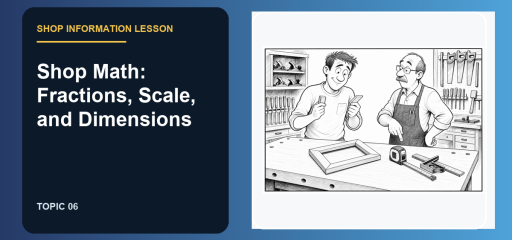
Numbers on a drawing do not answer the question by themselves. A dimension is useful only when you know what it measures and what unit it uses. Keeping that connection prevents a surprising number of errors.
Good shop judgment has a sequence: notice the condition, decide what the work requires, then act. Here, that means you should keep the unit, feature, and comparison together through the calculation.
What does shop math mean?
Shop math uses ordinary arithmetic to make a physical decision. You may read a fractional mark, compare a dimension with a tolerance, use scale, or find a simple diameter or area. The key is keeping the unit and the feature attached to every number.
Which clues should you notice first?
Start with the evidence you could point to in a picture. fractional marks, scaled dimensions, or a stated limit for a part gives you a concrete reason to eliminate choices that cannot handle the stated job.
- Working clue: fractional marks, scaled dimensions, or a stated limit for a part
- Best next move: keep the unit, feature, and comparison together through the calculation
- Why it matters: the right setup protects the work, the tool, and the person using it.
How do the close choices differ?
| Tool or idea | What it does |
|---|---|
| Scale | relates a drawing size to an actual size |
| Tolerance | states the acceptable variation around a required size |
Think in outcomes rather than appearances. The relevant question is whether the job needs what Scale does or what Tolerance does.
Put the clue into a shop decision
Imagine that a question or illustration gives you fractional marks, scaled dimensions, or a stated limit for a part. Before you look for a familiar name, say what the work actually needs: keep the unit, feature, and comparison together through the calculation. Then test each choice against the physical result. A choice that cannot produce the needed result is out, even if it belongs to the same general family. This is also where the difference between Scale and Tolerance becomes useful. One clear reason is enough to reject a close distractor.
Watch the skill in context
Shop Math Basics by Salty Antlers is a useful visual companion to this lesson. Use this as a short observation exercise: identify the material, the action, and the control before you move on.
Use this four-step routine
- Write the unit beside the number.
- Identify the actual feature.
- Reduce or compare only after the units match.
- Check whether the result meets the stated limit.
Try the decision, then check your reasoning
- You see fractional marks, scaled dimensions, or a stated limit for a part. What detail should lead your decision? The condition that changes the tool choice or safe setup is the first clue.
- What is the best response when the task calls for fractional marks, scaled dimensions, or a stated limit for a part? Keep the unit, feature, and comparison together through the calculation.
- How is Scale different from Tolerance? Scale relates a drawing size to an actual size; Tolerance states the acceptable variation around a required size.
- What should you do if the tool, setup, or workpiece does not match the job? Pause and correct the mismatch before applying more force.
Keep building your shop vocabulary
Use the ASVAB topic archive to move through the lessons in a practical order. Build speed only after you can explain the choice. Clear reasoning is what makes recognition reliable under time pressure.
Related lessons:

Related to This Article
More math articles
- How to Create a GED Math Study Plan?
- The Best Grade 7 ELA Practice Tests for Nevada Students
- When do the ACT Scores Come out?
- Top Calculators for the TASC 2026: Quick Review
- Geometry Puzzle – Challenge 59
- End of Reconstruction: Sharecropping, Courts and 1877
- The Role of Math in Game Design
- Praxis Core Math FREE Sample Practice Questions
- Competitive Wage: Market Supply, Demand and One Firm’s Hiring
- Reading political maps





















What people say about "Shop Math: Fractions, Scale, and Dimensions"?
No one replied yet.