Material Properties: Hardness, Toughness, and More
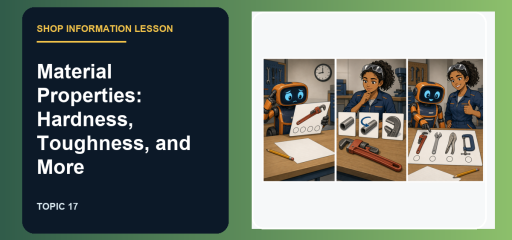
Property questions can sound abstract until you connect each word to a physical result. Ask what the material is being asked to do: resist a scratch, bend into a new shape, survive a blow, or stretch into wire.
Small differences decide this kind of question. Once you spot resistance to scratching, impact, bending, stretching, or heat, you can stop treating every nearby tool as an equally good option.
What does material properties mean?
Material properties describe how a material responds to force, heat, and wear. Hardness resists indentation, toughness resists breaking under impact, ductility allows drawing into wire, and malleability allows shaping under compression without immediate fracture. These terms describe different behaviors, so the action in the question matters more than which word sounds strongest.
Which clues should you notice first?
Do not rush past the physical clue. Resistance to scratching, impact, bending, stretching, or heat narrows the answer because it limits what a correct tool or setup can reasonably do.
- Working clue: resistance to scratching, impact, bending, stretching, or heat
- Best next move: match the stated behavior to the material property being described
- Why it matters: the right setup protects the work, the tool, and the person using it.
How do the close choices differ?
| Tool or idea | What it does |
|---|---|
| Hardness | resists localized indentation or scratching |
| Toughness | resists breaking under impact or stress |
These two ideas are worth keeping separate. Once you can say why Hardness differs from Toughness, a picture-based question becomes a function question.
Put the clue into a shop decision
Imagine that a question or illustration gives you resistance to scratching, impact, bending, stretching, or heat. Before you look for a familiar name, say what the work actually needs: match the stated behavior to the material property being described. Then test each choice against the physical result. A choice that cannot produce the needed result is out, even if it belongs to the same general family. This is also where the difference between Hardness and Toughness becomes useful. One clear reason is enough to reject a close distractor.
Watch the skill in context
Material Properties 101 by Real Engineering is a useful visual companion to this lesson. Pay attention to the feature nearest the workpiece. It usually gives better evidence than the handle, color, or brand.
Use this four-step routine
- Read the action word.
- Picture the physical test.
- Name the property that explains the result.
- Do not substitute a similar-sounding property.
Try the decision, then check your reasoning
- You see resistance to scratching, impact, bending, stretching, or heat. What detail should lead your decision? The condition that changes the tool choice or safe setup is the first clue.
- What is the best response when the task calls for resistance to scratching, impact, bending, stretching, or heat? Match the stated behavior to the material property being described.
- How is Hardness different from Toughness? Hardness resists localized indentation or scratching; Toughness resists breaking under impact or stress.
- What should you do if the tool, setup, or workpiece does not match the job? Pause and correct the mismatch before applying more force.
Keep building your shop vocabulary
Use the ASVAB topic archive to move through the lessons in a practical order. When you miss a question, record the evidence you overlooked, not just the correct name. That is the detail that will transfer to the next unfamiliar picture.
Related lessons:

Related to This Article
More math articles
- Algebra Puzzle – Challenge 40
- Is the PERT Test Hard?
- SAT Math FREE Sample Practice Questions
- How to Study for a Math Test in 7 Easy Steps
- Registered voters
- The European Theater and Allied Grand Strategy
- ISEE Middle-Level Math Worksheets: FREE & Printable
- Free Grade 6 English Worksheets for Delaware Students
- Sequence Calculator (Arithmetic & Geometric — nth Term & Sum)
- Top 10 5th Grade STAAR Math Practice Questions






















What people say about "Material Properties: Hardness and Toughness"?
No one replied yet.