The Immune and Lymphatic Systems
Students often see the immune and lymphatic systems as a cluster of new terms. A steadier route is to connect Innate defense with Adaptive defense, then place B cell and T cell into the same working picture.
Definition: The lymphatic system returns excess tissue fluid to the bloodstream, transports absorbed fats, and provides sites where immune cells monitor lymph. The immune system uses barriers, rapid nonspecific defenses, and targeted adaptive responses to recognize and control pathogens while remembering some previous exposures.
What do you need to know about the immune and lymphatic systems?
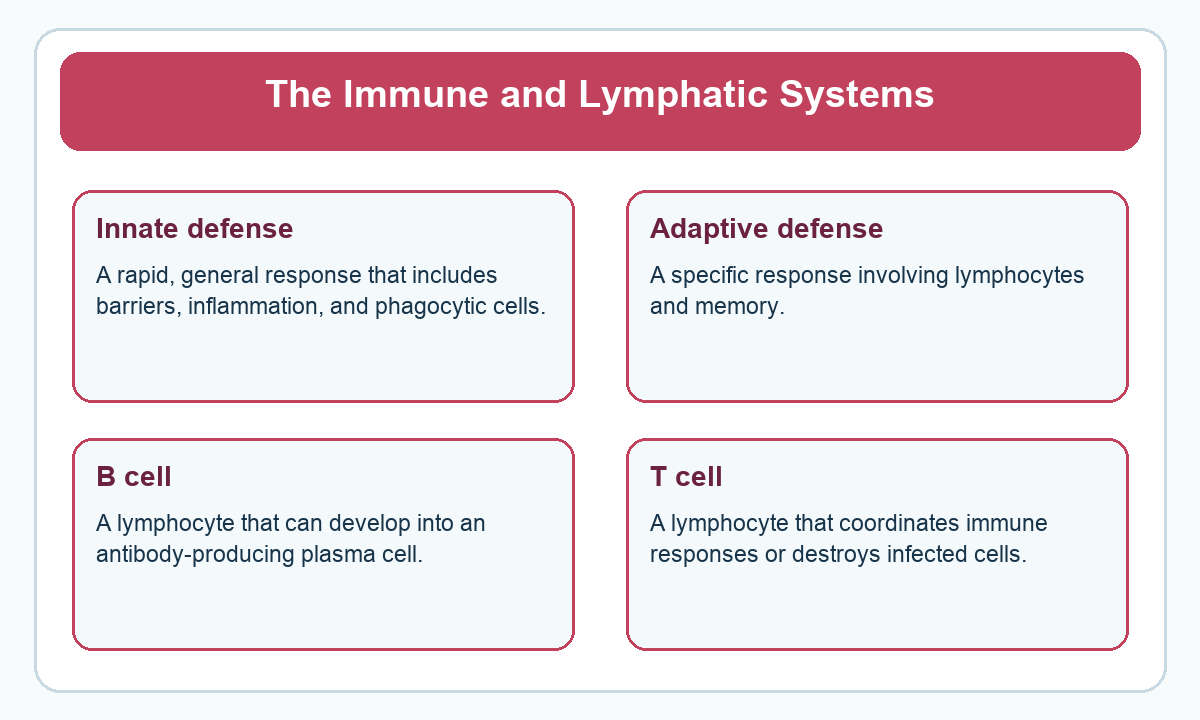
Use the visual as a recall tool: read the Innate defense box, cover it, and explain it from memory. Repeat that move for Adaptive defense, B cell, and T cell; then explain how the four ideas connect.
What should you remember about the immune and lymphatic systems?
| Idea | What it means |
|---|---|
| Innate defense | A rapid, general response that includes barriers, inflammation, and phagocytic cells. |
| Adaptive defense | A specific response involving lymphocytes and memory. |
| B cell | A lymphocyte that can develop into an antibody-producing plasma cell. |
| T cell | A lymphocyte that coordinates immune responses or destroys infected cells. |
How can each anchor help you answer a question?
Innate defense as a question clue
A rapid, general response that includes barriers, inflammation, and phagocytic cells. A useful contrast is adaptive defense: a specific response involving lymphocytes and memory.
Adaptive defense as a question clue
A specific response involving lymphocytes and memory. A useful contrast is b cell: a lymphocyte that can develop into an antibody-producing plasma cell.
B cell as a question clue
A lymphocyte that can develop into an antibody-producing plasma cell. A useful contrast is t cell: a lymphocyte that coordinates immune responses or destroys infected cells.
T cell as a question clue
A lymphocyte that coordinates immune responses or destroys infected cells. A useful contrast is innate defense: a rapid, general response that includes barriers, inflammation, and phagocytic cells.
What else helps this topic make sense?
Inflammation is an organized innate response, not a synonym for infection. Damaged or infected tissue releases signals that increase local blood flow and vessel permeability and recruit immune cells. Redness, warmth, swelling, and discomfort can result. The response helps contain damage and begin repair, but excessive or misdirected inflammation can harm healthy tissue. Adaptive immunity adds specificity and memory after the early response is underway.
How does this idea work in a real question?
A vaccine exposes the immune system to a safe form or component of an antigen. Adaptive cells respond and form memory cells. Later exposure can trigger a faster, stronger response before the pathogen causes severe disease.
For this example, first identify which of the four anchors is changing or acting. Follow its effect through the situation and name the result before comparing choices. This keeps your reasoning tied to evidence rather than to a familiar-looking term.
What is a reliable way to reason through it?
- Decide whether the question is mainly about Innate defense, Adaptive defense, B cell, or T cell.
- Restate the job of the named idea before reading the answer choices.
- Use the Innate defense, T cell map above to trace direction, cause, evidence, or outcome in the order supplied.
- Test the remaining choice against this specific warning: Antibiotics act against susceptible bacteria, not viruses. Viral infections depend on host cells, so an antibacterial drug does not automatically treat them.
What mistake should you watch for?
Antibiotics act against susceptible bacteria, not viruses. Viral infections depend on host cells, so an antibacterial drug does not automatically treat them.
If two choices survive, ask which one preserves the stated relationship between Innate defense and Adaptive defense. Then check it against B cell or T cell if either appears in the prompt.
Watch a short lesson
The lymphatic-system-and-prevention video connects fluid return, lymph structures, and immune protection. Pause the lesson when a diagram or process appears and connect it with the four anchors in this page’s visual.
Can you check your understanding?
Try these six checks from memory. Open an answer only after you have said or written your own response.
-
In your own words, what is the central idea in this lesson?
Check the answer
The lymphatic system returns excess tissue fluid to the bloodstream, transports absorbed fats, and provides sites where immune cells monitor lymph. The immune system uses barriers, rapid nonspecific defenses, and targeted adaptive responses to recognize and control pathogens while remembering some previous exposures.
-
What should you remember about innate defense?
Check the answer
A rapid, general response that includes barriers, inflammation, and phagocytic cells.
-
What should you remember about adaptive defense?
Check the answer
A specific response involving lymphocytes and memory.
-
What should you remember about b cell?
Check the answer
A lymphocyte that can develop into an antibody-producing plasma cell.
-
What should you remember about t cell?
Check the answer
A lymphocyte that coordinates immune responses or destroys infected cells.
-
What final check is most useful for a question about the immune and lymphatic systems?
Check the answer
Compare the choice with the relationship among Innate defense, Adaptive defense, B cell, and T cell. Then apply this warning: Antibiotics act against susceptible bacteria, not viruses. Viral infections depend on host cells, so an antibacterial drug does not automatically treat them.
Where does this fit in your science review?
The ATI TEAS Science Study Hub places this lesson inside the larger anatomy and physiology review. Continue with these connected lessons:
Recommended ATI TEAS resources

Related to This Article
More math articles
- Standard Deviation Calculator (Free)
- Top 10 Math Books for Grade 6 Students: Inspiring Masterminds
- Patient-Care Equipment Basics
- Fourteenth Amendment
- The Best Grade 5 ELA Practice Tests for South Carolina Students
- 10 Most Common 3rd Grade PARCC Math Questions
- The Best Grade 6 ELA Practice Tests for Connecticut Students
- 5th Grade PSSA Math Worksheets: FREE & Printable
- CLEP U.S. History I 051: Marshall Court and Judicial Review
- Visualizing the Magic: How to Multiply Fractions Using Models

















What people say about "ATI TEAS 7: The Immune & Lymphatic Systems"?
No one replied yet.