The Digestive System
Students often see the digestive system as a cluster of new terms. A steadier route is to connect Stomach with Small intestine, then place Large intestine and Accessory organs into the same working picture.
Definition: The digestive system breaks food into absorbable units, moves those units into blood or lymph, and eliminates material that was not absorbed. Mechanical digestion physically reduces food size, while chemical digestion uses enzymes and other secretions. Most nutrient absorption occurs in the small intestine.
What do you need to know about the digestive system?
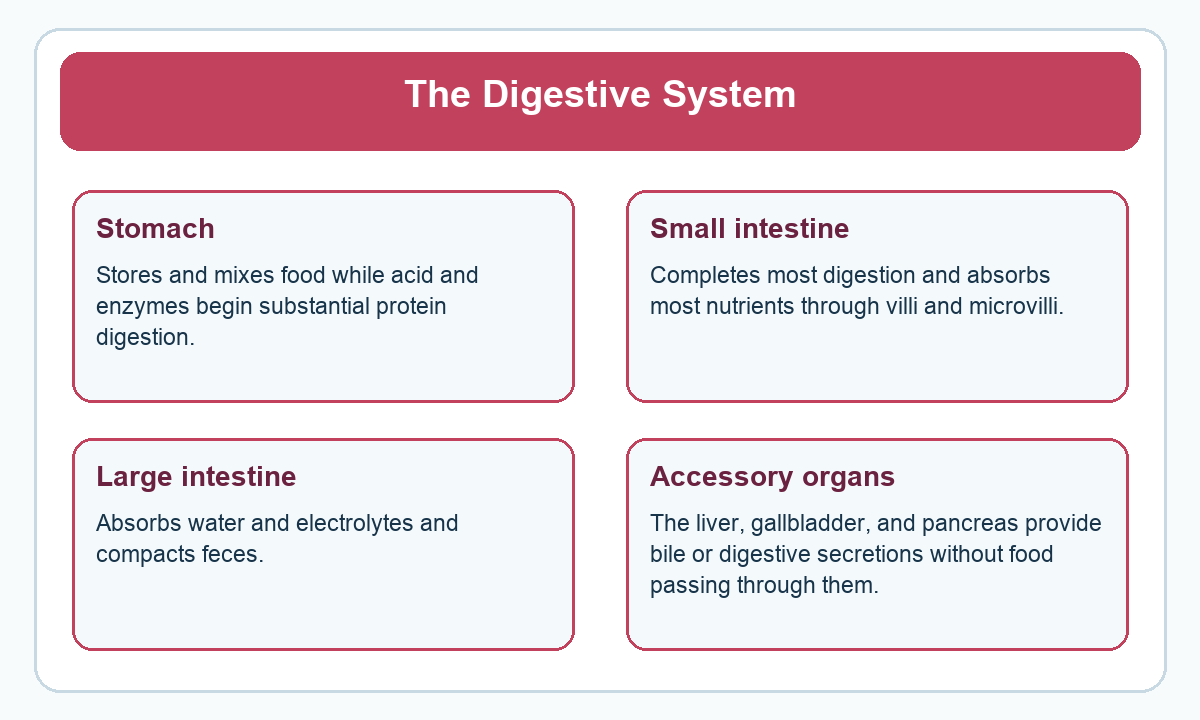
Use the visual as a recall tool: read the Stomach box, cover it, and explain it from memory. Repeat that move for Small intestine, Large intestine, and Accessory organs; then explain how the four ideas connect.
What should you remember about the digestive system?
| Idea | What it means |
|---|---|
| Stomach | Stores and mixes food while acid and enzymes begin substantial protein digestion. |
| Small intestine | Completes most digestion and absorbs most nutrients through villi and microvilli. |
| Large intestine | Absorbs water and electrolytes and compacts feces. |
| Accessory organs | The liver, gallbladder, and pancreas provide bile or digestive secretions without food passing through them. |
How can each anchor help you answer a question?
Stomach as a question clue
Stores and mixes food while acid and enzymes begin substantial protein digestion. A useful contrast is small intestine: completes most digestion and absorbs most nutrients through villi and microvilli.
Small intestine as a question clue
Completes most digestion and absorbs most nutrients through villi and microvilli. A useful contrast is large intestine: absorbs water and electrolytes and compacts feces.
Large intestine as a question clue
Absorbs water and electrolytes and compacts feces. A useful contrast is accessory organs: the liver, gallbladder, and pancreas provide bile or digestive secretions without food passing through them.
Accessory organs as a question clue
The liver, gallbladder, and pancreas provide bile or digestive secretions without food passing through them. A useful contrast is stomach: stores and mixes food while acid and enzymes begin substantial protein digestion.
What else helps this topic make sense?
Absorption is selective and uses different routes. Many sugars and amino acids enter intestinal capillaries and travel first toward the liver. Most dietary fats are packaged into particles that enter lymphatic vessels in the villi before reaching the bloodstream. The liver then processes, stores, or redistributes many absorbed substances. This route explains why digestion is not finished when food is broken apart; useful molecules still have to cross the intestinal lining and enter transport systems.
How does this idea work in a real question?
Fat entering the small intestine is emulsified by bile, which separates large fat droplets into smaller ones. Pancreatic enzymes then have more surface to work on, and the products are absorbed through the intestinal lining.
For this example, first identify which of the four anchors is changing or acting. Follow its effect through the situation and name the result before comparing choices. This keeps your reasoning tied to evidence rather than to a familiar-looking term.
What is a reliable way to reason through it?
- Decide whether the question is mainly about Stomach, Small intestine, Large intestine, or Accessory organs.
- Restate the job of the named idea before reading the answer choices.
- Use the Stomach, Accessory organs map above to trace direction, cause, evidence, or outcome in the order supplied.
- Test the remaining choice against this specific warning: Bile is not an enzyme. It helps physical dispersion of fat, while lipase performs chemical digestion of fat molecules.
What mistake should you watch for?
Bile is not an enzyme. It helps physical dispersion of fat, while lipase performs chemical digestion of fat molecules.
If two choices survive, ask which one preserves the stated relationship between Stomach and Small intestine. Then check it against Large intestine or Accessory organs if either appears in the prompt.
Watch a short lesson
The digestive-organs-and-absorption video traces the tract and highlights where breakdown and absorption occur. Pause the lesson when a diagram or process appears and connect it with the four anchors in this page’s visual.
Can you check your understanding?
Try these six checks from memory. Open an answer only after you have said or written your own response.
-
In your own words, what is the central idea in this lesson?
Check the answer
The digestive system breaks food into absorbable units, moves those units into blood or lymph, and eliminates material that was not absorbed. Mechanical digestion physically reduces food size, while chemical digestion uses enzymes and other secretions. Most nutrient absorption occurs in the small intestine.
-
What should you remember about stomach?
Check the answer
Stores and mixes food while acid and enzymes begin substantial protein digestion.
-
What should you remember about small intestine?
Check the answer
Completes most digestion and absorbs most nutrients through villi and microvilli.
-
What should you remember about large intestine?
Check the answer
Absorbs water and electrolytes and compacts feces.
-
What should you remember about accessory organs?
Check the answer
The liver, gallbladder, and pancreas provide bile or digestive secretions without food passing through them.
-
What final check is most useful for a question about the digestive system?
Check the answer
Compare the choice with the relationship among Stomach, Small intestine, Large intestine, and Accessory organs. Then apply this warning: Bile is not an enzyme. It helps physical dispersion of fat, while lipase performs chemical digestion of fat molecules.
Where does this fit in your science review?
The ATI TEAS Science Study Hub places this lesson inside the larger anatomy and physiology review. Continue with these connected lessons:
- The Respiratory System
- The Urinary System
- The Cardiovascular System
- The Immune and Lymphatic Systems
Recommended ATI TEAS resources

Related to This Article
More math articles
- What Socialization Is and Is Not
- How to Multiply and Divide Fractions? (+FREE Worksheet!)
- Top 10 8th Grade Common Core Math Practice Questions
- SHSAT Math Practice Test Questions
- Top 10 Tips to Create a PERT Math Study Plan
- Read axes before curves
- The Best Algebra 1 Book for Tennessee Students
- Why do I Struggle with Math so much?
- Predict before reading A-E
- Molecular Shape and Polarity: Why Bond Dipoles May Cancel






What people say about "ATI TEAS 7: The Digestive System"?
No one replied yet.