Equivalent Ratios Calculator (Ratio Table + Simplify)
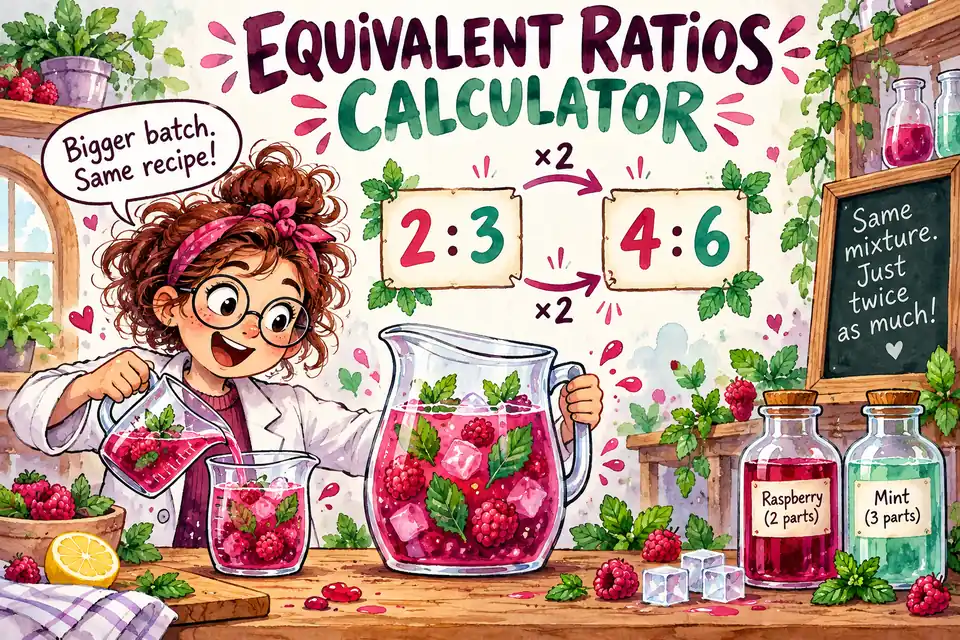
Equivalent ratios are ratios that name the same relationship, and you make them by multiplying or dividing every term by the same nonzero number: 3 : 4, 6 : 8 and 18 : 24 are all equivalent. This equivalent ratios calculator simplifies any ratio with GCF steps, builds a ratio table of the first 10 equivalent ratios, solves for a missing value, and checks whether two ratios are equivalent. It also accepts three-term ratios, decimals and fractions.
How to use the Equivalent Ratios Calculator
- Pick a mode: Simplify + ratio table, Find missing value, or Are they equivalent?
- Type a ratio with colons, such as 18:24 or 12:18:30. You can also type 8 to 12, 1.5:2.5 or 1/2:3/4.
- For a missing value, fill in three boxes of a : b = c : d and type x in the box you want to find.
- Press Calculate, Solve or Check (or the Enter key) to see the answer and every step.
- Try the practice questions below the calculator.
How to simplify a ratio using the GCF
A ratio is in simplest form when its terms have no common factor other than 1. To get there, find the greatest common factor (GCF) of all the terms and divide every term by it.
Worked example 1: simplify 42 : 56.
- List the factors. Factors of 42: 1, 2, 3, 6, 7, 14, 21, 42. Factors of 56: 1, 2, 4, 7, 8, 14, 28, 56.
- The greatest factor in both lists is 14, so the GCF is 14.
- Divide both terms by 14: 42 ÷ 14 = 3 and 56 ÷ 14 = 4.
- Answer: 42 : 56 = 3 : 4.
A three-term ratio works the same way. For 24 : 36 : 60, the GCF of all three numbers is 12, so divide each term by 12 to get 2 : 3 : 5.
If a ratio has decimals, multiply every term by 10, 100 or 1,000 first to make whole numbers. For 1.2 : 1.8, multiply by 10 to get 12 : 18, then divide by the GCF, 6, to get 2 : 3. If a ratio has fractions, multiply every term by the least common denominator: 1/2 : 3/4 times 4 gives 2 : 3. The GCF and LCM calculator can help with larger numbers.
Quick reference for simplifying ratios:
| Ratio | First step | GCF | Simplest form |
|---|---|---|---|
| 8 : 12 | none | 4 | 2 : 3 |
| 15 : 25 | none | 5 | 3 : 5 |
| 42 : 56 | none | 14 | 3 : 4 |
| 24 : 36 : 60 | none | 12 | 2 : 3 : 5 |
| 1.2 : 1.8 | × 10 → 12 : 18 | 6 | 2 : 3 |
| 1/2 : 3/4 | × 4 → 2 : 3 | 1 | 2 : 3 |
Ratio tables, missing values and equivalence
A ratio table lists equivalent ratios in rows or columns. Each new entry multiplies every term by the same number, so going down a column you add the simplest-form term each time.
Worked example 2: a lemonade recipe uses 4 scoops of mix for every 6 cups of water. How many scoops go with 15 cups of water?
- Simplify first: the GCF of 4 and 6 is 2, so 4 : 6 = 2 : 3.
- Build the table from 2 : 3: 2 : 3, 4 : 6, 6 : 9, 8 : 12, 10 : 15. The row with 15 cups has 10 scoops.
- The same answer by cross-multiplication: write 4 : 6 = x : 15 as 4/6 = x/15. Cross products are equal, so 6 × x = 4 × 15 = 60.
- Divide both sides by 6: x = 60 ÷ 6 = 10 scoops.
- Check: 4 × 15 = 60 and 6 × 10 = 60. The cross products match.
Cross-multiplication is the faster route when the numbers do not land on a neat row of the table, and it still works when the answer is a fraction. For 3 : 7 = x : 10, 7x = 30, so x = 30/7, about 4.29.
To test whether two ratios are equivalent, simplify both and compare, or, for two-term ratios, compare cross products.
- 9 : 12 and 15 : 20: 9 × 20 = 180 and 12 × 15 = 180. The products match, and both simplify to 3 : 4, so they are equivalent.
- 6 : 8 and 9 : 15: 6 × 15 = 90 but 8 × 9 = 72. The products differ (6 : 8 is 3 : 4, while 9 : 15 is 3 : 5), so they are not equivalent.
Common mistakes
- Adding instead of multiplying. Adding 2 to each term of 2 : 3 gives 4 : 5, which is not equivalent. Equivalent ratios come only from multiplying or dividing every term by the same number.
- Stopping too early. Dividing 18 : 24 by 2 gives 9 : 12, which is still not in simplest form. Use the greatest common factor, 6, to reach 3 : 4 in one step, or keep dividing until no common factor is left.
- Changing only one term. Whatever you do to one term, you must do to every term.
- Switching the order. 2 : 3 and 3 : 2 are different ratios. If the question asks for boys to girls, the boys come first.
- Using the GCF of only two terms in a three-term ratio. For 12 : 18 : 20, the GCF of 12 and 18 is 6, but 6 does not divide 20. The GCF of all three is 2, so the answer is 6 : 9 : 10.
When equivalent ratios are taught
Ratios begin in grade 6 in the Common Core standards. Students learn the concept of a ratio (6.RP.A.1) and make tables of equivalent ratios, find missing values in those tables, and use them to compare ratios (6.RP.A.3a). In grade 7, testing for equivalent ratios in a table is one way students decide whether two quantities are in a proportional relationship (7.RP.A.2a). Simplifying ratios also uses the same skill as simplifying fractions, so the simplify fractions calculator is a good companion. When you are ready to set up and solve full word problems, continue with these proportion practice problems.
Check your answer
After simplifying, multiply your answer by the GCF. You should get the original ratio back: 3 : 4 × 14 = 42 : 56. After finding a missing value, multiply the cross products. If they are equal, the two ratios are equivalent and your value is right.
Equivalent ratios practice quiz: 10 questions
Test yourself with 10 multiple-choice questions. Choose an answer and press Submit to see if you are right and why. Your score appears at the end.
The GCF of 18 and 24 is 6: 18 ÷ 6 = 3 and 24 ÷ 6 = 4, so 3:4. 9:12 and 6:8 are equivalent but not simplest.
Multiply both terms by 3: 12:21. Adding 4 to both terms (8:11) does not keep the ratio the same.
5 × 8 = 40, so multiply 3 by 8 as well: x = 24. Check: 3 × 40 = 120 = 5 × 24.
6:9 ÷ 3 = 2:3 and 10:15 ÷ 5 = 2:3. Same simplest form means the ratios are equivalent.
10:16, 25:40 and 2.5:4 all multiply both terms of 5:8 by the same number (2, 5, 0.5). 15:32 multiplies 5 by 3 but 8 by 4.
Quiz complete
Frequently asked questions
How do you find equivalent ratios?
Multiply or divide every term of the ratio by the same nonzero number. Starting from 2 : 5, multiplying by 2, 3 and 4 gives 4 : 10, 6 : 15 and 8 : 20, which are all equivalent to 2 : 5.
How do you simplify a ratio?
Find the greatest common factor of the terms and divide each term by it. For 18 : 24, the GCF is 6, so 18 : 24 simplifies to 3 : 4.
How do you know if two ratios are equivalent?
Simplify both ratios and see whether they match, or cross-multiply. For 6 : 9 and 8 : 12, the cross products are 6 × 12 = 72 and 9 × 8 = 72. They are equal, so the ratios are equivalent.
How do you simplify a ratio with three numbers?
Find the GCF of all three numbers and divide each one by it. For 12 : 18 : 30, the GCF is 6, so the simplest form is 2 : 3 : 5.
How do you find a missing value in a ratio table?
Find the number that multiplies one known term to get the term in the same row as the blank, then multiply the other term by the same number. You can also cross-multiply: for 3 : 5 = 12 : x, 3x = 60, so x = 20.
How do you simplify a ratio with decimals or fractions?
Turn the terms into whole numbers first. Multiply decimals by a power of 10, such as 1.5 : 2.5 times 10 to get 15 : 25, or multiply fractions by their least common denominator. Then divide by the GCF; 15 : 25 becomes 3 : 5.

Related to This Article
More math articles
- Verb Tenses, Forms, and Voice
- How to Unravel One-to-One Functions
- Short Run vs. Long Run: Shutdown, Exit and Fixed Costs
- Prime Factorization Calculator (Factor Tree, Free)
- Praxis Math Formulas
- 1994 Realignment: Polarization and Clinton Impeachment
- FREE CLEP College Math Practice Test
- Presidential relations with Congress
- How to Find Discount, Tax, and Tip? (+FREE Worksheet!)
- The Roots of Expansionism and the Annexation of Hawaii















What people say about "Equivalent Ratios Calculator: Ratio Table + Simplify"?
No one replied yet.