The Respiratory System
Students often see the respiratory system as a cluster of new terms. A steadier route is to connect Trachea with Bronchi and bronchioles, then place Alveoli and Diaphragm into the same working picture.
Definition: The respiratory system moves air to the lungs and exchanges oxygen and carbon dioxide between alveoli and capillaries. Ventilation is the movement of air; gas exchange is diffusion across thin moist surfaces. The diaphragm changes chest volume and pressure to drive inhalation and exhalation.
What do you need to know about the respiratory system?
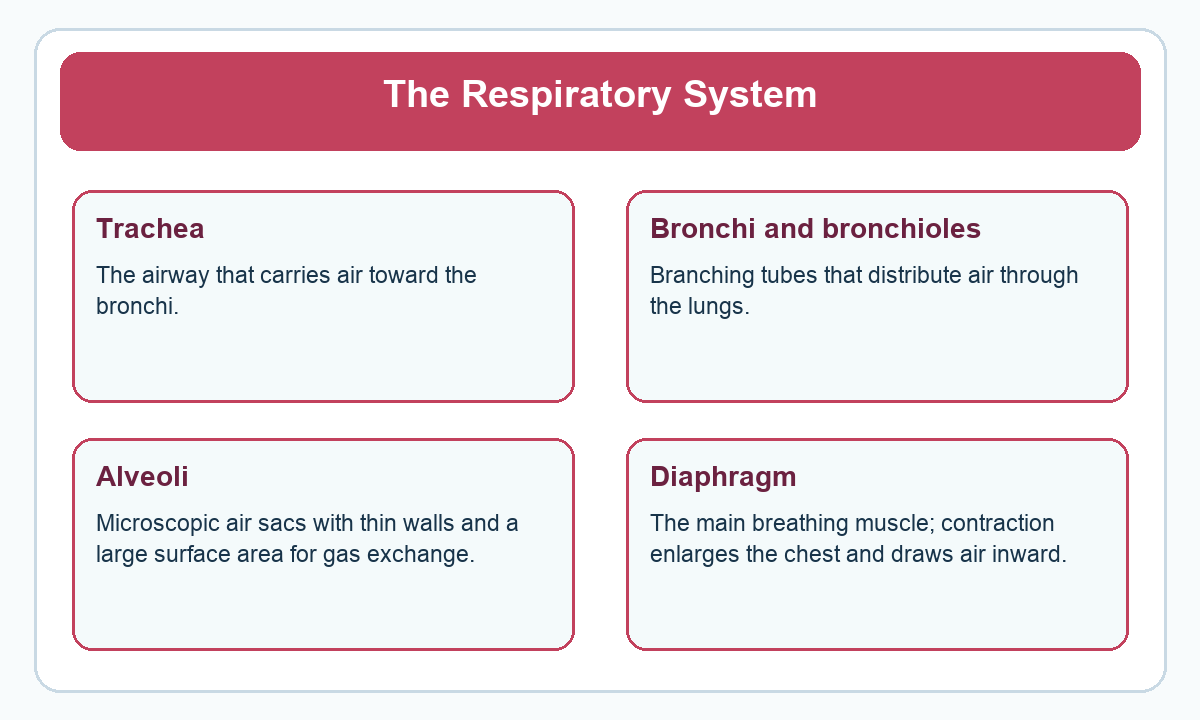
Use the visual as a recall tool: read the Trachea box, cover it, and explain it from memory. Repeat that move for Bronchi and bronchioles, Alveoli, and Diaphragm; then explain how the four ideas connect.
What should you remember about the respiratory system?
| Idea | What it means |
|---|---|
| Trachea | The airway that carries air toward the bronchi. |
| Bronchi and bronchioles | Branching tubes that distribute air through the lungs. |
| Alveoli | Microscopic air sacs with thin walls and a large surface area for gas exchange. |
| Diaphragm | The main breathing muscle; contraction enlarges the chest and draws air inward. |
How can each anchor help you answer a question?
Trachea as a question clue
The airway that carries air toward the bronchi. A useful contrast is bronchi and bronchioles: branching tubes that distribute air through the lungs.
Bronchi and bronchioles as a question clue
Branching tubes that distribute air through the lungs. A useful contrast is alveoli: microscopic air sacs with thin walls and a large surface area for gas exchange.
Alveoli as a question clue
Microscopic air sacs with thin walls and a large surface area for gas exchange. A useful contrast is diaphragm: the main breathing muscle; contraction enlarges the chest and draws air inward.
Diaphragm as a question clue
The main breathing muscle; contraction enlarges the chest and draws air inward. A useful contrast is trachea: the airway that carries air toward the bronchi.
What else helps this topic make sense?
Gas movement follows partial-pressure gradients. Fresh air in the alveoli maintains more oxygen than arrives in oxygen-poor pulmonary blood, so oxygen diffuses into the blood. Carbon dioxide is higher in that blood than in alveolar air, so it diffuses toward the alveoli for exhalation. Ventilation renews those gradients. If airflow or blood flow is severely reduced, an intact alveolar wall alone cannot maintain normal exchange.
How does this idea work in a real question?
During inhalation, the diaphragm contracts and moves downward. Chest volume increases, pressure inside the lungs falls below outside pressure, and air moves inward. Oxygen then diffuses from alveoli into nearby blood.
For this example, first identify which of the four anchors is changing or acting. Follow its effect through the situation and name the result before comparing choices. This keeps your reasoning tied to evidence rather than to a familiar-looking term.
What is a reliable way to reason through it?
- Decide whether the question is mainly about Trachea, Bronchi and bronchioles, Alveoli, or Diaphragm.
- Restate the job of the named idea before reading the answer choices.
- Use the Trachea, Diaphragm map above to trace direction, cause, evidence, or outcome in the order supplied.
- Test the remaining choice against this specific warning: Breathing and cellular respiration are related but different. Breathing moves air; cellular respiration is a chemical process in cells that releases usable energy from nutrients.
What mistake should you watch for?
Breathing and cellular respiration are related but different. Breathing moves air; cellular respiration is a chemical process in cells that releases usable energy from nutrients.
If two choices survive, ask which one preserves the stated relationship between Trachea and Bronchi and bronchioles. Then check it against Alveoli or Diaphragm if either appears in the prompt.
Watch a short lesson
The breathing-and-gas-exchange video follows airflow, pressure changes, and diffusion at the alveoli. Pause the lesson when a diagram or process appears and connect it with the four anchors in this page’s visual.
Can you check your understanding?
Try these six checks from memory. Open an answer only after you have said or written your own response.
-
In your own words, what is the central idea in this lesson?
Check the answer
The respiratory system moves air to the lungs and exchanges oxygen and carbon dioxide between alveoli and capillaries. Ventilation is the movement of air; gas exchange is diffusion across thin moist surfaces. The diaphragm changes chest volume and pressure to drive inhalation and exhalation.
-
What should you remember about trachea?
Check the answer
The airway that carries air toward the bronchi.
-
What should you remember about bronchi and bronchioles?
Check the answer
Branching tubes that distribute air through the lungs.
-
What should you remember about alveoli?
Check the answer
Microscopic air sacs with thin walls and a large surface area for gas exchange.
-
What should you remember about diaphragm?
Check the answer
The main breathing muscle; contraction enlarges the chest and draws air inward.
-
What final check is most useful for a question about the respiratory system?
Check the answer
Compare the choice with the relationship among Trachea, Bronchi and bronchioles, Alveoli, and Diaphragm. Then apply this warning: Breathing and cellular respiration are related but different. Breathing moves air; cellular respiration is a chemical process in cells that releases usable energy from nutrients.
Where does this fit in your science review?
The ATI TEAS Science Study Hub places this lesson inside the larger anatomy and physiology review. Continue with these connected lessons:
Recommended ATI TEAS resources

Related to This Article
More math articles
- Hypotheses and Judging a Good Experiment
- Algebra Puzzle – Challenge 53
- The Ultimate OAR Math Course (+FREE Worksheets)
- DAT Math Formulas
- 3rd Grade ISASP Math Worksheets: FREE & Printable
- The Ultimate 6th Grade MCAS Math Course (+FREE Worksheets)
- CLEP U.S. History I 099: Soldiers, Civilians, Women, and the Home Fronts
- 10 Most Common 6th Grade MAP Math Questions
- The Role of Math in Game Design
- Washington SBAC Grade 8 Math Free Worksheets: 72 Free Printable Worksheets with Step-by-Step Keys



















What people say about "ATI TEAS 7: The Respiratory System"?
No one replied yet.