The Endocrine System
Students often see the endocrine system as a cluster of new terms. A steadier route is to connect Hormone with Target cell, then place Pituitary gland and Negative feedback into the same working picture.
Definition: The endocrine system uses hormones carried in the blood to coordinate slower, longer-lasting changes in target cells. A hormone affects only cells with a matching receptor. Endocrine control supports growth, metabolism, reproduction, stress responses, water balance, and blood-glucose regulation.
What do you need to know about the endocrine system?
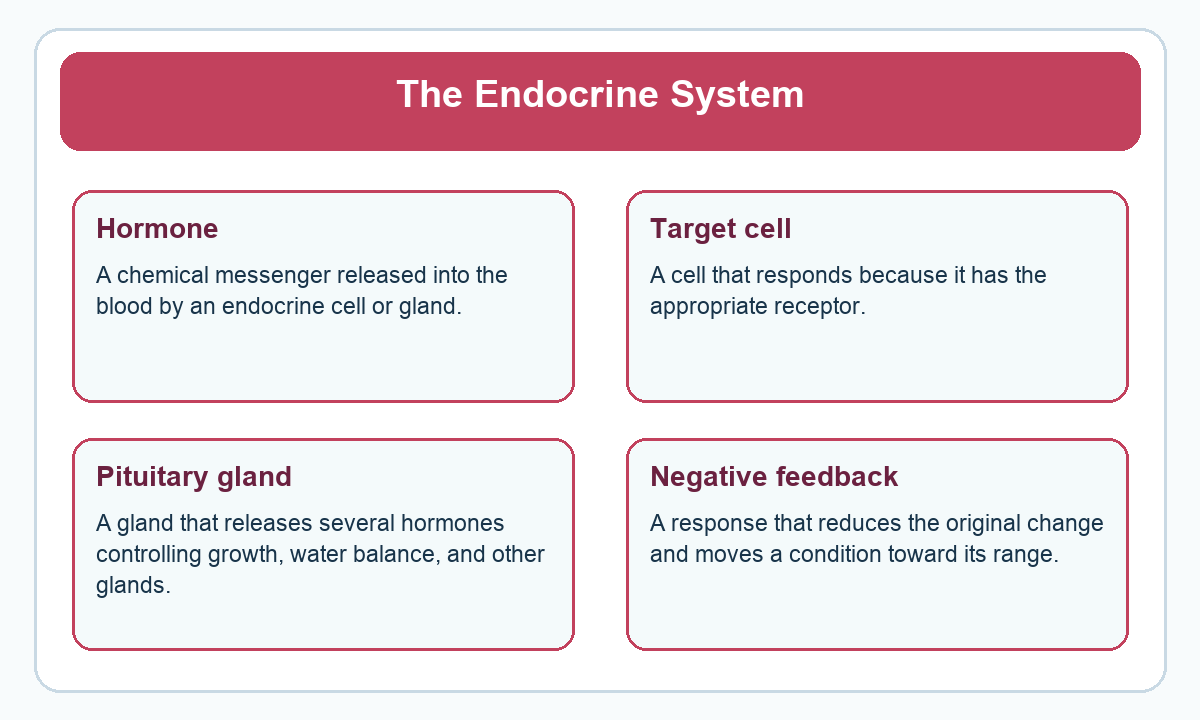
Use the visual as a recall tool: read the Hormone box, cover it, and explain it from memory. Repeat that move for Target cell, Pituitary gland, and Negative feedback; then explain how the four ideas connect.
What should you remember about the endocrine system?
| Idea | What it means |
|---|---|
| Hormone | A chemical messenger released into the blood by an endocrine cell or gland. |
| Target cell | A cell that responds because it has the appropriate receptor. |
| Pituitary gland | A gland that releases several hormones controlling growth, water balance, and other glands. |
| Negative feedback | A response that reduces the original change and moves a condition toward its range. |
How can each anchor help you answer a question?
Hormone as a question clue
A chemical messenger released into the blood by an endocrine cell or gland. A useful contrast is target cell: a cell that responds because it has the appropriate receptor.
Target cell as a question clue
A cell that responds because it has the appropriate receptor. A useful contrast is pituitary gland: a gland that releases several hormones controlling growth, water balance, and other glands.
Pituitary gland as a question clue
A gland that releases several hormones controlling growth, water balance, and other glands. A useful contrast is negative feedback: a response that reduces the original change and moves a condition toward its range.
Negative feedback as a question clue
A response that reduces the original change and moves a condition toward its range. A useful contrast is hormone: a chemical messenger released into the blood by an endocrine cell or gland.
What else helps this topic make sense?
Endocrine and nervous communication differ in delivery and timing. Nerve signals travel along specific cells and usually act quickly at nearby targets. Hormones circulate through blood and may take longer to produce a response, yet their effects can last much longer. The systems frequently cooperate. A stressful event can trigger rapid nervous activity and also stimulate hormone release that changes heart function, fuel availability, and water balance over a longer period.
How does this idea work in a real question?
After a meal, rising blood glucose stimulates insulin release. Insulin helps body cells take in glucose and promotes storage. As blood glucose falls toward its usual range, the signal for insulin release decreases.
For this example, first identify which of the four anchors is changing or acting. Follow its effect through the situation and name the result before comparing choices. This keeps your reasoning tied to evidence rather than to a familiar-looking term.
What is a reliable way to reason through it?
- Decide whether the question is mainly about Hormone, Target cell, Pituitary gland, or Negative feedback.
- Restate the job of the named idea before reading the answer choices.
- Use the Hormone, Negative feedback map above to trace direction, cause, evidence, or outcome in the order supplied.
- Test the remaining choice against this specific warning: A hormone does not affect every cell it reaches. Blood distributes the signal widely, but receptor matching determines which cells respond.
What mistake should you watch for?
A hormone does not affect every cell it reaches. Blood distributes the signal widely, but receptor matching determines which cells respond.
If two choices survive, ask which one preserves the stated relationship between Hormone and Target cell. Then check it against Pituitary gland or Negative feedback if either appears in the prompt.
Watch a short lesson
The endocrine-system video introduces hormones and major glands, reinforcing receptor specificity and feedback control. Pause the lesson when a diagram or process appears and connect it with the four anchors in this page’s visual.
Can you check your understanding?
Try these six checks from memory. Open an answer only after you have said or written your own response.
-
In your own words, what is the central idea in this lesson?
Check the answer
The endocrine system uses hormones carried in the blood to coordinate slower, longer-lasting changes in target cells. A hormone affects only cells with a matching receptor. Endocrine control supports growth, metabolism, reproduction, stress responses, water balance, and blood-glucose regulation.
-
What should you remember about hormone?
Check the answer
A chemical messenger released into the blood by an endocrine cell or gland.
-
What should you remember about target cell?
Check the answer
A cell that responds because it has the appropriate receptor.
-
What should you remember about pituitary gland?
Check the answer
A gland that releases several hormones controlling growth, water balance, and other glands.
-
What should you remember about negative feedback?
Check the answer
A response that reduces the original change and moves a condition toward its range.
-
What final check is most useful for a question about the endocrine system?
Check the answer
Compare the choice with the relationship among Hormone, Target cell, Pituitary gland, and Negative feedback. Then apply this warning: A hormone does not affect every cell it reaches. Blood distributes the signal widely, but receptor matching determines which cells respond.
Where does this fit in your science review?
The ATI TEAS Science Study Hub places this lesson inside the larger anatomy and physiology review. Continue with these connected lessons:
Recommended ATI TEAS resources

Related to This Article
More math articles
- 4th Grade Math: The Complete Parent’s Guide for 2026
- Free Grade 8 English Worksheets for West Virginia Students
- Top 10 ASVAB Math Prep Books (Our 2023 Favorite Picks)
- SSAT Lower Level Math Flashcards (Free Online: Formulas, Terms & Concepts)
- How to Find Inverses of 2×2 Matrices?
- How to Do Division Using Repeated Subtraction
- OAR Math FREE Sample Practice Questions
- How to Analyze and Understand Rational Functions: A Comprehensive Guide
- Energy and Simple Machines
- California CAASPP Grade 7 Math Worksheets: 95 Free Printable PDFs Covering Every Skill















What people say about "ATI TEAS 7: The Endocrine System"?
No one replied yet.