The income effect follows real purchasing power
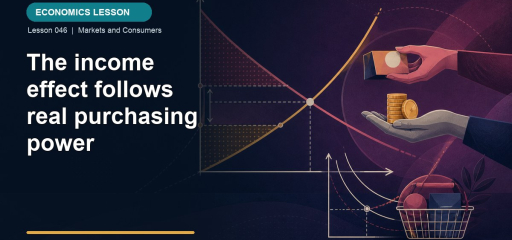
The income effect follows real purchasing power: this Effortless Math guide explains the topic in plain language, shows how it works through solved examples, and gives you free practice to try immediately, so the idea sticks instead of staying abstract.
Its direction depends on whether the good is normal or inferior.
A price decline allows the same money income to purchase more, raising real purchasing power. For a normal good, this income effect raises consumption and reinforces substitution. For an inferior good, higher real purchasing power reduces consumption, so the income effect opposes substitution.
Real income refers to the bundle of goods the consumer can afford, not merely the number printed on a paycheck. When one price falls and nominal income is unchanged, the old bundle costs less, so purchasing power rises. When a price rises, purchasing power falls because the old bundle may no longer be affordable.
For a normal good, consumption moves with real income. A price decrease raises real income and therefore raises consumption through the income effect. For an inferior good, consumption moves oppositely: the same price decrease raises real income but lowers demand through this channel. The substitution effect still increases consumption of the cheaper good.
Most inferior goods still obey the law of demand because the substitution effect is stronger. A Giffen good is a rare, strongly inferior good for which the opposing income effect exceeds substitution, causing quantity demanded to fall when price falls. A Giffen good is not simply any inferior good and is not the same as a prestige good purchased because a high price signals status.
| Price of focal good falls | Substitution effect | Income effect |
|---|---|---|
| Normal good | Raises quantity | Raises quantity. Reinforces |
| Ordinary inferior good | Raises quantity | Lowers quantity. Weaker opposition |
| Giffen good | Raises quantity | Lowers quantity by more. Net quantity falls |
One price decline, two effects
The price of instant noodles falls. Substitution makes noodles cheaper relative to other foods, raising noodle purchases. The price decline also raises real income. If noodles are inferior, that income effect lowers noodle purchases. If substitution is larger, the net quantity still rises.
Reverse the price change to check understanding. If noodle price rises, substitution lowers noodle consumption. Real purchasing power falls. For an inferior good, lower real income increases noodle consumption, so income again opposes substitution. Ordinary inferior demand still falls because substitution dominates.
A Veblen or prestige effect is conceptually different. Some buyers may value a good partly because its high price signals status, meaning a preference determinant changes with perceived price. Giffen behavior arises from a large negative income effect under a tight budget, not from prestige. Answer choices sometimes use the labels interchangeably. Keep the mechanisms separate.
The decomposition explains the law of demand rather than replacing it. For normal goods, both effects support downward-sloping demand. For most inferior goods, substitution remains stronger. Only the demanding Giffen conditions reverse the ordinary result, so do not label any low-quality or inexpensive product Giffen without evidence of a dominant income effect.
When a stem asks only for the substitution effect, ignore the good’s normal or inferior status. When it asks for the income effect, identify both the direction of real purchasing power and the good’s classification. When it asks for the total effect, combine the two and note any ambiguity if their relative sizes are not given.
For an inferior good, a price decrease produces a substitution effect that raises consumption and an income effect that
- reduces consumption
- also raises consumption
- is always zero
- changes only supply
- makes the good normal
reduces consumption For an inferior good, the increase in real purchasing power reduces consumption, so the income effect opposes substitution.
The price of movie tickets falls. The substitution effect alone causes a consumer to
- buy fewer tickets because real income rose
- buy more of every normal good
- buy fewer tickets if movies are inferior
- leave ticket purchases unchanged
- buy more tickets because they are relatively cheaper
buy more tickets because they are relatively cheaper A lower ticket price reduces the relative price of movies, so substitution moves consumption toward tickets regardless of whether they are normal or inferior.
For a normal good, a price decrease creates
- both substitution and income effects that raise consumption
- a substitution effect that lowers consumption and an income effect that raises it
- an income effect only
- effects that always offset exactly
- a substitution effect only
both substitution and income effects that raise consumption For a normal good, the lower relative price and the increase in real purchasing power both raise consumption.
Watch the idea in action
A focused video lesson from Economique.

Reza is an experienced Math instructor and a test-prep expert who has been tutoring students since 2008. He has helped many students raise their standardized test scores--and attend the colleges of their dreams. He works with students individually and in group settings, he tutors both live and online Math courses and the Math portion of standardized tests. He provides an individualized custom learning plan and the personalized attention that makes a difference in how students view math.
Related to This Article
More math articles
- Best Digital Pen Tablet for Online Math Teaching in 2026
- Converting Units of Capacity for 4th Grade
- 7th Grade TCAP Math Worksheets: FREE & Printable
- Chemistry Final Review: Fix Mistakes and Plan Practice
- The Ultimate FTCE General Knowledge Math Course (+FREE Worksheets & Tests)
- Power, Authority, Pluralism, and Elites
- How to Solve Compound Interest Problems?
- CPA ISC Type 1 vs Type 2 Reports: Point in Time or a Period (2027 Prep)
- Distance Measurement for 4th Grade
- 3rd Grade NSCAS Math Worksheets: FREE & Printable



















What people say about "The Income Effect and Purchasing Power"?
No one replied yet.