Order of Operations Calculator (PEMDAS) with Steps
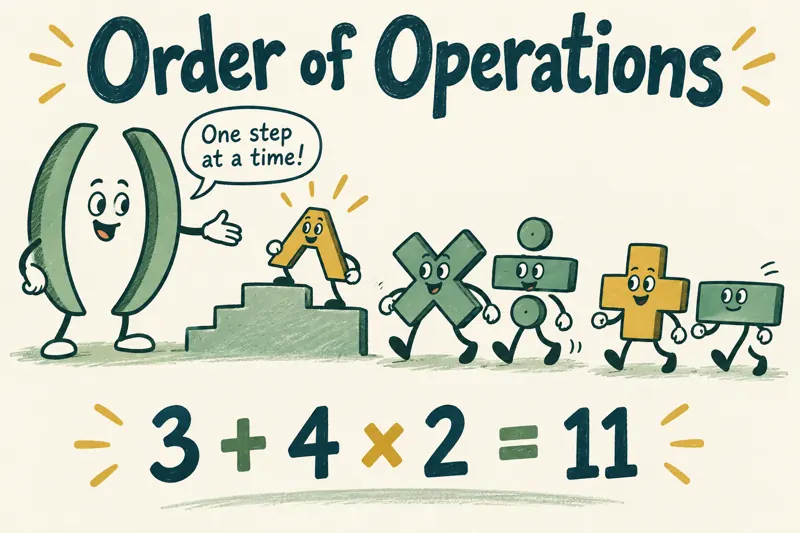
Use this free order of operations (PEMDAS) calculator to check an arithmetic expression and follow its reduction steps. It accepts parentheses, powers, decimals and fractions entered with a division sign. Try the calculation by hand first, then compare the first step where your work differs.
Calculate and compare the steps
Open the calculator in full screen → for more room to review a long expression.
What to type
Use + - * / ^ or + − × ÷, with ordinary parentheses ( ). For example, type 3+4*2^2. The superscript ² also works. Include a multiplication sign: write 2*(3+4), rather than 2(3+4). Letters, roots and equations with an equals sign are outside this tool’s scope.
For fractions: type 1/2. Group a whole numerator or denominator: (2+3)/(7-5) means 5 divided by 2, or 2.5. To add one half and one third, type 1/2+1/3. Results use floating-point arithmetic and decimal approximations; this is not an exact-fraction simplifier.
For negative bases: (-2)^2 is 4, while -2^2 is −4 because the power is evaluated before the leading minus. Type 2^(-3) for a negative exponent. Group chained powers explicitly if you want a particular interpretation: (2^3)^2 is 64, while 2^(3^2) is 512.
Worked examples to check
Multiplication before addition
3 + 4 × 2² = 3 + 4 × 4 = 3 + 16 = 19
Evaluate the exponent first, multiply next, then add. Multiplying 3 + 4 first would change the expression.
Division and multiplication from left to right
18 ÷ 3 × 2 = 6 × 2 = 12
Multiplication does not automatically go before division. The two operations share a priority level.
Parentheses with fractions
(1/2 + 1/3) × 6 = (5/6) × 6 = 5
The fractions are added inside the group before multiplying by 6. The tool displays intermediate decimals, so your handwritten fraction steps may look different.
What PEMDAS means
- Parentheses: simplify inside grouped expressions, starting with the innermost group.
- Exponents: evaluate powers.
- Multiplication and division: work from left to right.
- Addition and subtraction: work from left to right.
The same grouping and priority rules appear in OpenStax’s introduction to the language of algebra.
Does addition come before subtraction?
They have equal priority. For 10 − 4 + 2, subtract first because it is farther left: 6 + 2 = 8.
Why did I get an error?
Check for missing numbers, unmatched parentheses, a missing multiplication sign or division by zero. Very large powers and expressions without a finite real result cannot be evaluated. Make one correction at a time, then calculate again.
Keep practicing without the calculator
Read our order of operations lesson and its existing free worksheet. Work a few problems on paper, then use this calculator to check your results. For related review, the Pre-Algebra Online Center connects number skills with the next algebra topics.

Related to This Article
More math articles
- Why Math is a Difficult Subject?
- Understanding Quadrants
- Pennsylvania PSSA Grade 8 Math Free Worksheets: Free Printable PDF Worksheets for Every Skill
- How to Determine Indeterminate Form and Vague Limits
- Average Rate of Change Calculator (Free, with Graph)
- How to Find Elapsed Time?
- Advanced Vocabulary Words: Impertinence to Keen
- How to Identify Shop Tools From Their Shapes
- How to Use Matrices to Represent Data
- How to Solve Math Word Problems: A Proven 5-Step System








What people say about "Order of Operations Calculator (PEMDAS) with Steps"?
No one replied yet.