Fraction to Decimal to Percent Converter
Fractions & numbersFreeNo sign-up
To change a fraction to a decimal, divide the numerator by the denominator; to get a percent, multiply that decimal by 100. So 3/8 = 3 ÷ 8 = 0.375 = 37.5%, and 5/12 = 0.41666… = 41.(6)%. The fraction to decimal calculator below converts any fraction, mixed number, decimal (repeating ones too) or percent into the other two forms, exactly, with the long division shown.
5/12 = 0.41666… = 41.66666…%.
Show steps
- SimplifyThe greatest common factor of 5 and 12 is 1, so 512 is already in lowest terms.
- Fraction to decimalDivide the numerator by the denominator: 5 ÷ 12 = 0.41(6) repeating. The remainder 8 comes back in the long division, so the digits from there repeat forever: the digit 6 repeats. Write it as 0.41(6) or with a bar over the repeating digit. This happens because the denominator 12 = 2² × 3 has a prime factor other than 2 and 5.
- To percentMultiply by 100 and write the % sign (the decimal point moves two places to the right): 0.41(6) × 100 = 41.(6)%. With a fraction instead: 512 × 100 = 1253 = 41 23, so the exact percent is 41 2/3%.
Long division
Divide 5 by 12. Row 1 gives the whole-number part. In every later row, bring down a 0 (multiply the last remainder by 10) and divide again: each digit goes after the decimal point.
| # | Divide | Digit | Remainder |
|---|---|---|---|
| 1 | 5 ÷ 12 | 0. | 5 |
| 2 | 50 ÷ 12 | 4 | 2 |
| 3 | 20 ÷ 12 | 1 | 8 |
| 4 | 80 ÷ 12 | 6 | 8 |
The highlighted row starts with remainder 8, which appeared before. From that point the same digits repeat forever: 0.41(6).
Next: simplify a fraction · add, subtract, multiply or divide fractions · find a percent of a number

How to use the fraction, decimal and percent converter
- Pick what you start with: Fraction, Decimal or Percent.
- Fraction: type the numerator and denominator. For a mixed number such as 2 3/4, also fill in the whole-number box. Decimal: type it as usual, and mark repeating digits with parentheses, 0.1(6), or by typing them a few times followed by dots, 0.1666… Percent: type the number in front of the % sign, for example 12.5, 33 1/3 or 66.(6).
- Read the three answers at the top: the fraction in lowest terms, the exact decimal (repeating digits get a bar) and the exact percent. Below them are the rounded values, the mixed number and the reason the decimal stops or repeats.
- Open Show steps for the full working and Long division for the digit-by-digit division table.
How the conversions work
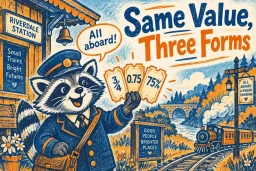
A fraction, a decimal and a percent are three ways of writing the same number. The fraction 1/2, the decimal 0.5 and the percent 50% all mean “half”. Converting only changes the form, never the value.
| From | To | Rule | Example |
|---|---|---|---|
| Fraction | Decimal | Divide the numerator by the denominator | 3/8 = 3 ÷ 8 = 0.375 |
| Decimal | Percent | Multiply by 100 (move the point two places right) | 0.375 = 37.5% |
| Percent | Decimal | Divide by 100 (move the point two places left) | 37.5% = 0.375 |
| Decimal | Fraction | Write the digits over 10, 100, 1000…, then simplify | 0.375 = 375/1000 = 3/8 |
| Percent | Fraction | Write it over 100, then simplify | 37.5% = 37.5/100 = 375/1000 = 3/8 |
| Fraction | Percent | Multiply by 100 and simplify | 3/8 × 100 = 300/8 = 37.5% |
Fraction to decimal with long division
Dividing 3 by 8 by hand: 8 does not go into 3, so write 0 and a decimal point. Bring down a 0 to make 30: 8 goes into 30 three times (24), remainder 6. Bring down a 0 to make 60: seven times (56), remainder 4. Bring down a 0 to make 40: five times exactly, remainder 0. The digits are 3, 7, 5, so 3/8 = 0.375.
When the remainder never reaches 0, a remainder must eventually come back, because there are only so many remainders smaller than the denominator. From that moment the digits repeat. For 5/12 the remainders are 5, 2, 8, 8, …, so the digits are 0.41666… The 6 repeats forever, written 0.41(6) or with a bar over the 6.
Will the decimal stop or repeat?
Simplify the fraction first and look at the prime factors of the denominator. If the only prime factors are 2 and 5, the decimal terminates: 3/8 has 8 = 2³, so 3/8 = 375/1000 = 0.375. If any other prime appears, the decimal repeats: 5/12 has 12 = 2² × 3, and the 3 makes it repeat. Sevenths repeat in a block of six digits: 1/7 = 0.(142857). The converter names the factor that causes the repetition.
Decimal to fraction, including repeating decimals
For a decimal that stops, use place value. 0.6 is 6 tenths, so 0.6 = 6/10 = 3/5. 0.125 is 125 thousandths, so 0.125 = 125/1000 = 1/8 after dividing both by the greatest common factor 125. A decimal larger than 1 becomes a mixed number: 2.75 = 2 + 75/100 = 2 3/4, which is 11/4 as an improper fraction.
For a repeating decimal, use a little algebra. Let x = 0.1666… Multiply by 10 to move the digit that does not repeat: 10x = 1.666… Multiply by 100 to move one repeating block as well: 100x = 16.666… Subtract: 100x − 10x = 16.666… − 1.666…, so 90x = 15 and x = 15/90 = 1/6. The same method shows that 0.(9) = 9/9 = 1 exactly, a fact that surprises many students.
Percent to fraction and decimal
Percent means “per hundred”, so write the percent over 100 and simplify. 12.5% = 12.5/100; multiply the top and bottom by 10 to clear the decimal: 125/1000 = 1/8. Small percents work the same way: 0.5% = 0.5/100 = 5/1000 = 1/200. A mixed-number percent needs one extra step: 33 1/3% = (100/3)/100 = 100/300 = 1/3. For the decimal, move the point two places left: 12.5% = 0.125 and 0.5% = 0.005.
Common fractions, decimals and percents chart
| Fraction | Decimal | Percent |
|---|---|---|
| 1/2 | 0.5 | 50% |
| 1/3 | 0.(3) = 0.333… | 33 1/3% ≈ 33.33% |
| 2/3 | 0.(6) = 0.666… | 66 2/3% ≈ 66.67% |
| 1/4 | 0.25 | 25% |
| 3/4 | 0.75 | 75% |
| 1/5 | 0.2 | 20% |
| 2/5 | 0.4 | 40% |
| 1/6 | 0.1(6) = 0.1666… | 16 2/3% ≈ 16.67% |
| 1/7 | 0.(142857) | ≈ 14.29% |
| 1/8 | 0.125 | 12.5% |
| 3/8 | 0.375 | 37.5% |
| 1/9 | 0.(1) = 0.111… | 11 1/9% ≈ 11.11% |
| 1/10 | 0.1 | 10% |
| 1/12 | 0.08(3) = 0.0833… | 8 1/3% ≈ 8.33% |
| 1/16 | 0.0625 | 6.25% |
| 1/20 | 0.05 | 5% |
| 1/25 | 0.04 | 4% |
| 1/100 | 0.01 | 1% |
Common mistakes to avoid
- Dividing the wrong way. 3/8 is 3 ÷ 8 = 0.375, not 8 ÷ 3. A proper fraction always gives a decimal less than 1.
- Moving the point only one place. 0.4 is 40%, not 4%. Percent to decimal: 0.5% is 0.005, not 0.5.
- Rounding a repeating decimal and calling it exact. 0.33 is 33/100, not 1/3. Keep the bar, or the fraction, until the final step.
- Forgetting to simplify. 0.75 = 75/100 is correct but not finished: divide by 25 to get 3/4.
- Reading 0.1666… as 1/6 by guesswork. Check with the algebra method or the converter: only the 6 repeats, and the 1 does not.
Using the converter for homework
Estimate first: 5/12 is a little under half, so the decimal should be a little under 0.5 and the percent a little under 50%. Work the problem by hand, then compare your working with Show steps line by line; the first line that differs is where the mistake is. Watch for answers that cannot be right, such as a probability above 1 or a part bigger than the whole. When a question says “round to the nearest hundredth”, use the rounded chip; when it asks for an exact answer, give the fraction or the repeating decimal with a bar. For adding or multiplying fractions, use the fraction calculator; for “what is 15% of 80?”, use the percentage calculator.
Where conversions show up
Test scores (18 out of 24 is 18/24 = 3/4 = 75%), sale prices (25% off is a quarter off), recipes and measurements (0.375 inches is 3/8 of an inch), sports statistics (a 0.300 batting average means 3 hits in 10 at-bats) and probability (a 1/6 chance on a die is about 16.67%) all switch between the three forms.
Fraction, decimal and percent conversions practice quiz: 10 questions
Test yourself with 10 multiple-choice questions. Choose an answer and press Submit to see if you are right and why. Your score appears at the end.
Divide the numerator by the denominator: 3 ÷ 8 = 0.375. Dividing 8 by 3 (2.667) is the most common mistake.
0.45 = 45/100. The greatest common factor of 45 and 100 is 5, so 45/100 = 9/20.
2 ÷ 5 = 0.4, and 0.4 × 100 = 40%. Moving the decimal point only one place gives the wrong answer 4%.
Let x = 0.333… Then 10x = 3.333…, and 10x − x = 3, so 9x = 3 and x = 1/3. 33/100 is only an approximation.
5 ÷ 6 = 0.8333…: the remainder 2 keeps coming back, so only the 3 repeats.
In lowest terms, 20 = 2² × 5 has only the prime factors 2 and 5, so 7/20 = 0.35 stops. 6, 9 and 12 have a factor of 3, so those decimals repeat.
Let x = 0.1666… Then 100x − 10x = 16.666… − 1.666… = 15, so 90x = 15 and x = 15/90 = 1/6.
Quiz complete
Frequently asked questions
How do you convert fractions to decimals to percents?
Divide the numerator by the denominator to get the decimal, then multiply the decimal by 100 to get the percent. For 3/8: 3 ÷ 8 = 0.375, and 0.375 × 100 = 37.5%. To go back, divide the percent by 100 and write the decimal as a fraction: 37.5% = 0.375 = 375/1000 = 3/8.
What is a fraction, a decimal and a percentage?
All three name a part of a whole. A fraction uses a numerator over a denominator (1/2), a decimal uses place value in tenths, hundredths and so on (0.5), and a percent counts parts out of 100 (50%). They are interchangeable: 1/2 = 0.5 = 50%.
How do you turn a decimal percentage into a fraction?
Write the percent over 100, multiply the top and bottom by 10 for each decimal place, then simplify. 12.5% = 12.5/100 = 125/1000 = 1/8, and 0.5% = 0.5/100 = 5/1000 = 1/200.
How do you find the fraction of a decimal number?
Count the decimal places, write the digits over 10, 100 or 1000 to match, and simplify by the greatest common factor: 0.6 = 6/10 = 3/5 and 0.125 = 125/1000 = 1/8. For a repeating decimal such as 0.(3), use the algebra method: 10x − x = 3, so x = 3/9 = 1/3.
Is there a fraction, decimal and percent chart?
Yes: the chart above lists the common values, such as 1/4 = 0.25 = 25%, 1/5 = 0.2 = 20%, 1/8 = 0.125 = 12.5% and 1/3 = 0.333… = 33 1/3%. For any fraction not in the chart, type it into the converter.
Is there a fraction, decimal and percent worksheet?
The 10-question practice quiz on this page works as a short worksheet with instant feedback. For more practice, make your own: convert 5/6, 0.4% and 2 1/4 by hand, then check each one in the converter (5/6 = 0.8(3) = 83 1/3%, 0.4% = 1/250 = 0.004, 2 1/4 = 2.25 = 225%).
Related calculators
- Fraction calculator
- Percentage calculator
- Simplify fractions calculator
- Mixed number to improper fraction calculator
- Long division calculator
- Rounding calculator
More fractions & numbers calculators

Related to This Article
More math articles
- Supply and Demand Graphs: Shifts, Equilibrium and Controls
- Majority Rule and Minority Rights
- Free Grade 6 English Worksheets for Vermont Students
- The Best Grade 5 ELA Practice Tests for Maine Students
- Grade 8 Grammar and Revision Skills: Sentence Variety, Precision, and Editing Habits
- Top 10 4th Grade Georgia Milestones Assessment System Math Practice Questions
- Incumbency advantage
- Free Grade 5 English Worksheets for Kansas Students
- Stratification, Life Chances, and Unequal Dimensions
- Voter identification laws




What people say about "Fraction, Decimal & Percent Converter: Fraction to Decimal"?
No one replied yet.