8th Grade PSSA Math Practice Test Questions

8th Grade PSSA Math Practice Test Questions is a multiple-choice math challenge from Effortless Math. Read the problem, choose from the answer options below, then open the solution to see the full step-by-step working and check your reasoning against it.
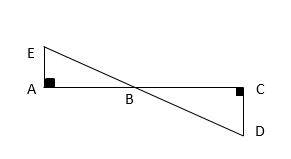
B. 4.8
C. 7.2
D. 24
3- If a gas tank can hold 25 gallons, how many gallons does it contain when it is \(\frac{2}{5}\) full?
A. 50
B. 125
C. 62.5
D. 10
4- In the xy-plane, the point \((4,3)\) and \((3,2)\) are on line \(A\). Which of the following equations of lines is parallel to line \(A\)?
A. \(y=3x \)
B. \(y=\frac{x}{2}\)
C. \(y=2x \)
D. \(y=x \)
5- If \(x\) is directly proportional to the square of \(y\), and \(y=2\) when \(x=12\), then when \(x=75 y=\)?
A. \(\frac{1}{5}\)
B. 1
C. 5
D. 12
6- Jack earns $616 for his first 44 hours of work in a week and is then paid 1.5 times his regular hourly rate for any additional hours. This week, Jack needs $826 to pay his rent, bills, and other expenses. How many hours must he work to make enough money this week?
A. 40
B. 48
C. 53
D. 54
7-
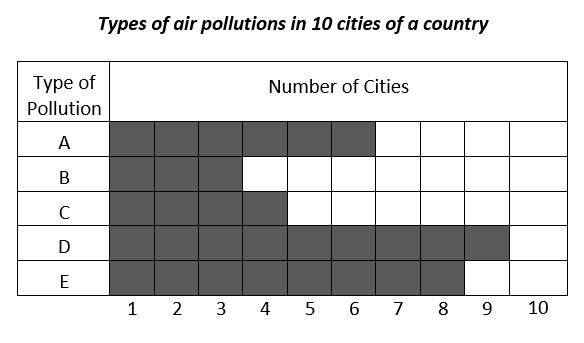
If a is the mean (average) of the number of cities in each pollution type category, b is the mode, and c is the median of the number of cities in each pollution type category, then which of the following must be true?
A. \(a<b<c\)
B. \(b<a<c\)
C. \(a=c\)
D. \(b<c=a\)
8-
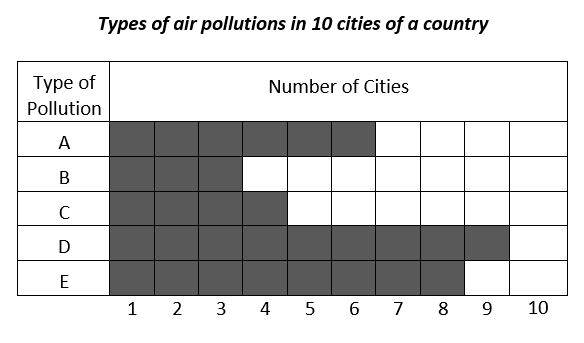
What percent of cities are in the type of pollution \(A, C,\) and \(D\) respectively?
A. \(60\%, 40\%, 90\%\)
B. \(30\%, 40\%, 90\%\)
C. \(30\%, 40\%, 60\%\)
D. \(40\%, 60\%, 90\%\)
9-
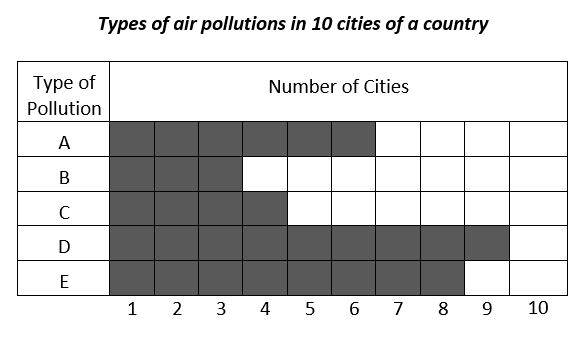
How many cities should be added to the type of pollution \(B\) until the ratio of cities in the type of pollution \(B\) to cities in the type of pollution \(E\) will be 0.625?
A. 2
B. 3
C. 4
D. 5
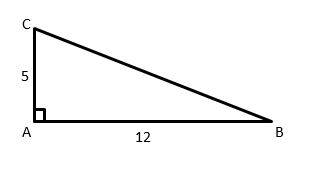
10- In the following right triangle, if the sides \(AB\) and \(AC\) become twice longer, what will be the ratio of the perimeter of the triangle to its area?
A. \(\frac{1}{2}\)
B. 2
C. \(\frac{1}{3}\)
D. 3
Best 8th Grade PSSA Math Prep Resource for 2026
Answers:
1- D
Five years ago, Amy was three times as old as Mike. Mike is 10 years old now. Therefore, 5 years ago Mike was 5 years.
Five years ago, Amy was: \( A=3×5=15 \)
Now Amy is 20 years old: \(15 + 5 = 20\)
2- B
Two triangles \(∆BAE\) and \(∆BCD\) are similar. Then:
\(\frac{AE}{CD}=\frac{AB}{BC}=\frac{4}{6}=\frac{x}{12}\)
\(→48-4x=6x→10x=48→x=4.8\)
3- D
\(\frac{2}{5}×25=\frac{50}{5}=10\)
4- D
The slope of line A is:
\(m = \frac{y_2-y_1}{x_2-x_1}=\frac{3-2}{4-3}=1\)
Parallel lines have the same slope, and only choice \(D (y=x)\) has a slope of 1.
5- C
\(x\) is directly proportional to the square of \(y\). Then:
\(x=cy^2\)
\(12=c(2)^2→12=4c→c=\frac{12}{4}=3\)
The relationship between \(x\) and \(y\) is:
\(x=3y^2\)
\(x=75\)
\(75=3y^2→y^2=\frac{75}{3}=25→y=5\)
6- D
The amount of money that Jack earns for one hour: \(\frac{$616}{44}=$14\)
Number of additional hours that he works to make enough money is: \(\frac{$826-$616}{1.5×$14}=10\)
Number of total hours is: \(44+10=54\)
7- C
Let’s find the mean (average), mode, and median of the number of cities for each type of pollution.
Number of cities for each type of pollution: \(6, 3, 4, 9, 8\)
\(mean (average) = \frac{sum \space of \space terms}{number \space of \space terms}=\frac{6+3+4+9+8}{5}=6\)
Median is the number in the middle. To find the median, first list numbers in order from smallest to largest.
\(3, 4, 6, 8, 9\)
Median of the data is 6.
Mode is the number that appears most often in a set of numbers. Therefore, there is no mode in the set of numbers.
\(Median = Mean, then, a=b\)
8- A
Percent of cities in the type of pollution A: \(\frac{6}{10} × 100=60\%\)
Percent of cities in the type of pollution C: \( \frac{4}{10} × 100 = 40\%\)
Percent of cities in the type of pollution D: \( \frac{9}{10}× 100 = 90\%\)
9- A
Let the number of cities be added to the type of pollution \(B\) be \(x\). Then:
\(\frac{x + 3}{8}=0.625→x+3=8×0.625→x+3=5→x=2\)
10- A
\(AB=12\) And \(AC=5\)
\(BC=\sqrt{(12^2+5^2 )} = \sqrt{(144+25)} = \sqrt{169}=13\)
\(Perimeter =5+12+13=30 \)
\(Area =\frac{5×12}{2}=5×6=30\)
In this case, the ratio of the perimeter of the triangle to its area is:
\(\frac{30}{30}= 1\)
If the sides \(AB\) and \(AC\) become twice longer, then:
\(AB=24\) And \(AC=10\)
\(BC=\sqrt{(24^2+10^2 )} = \sqrt{(576+100)} = \sqrt{676} = 26\)
Perimeter \(=26+24+10=60\)
\(Area =\frac{10×24}{2}=10×12=120\)
In this case the ratio of the perimeter of the triangle to its area is:
\(\frac{60}{120}=\frac{1}{2}\)
Looking for the best resource to help you succeed on the PSSA Math Grade 8 test?
The Best Books to Ace the 8th Grade PSSA Math Test

Related to This Article
More math articles
- Open-Economy Macroeconomics and Exchange Rates
- 4th Grade WVGSA Math Worksheets: FREE & Printable
- Estimating Products
- Low-Temperature Sterilization Methods
- The Ultimate TABE Math Course (+FREE Worksheets & Tests)
- SAT versus PSAT: What You Need to Know
- Gender
- Free Grade 6 English Worksheets for Kentucky Students
- The Remainder Theorem
- Do You Need to Pass the CBEST to be a Substitute Teacher?







What people say about "Grade 8 PSSA Math Practice Test Questions"?
No one replied yet.