Transcription and RNA Processing: Steps and Worked Examples
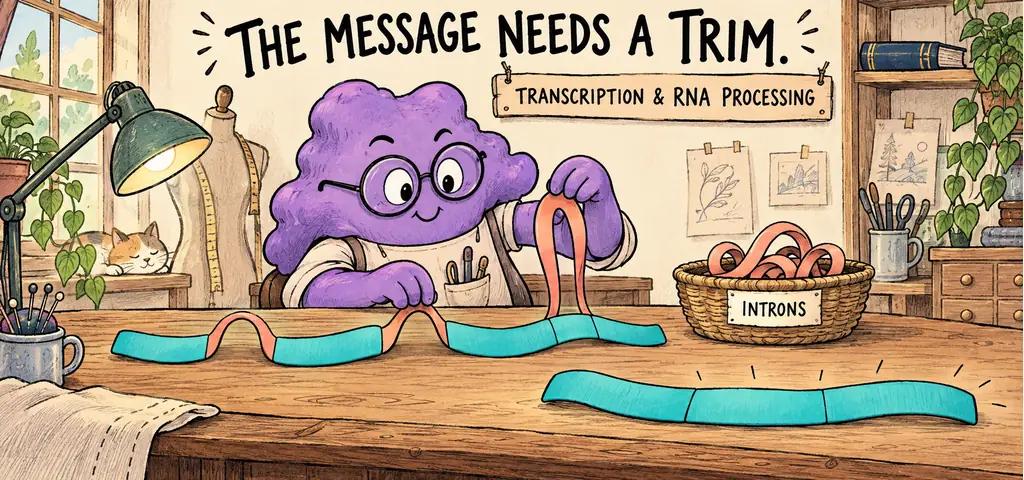
Transcription makes RNA from a DNA template; RNA processing modifies that transcript. For a typical eukaryotic protein-coding gene, RNA polymerase II produces pre-mRNA, and capping, splicing and polyadenylation help prepare a mature message. To solve strand questions, read the template 3′ to 5′ and write complementary RNA 5′ to 3′.
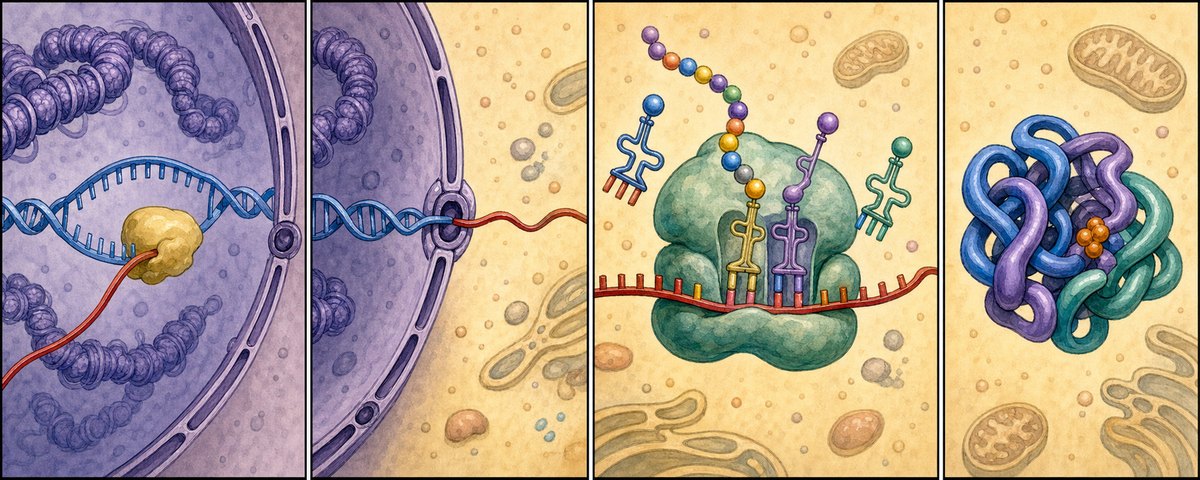
A eukaryotic cell can use a gene without moving its nuclear DNA to a ribosome. It transcribes the gene into RNA, processes the transcript when needed, and exports the message for translation. Following those steps helps you locate an experimental defect: failure to make RNA, incorrect splicing, and failure to translate a message produce different results.
Watch the process
Transcription and mRNA processing | Biomolecules | MCAT | Khan Academy
Transcription produces RNA from a DNA template. One strand is read for a particular transcription unit, and the RNA grows \(5’\) to \(3’\). A unit may encode one gene or several bacterial operon genes. The other DNA strand can serve as template for a different unit elsewhere. Some transcripts become mRNA; others function as tRNA, rRNA, or regulatory RNA.
Where the Machinery Lands, and What It Decides
Transcription begins at a promoter, a DNA region that helps position the machinery for transcription initiation. In the simple protein-coding model used here, promoter elements lie near the transcription start site, often upstream. The promoter does more than mark a starting place. Its orientation helps establish the initiation direction, which determines the template strand for that transcription unit. Use promoter orientation together with strand-end labels to determine the template and direction of transcription.
In bacteria, RNA polymerase binds the promoter directly, guided by a detachable subunit called a sigma factor that recognizes the promoter sequence. Different sigma factors recognize different promoter families, so swapping the sigma factor swaps which whole group of genes gets transcribed. In eukaryotes the polymerase cannot find a promoter on its own. General transcription factors, proteins that bind DNA and control transcription, assemble at the promoter first, often at a T-and-A-rich sequence called the TATA box, and RNA polymerase II is recruited to the initiation complex for a typical nuclear protein-coding gene. Regulation of transcription-complex assembly can control expression; other steps also provide control points.
The Three Stages, and the Failure Behind Each
In initiation, the polymerase and its accessory proteins assemble at the promoter and the DNA is opened over a short stretch. A promoter mutation that prevents assembly can block initiation, so little or no transcript is made, even though every codon in the gene is intact.
In elongation, RNA polymerase reads the template strand in the \(3’\) to \(5’\) direction and builds RNA in the \(5’\) to \(3’\) direction, adding each ribonucleotide to the free \(3’\) hydroxyl of the growing RNA, exactly as DNA polymerase does. Two differences from replication matter. The polymerase needs no primer, so it can start a chain from nothing. RNA polymerases can correct some errors, but transcription is generally less accurate than DNA replication. An erroneous transcript is usually temporary, whereas an unrepaired DNA change can be inherited by daughter cells. RNA lifetimes vary, and DNA mutations are not necessarily retained forever. The strand not read is the coding strand, whose sequence matches the transcript except that every T stands where the RNA carries a U. When writing a transcript, check both complementarity and strand direction.
In termination, the polymerase releases the DNA and the transcript. Some bacterial terminators cause an RNA hairpin and a weak RNA-DNA hybrid that help release the transcript; other bacterial termination mechanisms use additional proteins. For typical eukaryotic protein-coding genes, polymerase transcribes a processing signal, the RNA is cleaved downstream, and transcription terminates farther along. Only about 10 to 30 base pairs of DNA are unwound at any moment, and the helix zips shut behind the polymerase.
Getting the Strand and the Direction Right
A gene’s template strand includes the segment \(3’\text{-TACGGCTAA-}5’\). Write the RNA transcribed from it, and write the coding strand.
Pair each template base with its RNA partner, remembering U for A: T pairs with A, A with U, C with G, G with C, G with C, C with G, T with A, A with U, A with U. Reading in the order given produces AUGCCGAUU, and because the template was written \(3’\) to \(5’\), that reading runs \(5’\) to \(3’\) already. No reversal is needed here, which is exactly why stems specify the ends.
The coding strand is the DNA version of the same sequence: substitute T for U and keep the direction.
Answer
RNA: \(5’\text{-AUGCCGAUU-}3’\). Coding strand: \(5’\text{-ATGCCGATT-}3’\).
Which Strand Is the Template? Working It Out From the Product
A short transcribed region is shown as a double helix. Its strand directions are labeled, but the template is not identified.
Strand I: 5’-T A C G G A T C A T G-3’
Strand II: 3’-A T G C C T A G T A C-5’
An investigator isolates the mRNA made from this region and finds that it contains a functional AUG start codon beginning at the second base of this displayed RNA segment. Decide which strand is the template.
Reason from what a transcript must look like. The mRNA matches the coding strand base for base, with U replacing T, and it is complementary and antiparallel to the template strand. Test the candidates one at a time rather than guessing.
Test Strand I as coding strand. Written \(5’\) to \(3’\), Strand I begins TAC, so as a coding strand it would give a transcript beginning UAC. The segment does not begin with C followed by AUG; its AUG occurs near the other end. This assignment does not match the observation.
Test Strand II as coding strand. Strand II is printed \(3’\) to \(5’\), so read it conventionally by starting at its other end: \(5’\text{-CATGATCCGTA-}3’\). As a coding strand that gives a transcript beginning CAUG. There is an AUG, and it sits one base in from the \(5’\) end, matching the observation.
Confirm from the other direction. If Strand II is the coding strand, Strand I must be the template. Read Strand I in its \(3’\) to \(5’\) direction, which means starting from its right-hand end: G, T, A, C, T, A, G, G, C, A, T. Pair each base with its RNA partner: C, A, U, G, A, U, C, C, G, U, A. The transcript is \(5’\text{-CAUGAUCCGUA-}3’\), the same molecule the coding-strand test predicted. Two independent routes to the same sequence is the check worth doing on the exam when time allows.
Read the frame. Starting at the AUG, the codons are AUG, AUC, CGU, with an A left over. The polypeptide begins Met-Ile-Arg. The leading C lies before the specified start and is not translated in this reading frame, which is normal: transcripts routinely carry untranslated bases ahead of the start codon.
Answer
Strand I is the template and Strand II is the coding strand. Decide this by testing which assignment reproduces the observed transcript, never by which strand is drawn on top.
What Happens to a Eukaryotic Transcript Before It Leaves
A bacterial protein-coding transcript can begin translation while RNA polymerase is still transcribing it. Most eukaryotic protein-coding transcripts undergo processing in the nucleus. The primary transcript is called pre-mRNA; capping, polyadenylation, and splicing prepare many such messages for use.
A modified guanine nucleotide is added to the \(5’\) end, forming the 5’ cap. The cap protects the transcript from degradation by enzymes that attack free \(5’\) ends, and cap-binding initiation factors help recruit the small ribosomal subunit to the message. A string of 50 to 250 adenine nucleotides is added to the \(3’\) end, forming the poly-A tail, which also protects against degradation and, because it shortens over time, helps set a transcript’s working lifetime. These features support stability, export, and efficient translation of typical mRNAs. They are not universal requirements for every RNA; some functional mRNAs, such as replication-dependent histone messages, lack a poly-A tail.
The third modification changes the message itself. Many eukaryotic genes are interrupted by introns, segments that are transcribed but do not appear in the finished mRNA, separated by exons, the segments that do. Splicing removes the introns and joins the exons, and it is carried out by the spliceosome, a complex of small nuclear RNAs and proteins that recognizes sequences at the intron boundaries. Notice that the recognition is done partly by RNA rather than entirely by protein.
Alternative Splicing Breaks the One-Gene-One-Protein Rule
Alternative splicing is the inclusion of different subsets of a gene’s exons in different mature transcripts. A gene with exons numbered 1 through 5 can yield a message containing exons 1, 2, 3, and 5 in one cell type and a message containing exons 1, 2, 4, and 5 in another. If both transcripts preserve a functional reading frame and are translated, their proteins can share most of their sequence and differ in one region, which often means they differ in one binding site, one membrane anchor, or one regulatory domain. This is why the human genome contains roughly 20,000 protein-coding genes and produces a far larger number of distinct proteins. It is also a regulation point in its own right, since which splice form a cell makes is controlled by proteins that vary between cell types.
Count the possibilities and the scale becomes clear. A gene with five exons whose third and fourth exons are each independently included or skipped yields \(2 \times 2 = 4\) distinct mature messages. One gene can therefore produce multiple RNA isoforms; not every possible transcript is stable, translated, or functional.
Processing is also a control point in a second sense. Defective capping or splicing can trigger RNA surveillance and degradation, while tail length can affect stability and translation. Some altered transcripts reach ribosomes or are degraded in the cytoplasm, so the consequence depends on the defect. Regulation of expression therefore does not require touching the promoter at all. A cell can transcribe a gene steadily and still make almost none of its protein.
Template Choice and RNA Processing
A transcription unit has a template strand that is read and a coding strand with the corresponding RNA-like sequence. The template strand is the one the polymerase actually reads, so the transcript is complementary to it. The coding strand is not used as the template for this transcription unit. Because it is complementary to the template strand, it matches the RNA sequence, with T where RNA has U. Students who reason “the coding strand codes for the protein, so it must be the one that gets copied” have taken the name as a description of the chemistry. Say it this way instead: the coding strand shares the message, the template strand supplies it.
RNA processing modifies the transcript produced by transcription. Transcription produces the primary transcript base for base, introns included. Much processing begins during transcription and continues in the nucleus, and changes the molecule: a cap on one end, a tail on the other, introns cut out and exons joined. A splice-site mutation can alter RNA processing without preventing initiation. The primary transcript contains the changed nucleotide, and processing may retain an intron, skip an exon, or use a different splice site. Assign every described defect to one step or the other before you predict a consequence.
Exons and introns are the third pair worth separating, and the words themselves help if you let them. In a typical spliced nuclear mRNA, exons are retained and joined, while introns are removed from the pre-mRNA. Exons can contain untranslated regions as well as protein-coding sequence, so exon does not mean translated codon. Both are transcribed, so both are present in the primary transcript, so both appear before splicing. When a stem says a mutation falls “within an intron,” it has told you the base is transcribed and then removed, so a change may leave the protein sequence unaffected, but introns can also contain internal splicing signals and regulatory elements. Location away from the boundary alone does not guarantee no effect.
Transcription reads a DNA template in a transcription unit to produce RNA, built \(5’\) to \(3’\) against a template read \(3’\) to \(5’\).
Promoter changes can alter RNA production; splice-site changes can alter RNA processing; cap and tail changes can affect RNA stability, export, or translation. Measure the relevant step before choosing one explanation.
Do not decide which strand is the template from its position in the diagram. Decide it from the labeled ends and from the promoter, then build the RNA one base at a time.
Transcription and RNA processing
Practice question 1
A segment of a gene’s template strand reads \(3’\text{-ACCGTTAGC-}5’\). The mRNA transcribed from it is
-
\(5’\text{-UGGCAAUCG-}3’\)
-
\(5’\text{-ACCGUUAGC-}3’\)
-
\(5’\text{-GCUAACGGU-}3’\)
-
\(5’\text{-TGGCAATCG-}3’\)
Practice question 2
A mutation destroys the sequence at the boundary between intron 2 and exon 3 of a eukaryotic gene, with no change to any codon inside an exon. The most likely consequence is that
-
transcription never begins, because splice sites are required for RNA polymerase to bind
-
splicing is altered, potentially retaining an intron or skipping an exon and changing the protein product
-
the transcript is exported normally and translated into the usual protein
-
the poly-A tail is added to the wrong end of the transcript
Practice question 3
The 5’ cap and the poly-A tail share which function?
-
they encode the first and last amino acids of the protein
-
they mark the boundaries between introns and exons for the spliceosome
-
they support transcript stability, processing or export, and efficient use in translation
-
they attach the transcript to a tRNA anticodon
Practice answer key
1. A; 2. B; 3. C.
Practice answer explanations
-
Transcription and RNA processing, Question 1. Choice A is correct. Pairing \(3’\text{-ACCGTTAGC-}5’\) base by base with RNA gives UGGCAAUCG, and because the template was written \(3’\) to \(5’\) the product reads \(5’\) to \(3’\) as written. Choice B copies the template instead of complementing it. Choice C corresponds to treating the given DNA strand as the coding strand instead of using it as the template. Choice D gives a DNA sequence with T rather than an RNA product.
-
Transcription and RNA processing, Question 2. Choice B is correct. A disrupted splice site can cause intron retention, exon skipping, or use of an alternative site, potentially changing the protein. It does not uniquely predict one outcome. Choice A confuses splicing signals with promoter assembly. Choice C assumes normal processing despite destruction of a required site. Choice D puts the poly-A tail on the wrong end without evidence.
-
Transcription and RNA processing, Question 3. Choice C is correct. The cap and poly-A tail support stability and efficient handling of typical eukaryotic mRNAs, including export and translation. Not every functional RNA requires both. Choice A treats the modifications as translated codons. Choice B assigns them intron-boundary recognition. Choice D confuses message processing with tRNA pairing.
Continue your review at the AP Biology study hub.
Further reading
See OpenStax Biology 2e: Eukaryotic Transcription and RNA Processing in Eukaryotes for the transcription machinery and processing steps.

Related to This Article
More math articles
- 7th Grade English Worksheets for New York (NYS ELA): 43 Free Printable PDFs
- CLEP U.S. History I 069: Temperance, Schools, Prisons, and Asylums
- The Ultimate 7th Grade ISASP Math Course (+FREE Worksheets)
- 5 Tips on How to Score Higher on SAT Math
- The Complete Guide to 5 Best GED Math Study Guides
- Migration, Urbanization, Borders, and Development
- Deviance, Crime, Harm, and Social Definition
- How to Write an Equation from a Graph?
- HiSET Math Formulas
- Checks on Presidential Power







What people say about "Transcription and RNA Processing: Steps and Worked Examples"?
No one replied yet.