The Open Door, the Panama Canal, and Competing Diplomacies
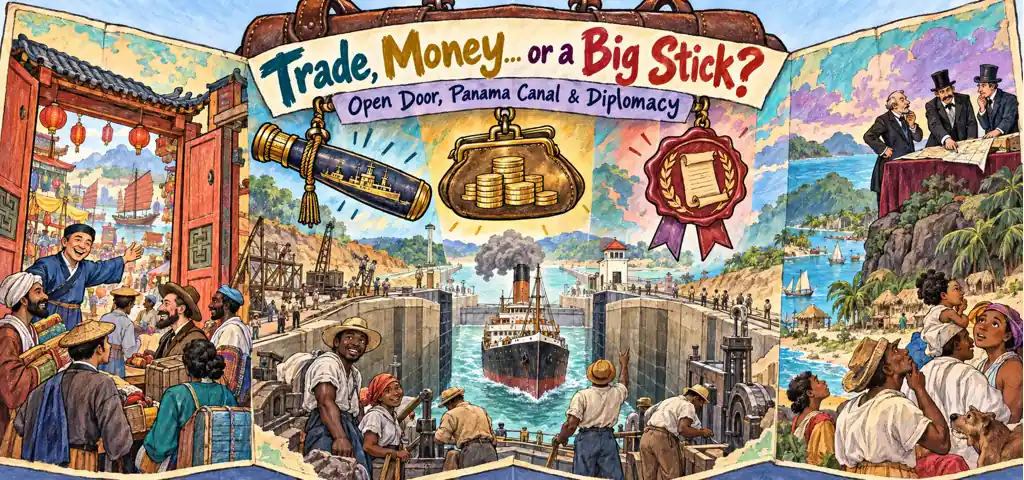
Chapter 6 of the CLEP History of the United States II study guide on Effortless Math covers The Open Door, the Panama Canal, and Competing Diplomacies: the key terms, the core ideas, and worked examples showing how this topic is tested on the exam.
CLEP History of the United States II, Chapter 6
The Open Door sought access without partition
As European powers and Japan established spheres of influence in China, Secretary of State John Hay sent Open Door Notes in 1899 asking them to preserve equal commercial opportunity within their zones. After the Boxer uprising, his 1900 note also called for China's territorial and administrative integrity. The powers did not sign a binding multilateral treaty, and their replies were qualified. The policy nevertheless announced an American interest in equal market access without acquiring a Chinese colony. It linked commercial opportunity to a diplomatic claim that no power should close its sphere to others.
The Boxer crisis tested the policy
The anti-foreign Boxer movement attacked missionaries and Chinese Christians and besieged foreign legations in Beijing in 1900. The United States joined an eight-nation expedition that relieved the legations. Hay opposed using the settlement to partition China further. American troops' participation demonstrated that the Open Door was not passive free-trade rhetoric; officials were willing to use force within a multinational intervention. At the same time, preserving Chinese integrity served American access because the United States lacked a large exclusive sphere of its own.
Canal diplomacy first removed Britain
The Clayton-Bulwer Treaty of 1850 had barred either the United States or Britain from exclusive control of a Central American canal. The Hay-Pauncefote Treaty of 1901 replaced that arrangement and permitted the United States to build and manage a neutral canal. Congress then chose the Panama route over Nicaragua. Colombia controlled Panama, and the Hay-Herran Treaty would have leased a canal zone, but the Colombian Senate rejected it in 1903. Removing the British obstacle did not yet provide land; a second diplomatic crisis determined the canal's location and terms.
Panamanian independence produced a contested treaty
Roosevelt's administration encouraged Panamanian separatists and prevented Colombian troops from easily suppressing their November 1903 revolt. The United States quickly recognized Panama. Philippe Bunau-Varilla, a French canal promoter representing the new republic, signed a treaty granting the United States control of a ten-mile-wide Canal Zone in perpetuity for cash and annual payments. Panamanians later condemned the speed and unequal terms. The episode exemplified Big Stick diplomacy: strategic purpose, naval power, and rapid recognition produced a result Colombia had refused.
The federal government built the canal
The United States bought the failed French company's property for $40 million, paid Panama $10 million plus an annuity, and financed construction through congressional appropriations. Federal engineers chose locks rather than a sea-level cut. William Gorgas's sanitation campaign reduced yellow fever and malaria; tens of thousands of workers, especially migrants from the British Caribbean, performed dangerous labor under racially unequal pay systems. Opened in 1914, the canal was federally built and owned, and ships paid tolls. It was not a privately financed concession or a project transferred to the states.
The Roosevelt Corollary expanded Monroe's claim
The original Monroe Doctrine warned European powers against new colonization or interference in the Americas. Roosevelt's 1904 Corollary asserted that "chronic wrongdoing" or instability could justify the United States exercising international police power in the Western Hemisphere. European creditor intervention in Venezuela supplied the immediate background. American customs receiverships and occupations followed in the Dominican Republic and elsewhere. The doctrine moved from warning outsiders toward claiming an American right to intervene inside neighboring states.
Big Stick diplomacy mixed mediation and display
Roosevelt mediated the 1905 Treaty of Portsmouth ending the Russo-Japanese War. Japan gained recognition of its dominant interest in Korea and Russian leases in southern Manchuria but received no indemnity, disappointing Japanese opinion. Roosevelt later sent sixteen battleships, the Great White Fleet, around the world beginning in 1907 to display naval power, especially to Japan, and test fleet logistics. Mediation and display were different instruments: one brokered terms between belligerents, the other made American capacity visible without beginning a war.
Agreements managed conflict with Japan
The 1905 Taft-Katsura memorandum recorded an informal conversation, not a ratified alliance: Prime Minister Katsura disclaimed aggressive designs on the American Philippines, while Secretary of War Taft accepted Japan's dominant position in Korea. When San Francisco later ordered Japanese students into a segregated school, Roosevelt arranged the informal Gentlemen's Agreement of 1907-1908. The school order was withdrawn, and Japan restricted passports for laborers bound for the mainland. The Root-Takahira exchange of 1908 affirmed respect for each country's Pacific possessions, the status quo, China's independence, and the Open Door. None of these arrangements created a mutual-defense alliance. They reduced immediate tension while leaving racial exclusion, Korean subordination, and Pacific rivalry unresolved.
Territorial government created unequal categories
The Foraker Act of 1900 established civil government in Puerto Rico with an appointed governor and executive council and an elected house of delegates. The Insular Cases held that an unincorporated territory was not necessarily on a path to statehood and that only rights deemed fundamental applied there automatically. The Philippines likewise had appointed executive government; residents were American nationals rather than U.S. citizens. The Jones Law of 1916 promised eventual Philippine independence once stable government existed. The Jones-Shafroth Act of 1917, by contrast, extended U.S. citizenship and reorganized government in Puerto Rico.
Pacific settlements recognized a balance
The tripartite convention of 1899 divided Samoa: the United States took the eastern islands and Pago Pago harbor, Germany took the western islands, and Britain withdrew in exchange for concessions elsewhere. The Root-Takahira Agreement later recognized American and Japanese possessions while defending the Open Door. These bargains stabilized spheres without applying self-determination to island peoples. Diplomatic balance among great powers could therefore coexist with colonial administration below them.
Dollar diplomacy privileged finance
President William Howard Taft and Secretary of State Philander Knox promoted American bank loans and investment as instruments of influence, especially in China, Nicaragua, and the Caribbean. Officials hoped finance would create stability, open markets, and reduce the need for force. In practice, the government sometimes used marines to protect financial arrangements, so dollar diplomacy did not eliminate coercion. Its distinctive emphasis was private capital backed by state power, compared with Roosevelt's more visible executive intervention and naval display.
Moral diplomacy also used force
Woodrow Wilson promised to support constitutional government and denied recognition to Victoriano Huerta's Mexican regime. In 1914, after the Tampico incident, American forces occupied Veracruz to block an arms shipment. War was avoided when Argentina, Brazil, and Chile-the ABC powers-mediated, and Huerta soon fell. Wilson's language differed from dollar diplomacy, but moral purpose did not prevent military occupation. Comparing diplomatic labels requires examining instruments and outcomes, not merely presidential rhetoric.
classify the instrument
A policy offers bank loans to stabilize customs revenue; another sends battleships on a world cruise; a third withholds recognition from a regime.
Diplomacy managed an empire as well as foreign relations
The Open Door defended commercial access; the canal rearranged geography and sovereignty; the Roosevelt Corollary licensed intervention; agreements with Japan balanced possessions; and territorial statutes governed people without equal constitutional incorporation. Big Stick, dollar, and moral diplomacy were not sealed eras. Each combined ideals, markets, law, and power differently. The most accurate analysis asks who controlled territory, who financed the policy, which branch or treaty supplied authority, and whether the affected population consented.
Watch the history in motion
This short lesson adds voices, images, and chronology to the ideas you just studied.
Video: USH – Unit 4 – Lesson 7 – Open Door Policy, Panama Canal, Dollar Diplomacy, Taft, What'd I miss? History with Mr. Wagstaff.
Try four CLEP-style questions
- Which comparison best shows two different ways the United States pursued an Asian commercial presence after 1898?
- It pursued nondiscriminatory access without direct political authority in both places.
- It sought nondiscriminatory access in sovereign China while exercising territorial government in the Philippines.
- It governed treaty ports in China while recognizing immediate Philippine independence.
- It treated both places as unincorporated territories under appointed governors.
- It accepted exclusive European spheres in China while limiting Philippine policy to trade notes.
- Why did the Hay-Pauncefote Treaty not by itself permit canal construction to begin in Panama?
- Removing British restraint did not supply a canal-zone grant.
- It selected a Nicaraguan route and left the Panamanian alternative unavailable.
- It addressed the financial terms Colombia would receive but not the earlier British restriction.
- It transferred French machinery and excavation rights but required no territorial concession.
- It authorized unilateral construction only after Colombia rejected compensation.
- A president claims moral standards for recognition but then occupies a port. What conclusion best follows?
- Recognition doctrine displaced armed pressure as soon as a regime failed the legitimacy test.
- Occupation necessarily converted the port into a constitutional territory.
- Financial influence rather than recognition supplied the administration's only instrument.
- Acceptance of regional mediation prevented the earlier use of American force.
- Moral diplomacy and military coercion could operate within the same policy.
- What institutional difference separates the Open Door from the unincorporated-territory doctrine?
- Both placed customs administration under locally elected American territorial officers.
- Both paired commercial access with a binding promise of eventual statehood.
- One sought foreign access; the other governed possessions without promised incorporation.
- The Open Door established American sovereignty, while territorial doctrine requested trade access.
- Both limited American action to diplomatic requests made outside any governing relationship.
Check your answers and reasoning
Independent preparation. CLEP is a registered trademark of the College Board, which does not endorse this lesson.

Related to This Article
More math articles
- 3rd Grade PACE Math Worksheets: FREE & Printable
- Cancer and Cell-Cycle Control: Mutations and Checkpoints
- Full-Length 8th Grade SBAC Math Practice Test-Answers and Explanations
- Arizona Grade 2 Math Worksheets — Free Printable PDFs
- Mastering Algebra II in Virginia: A Complete Guide for Students and Parents
- FREE 6th Grade OST Math Practice Test
- The Best Grade 5 ELA Practice Tests for Idaho Students
- Math Courses Required For A Business Degree
- Grade 3 Math: Comparing and Ordering Numbers
- ATI TEAS Math Study Plan: A 30-Day Roadmap to a Top Score



















What people say about "Open Door, Panama Canal, and Diplomacy"?
No one replied yet.