Grade 3 Math: Comparing and Ordering Numbers
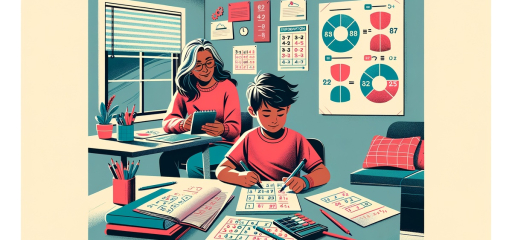
To compare whole numbers, line up their place values and start with the greatest place. If the hundreds are equal, compare the tens; if those are equal, compare the ones. To order numbers, use the same comparisons to arrange them from least to greatest or greatest to least.
What do >, <, and = mean?
- 18 < 25: 18 is less than 25.
- 47 > 39: 47 is greater than 39.
- 406 = 406: both numbers have the same value.
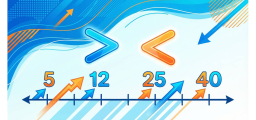
The open side of > or < faces the greater number. Read the comparison from left to right to check that your symbol matches your words.
Compare hundreds, tens, and ones
Compare 596 and 562. Both have 5 hundreds, so the hundreds are equal. Compare the tens next: 9 tens are greater than 6 tens. Therefore, 596 > 562. You can stop at the tens; the ones cannot change the result.
| Number | Hundreds | Tens | Ones |
|---|---|---|---|
| 596 | 5 | 9 | 6 |
| 562 | 5 | 6 | 2 |
When a number contains zero: compare 407 and 470. The hundreds are equal, but 0 tens are less than 7 tens, so 407 < 470. Keep the zero in its place.
When the numbers have different lengths: 98 < 102. The number 102 has a hundred, while 98 has no hundreds. Do not compare the 9 in 98 directly with the 1 in 102; those digits have different place values.
If every corresponding digit matches, use =. For example, 638 = 638.
Order numbers from least to greatest
Put 352, 325, 253, and 532 in order.
- Compare the hundreds. The smallest is 253, and the largest is 532.
- Compare the two numbers with 3 hundreds: 325 and 352. Since 2 tens are less than 5 tens, 325 comes first.
- Write the complete order: 253 < 325 < 352 < 532.
For greatest to least, reverse that order: 532 > 352 > 325 > 253. Check each neighboring pair before you finish.
Try these six practice questions
Write >, <, or = for questions 1–4. Then order the numbers in questions 5–6. Explain which place helped you decide.
- 624 ___ 642
- 508 ___ 580
- 731 ___ 731
- 99 ___ 105
- Least to greatest: 416, 461, 146, 164
- Greatest to least: 290, 209, 902, 920
Check answers and explanations
- 624 < 642: the hundreds match; 2 tens are less than 4 tens.
- 508 < 580: the hundreds match; 0 tens are less than 8 tens.
- 731 = 731: all three place values match.
- 99 < 105: 105 has 1 hundred; 99 has none.
- 146, 164, 416, 461. Compare hundreds first, then tens within each pair.
- 920, 902, 290, 209. Start with 9 hundreds, then compare tens; repeat for 2 hundreds.
Check these common mistakes
Starting with the ones: 398 is less than 402 even though 8 is greater than 2. The hundreds decide first.
Skipping a zero: 305 has 0 tens. It is not the same as 35.
Reversing the direction: underline “least to greatest” or “greatest to least” before ordering a list.
Find matching Grade 3 practice
Open the Numbers, Comparing, and Patterns section of the Grade 3 worksheet collection. It includes a Comparing and Ordering Numbers exercise control. The collection contains both printable links and online exercises; check the control you choose rather than assuming every item is a PDF.
Review the Grade 3 place-value lesson if you need help lining up hundreds, tens, and ones. Then continue to rounding numbers, or use the Grade 3 learning hub to choose another topic.
For parents and teachers: this is a place-value review for Grade 3 learners. Three-digit comparison is introduced in Common Core 2.NBT.A.4.
Optional Grade 3 study books
Continue with the free lesson and practice above, or explore these Grade 3 books for additional study.

Related to This Article
More math articles
- Informal constitutional change
- How to Prepare for the DAT Quantitative Reasoning Math Test?
- Function Values of Special Angles
- Transitions Between Sections
- Top 10 Tips to Create the HSPT Math Study Plan
- How to Graph Triangles and Quadrilaterals?
- The Nature of Science
- How to Solve Systems of Equations with Substitution?
- Multistep Chemistry Problems: Moles to Gas Volume
- 10 Most Common TASC Math Questions








What people say about "Grade 3 Math: Comparing and Ordering Numbers"?
No one replied yet.