How to Prepare for the California Grade 3 CAASPP Math Test: A Parent’s Step-by-Step Guide
If your child is preparing for California’s Grade 3 CAASPP Math test, start with three manageable steps: ask the teacher when the class will test, find out which skills the class is reviewing, and choose a short routine your child can sustain. The test is one snapshot of how students apply grade-level math; it is not a verdict on a child’s ability or future.
California gives a statewide assessment so families, schools, districts, and the state can see how students are progressing toward shared learning expectations. Results contribute to school and state accountability and help adults ask better questions about where students are doing well and where instruction or practice may help. Read the state assessment system overview for more about its purpose. Assessment results are one source of information alongside classwork, teacher observations, and classroom assessments.
Preparation does not mean cramming or guessing the test. It means refreshing important math, practicing how to explain a strategy, becoming comfortable with online tools, and offering calm support before, during, and after testing. After a brief test overview, this guide offers a short quiz, a Grade 3 standards guide, practical preparation plans, and parent support.
What is the California Grade 3 CAASPP math test?
CAASPP stands for California Assessment of Student Performance and Progress. Most California public-school students in grades 3–8 and grade 11 take the Smarter Balanced Summative Assessment in mathematics, which measures grade-level California Common Core math standards.
Eligible students whose individualized education program (IEP) team has designated an alternate assessment take the California Alternate Assessment (CAA) instead. This guide focuses on Smarter Balanced. See the official CAA overview for information about alternate assessments.
The Smarter Balanced assessment’s computer-adaptive section selects questions in response to a student’s answers. A separate performance task asks students to use related information and show mathematical thinking. Students may choose an answer, enter a number or explanation, or interact with an on-screen model. The assessment is untimed. Ask your school about its session schedule, breaks, and which universal tools, designated supports, or accommodations may be appropriate; California’s current CAASPP accessibility resources matrix describes the allowed resources. See the California Department of Education assessment overview.
The goal of preparation is not to memorize answers or race through a test. Students benefit from understanding a calculation, choosing a sensible strategy, checking whether an answer makes sense, and showing their reasoning. Try our free online Grade 3 practice test early enough to discuss missed questions and return to the skills that need work.
Try the short quiz below before reading the standards guide. It covers selected skills only; use it to choose practice, not to predict a CAASPP score.
Quick California Grade 3 CAASPP Math Check: 10 Questions
Try all ten questions on your own. Use scratch paper and show your thinking. Each correct answer earns 10 points. After Question 10, you’ll see your score and the explanations. This quiz samples a few Grade 3 skills. Use it alongside your child’s classwork and teacher feedback.
If the quiz does not load, try the free Grade 3 practice test in the Effortless Math Online Center.
Question 1 of 10
Quiz results
An 80/100 means eight correct answers on these ten questions. Pick a problem your child missed or felt unsure about. Ask how they started, then try a new problem on the same skill together.
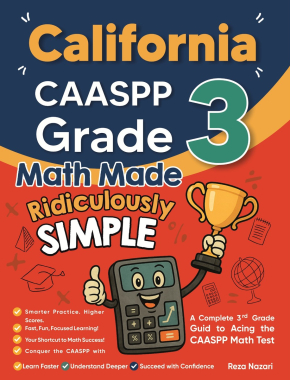
Help your child get ready for CAASPP math. Made Ridiculously Simple walks through problems one step at a time. Open to a skill your child found tricky and read one example together. Then ask, “What would you try first on a new problem like this one?”
Answers and explanations
1. There are 6 bags with 7 apples in each bag. How many apples are there altogether?
Your answer:
Correct answer: B. 42 apples
Six equal groups of seven make 6 × 7 = 42 apples.
2. 56 stickers are shared equally among 8 students. How many stickers does each student get?
Your answer:
Correct answer: B. 7 stickers
Share 56 stickers into 8 equal groups: 56 ÷ 8 = 7 stickers each. Check with 8 × 7 = 56.
3. Round 418 to the nearest hundred.
Your answer:
Correct answer: A. 400
418 is between 400 and 500 and below the midpoint 450, so it is closer to 400.
4. What is 426 + 287?
Your answer:
Correct answer: C. 713
Add by place value: 426 + 200 = 626; + 80 = 706; + 7 = 713.
5. Which fraction is greater: three fourths or two fourths?
Your answer:
Correct answer: B. Three fourths
Both fractions name fourths. Three fourths is one fourth more than two fourths.
6. A movie begins at 2:35 p.m. and ends at 3:10 p.m. How long is the movie?
Your answer:
Correct answer: B. 35 minutes
From 2:35 to 3:00 is 25 minutes; 3:00 to 3:10 is 10 more. The total is 35 minutes.
7. Four containers each hold 6 liters of water. How many liters do they hold altogether?
Your answer:
Correct answer: C. 24 liters
Four groups of 6 liters: 4 × 6 = 24 liters altogether.
8. A rectangle is 7 inches long and 4 inches wide. What is its area?
Your answer:
Correct answer: C. 28 square inches
A 7-by-4 rectangle covers 7 rows of 4 unit squares: 7 × 4 = 28 square inches. Area uses square units.
9. A picture graph uses one star to stand for 2 books. How many stars represent 10 books?
Your answer:
Correct answer: B. 5 stars
Each star stands for 2 books. Divide 10 books by 2 books per star: 10 ÷ 2 = 5 stars.
10. A rectangle has side lengths of 6 feet and 3 feet. What is its perimeter?
Your answer:
Correct answer: B. 18 feet
Perimeter is the distance around the rectangle: 6 + 3 + 6 + 3 = 18 feet.
What to practice next
Use missed or uncertain answers as a starting point. Ask your child to explain the attempt, then try three to five fresh questions on that skill. If the difficulty repeats, review the idea with a model or lesson and check again another day. One correct answer does not establish mastery of a whole topic.
- Questions 1–2: multiplication and division with equal groups.
- Questions 3–4: rounding and addition. Mark hundreds and the midpoint on a number line; split addition into hundreds, tens, and ones.
- Question 5: comparing fractions with the same denominator.
- Questions 6–7: elapsed time and multiplication in a liquid-volume story. Count elapsed time in jumps across the hour.
- Question 8: rectangle area. Tile the inside with unit squares before multiplying.
- Question 9: using a picture-graph key. Draw a simple graph and compare two categories.
- Question 10: perimeter. Trace or label the four outside sides.
This is an informal check of selected Grade 3 skills. It does not include subtraction, shape classification, two-step problem solving, fraction number lines, or making a graph.
California Grade 3 math topics to review
California’s Grade 3 math standards are grouped into five official domains. This overview is based on the California Department of Education mathematics standards and resources. The examples below show what students learn and what parents can look for; they are a study guide, not a promise that every skill appears on one test.
Operations and Algebraic Thinking
Understand multiplication as equal groups, arrays, or rows and columns; understand division as sharing or making equal groups; connect multiplication and division; and develop fluency with products and quotients within 100. By the end of Grade 3, students should recall products of two one-digit numbers and use those facts to find related quotients. They use properties such as 6 × 4 = (5 × 4) + (1 × 4), find a missing number such as 7 × □ = 42, represent and solve two-step stories, and check whether an answer is reasonable.
For example, three bags of eight apples plus five loose apples can be represented as 3 × 8 + 5 = 29. Students should explain both steps and why 29 is reasonable. They also explain patterns in arithmetic tables, such as why multiples of four are even.
Can my child explain why 4 × 6 and 6 × 4 have the same product?
Number and Operations in Base Ten
Use place-value understanding to round whole numbers to the nearest ten or hundred; fluently add and subtract within 1,000 using place-value strategies; and multiply a one-digit number by 10, 20, …, 90.
For example, 6 × 40 is 6 × 4 tens, or 24 tens = 240.
Can my child show why 526 + 187 = 713 by regrouping?
Number and Operations—Fractions
Understand a fraction as a number made from equal parts; use denominators 2, 3, 4, 6, and 8; mark fractions on a number line; and recognize whole numbers as fractions (four fourths equals one).
Equivalent fractions name the same amount: one half equals two fourths because both cover the same amount of an equal-sized whole and land at the same point on a number line. Fractions can be greater than one: five fourths is five one-fourth steps from zero, one step beyond one.
When comparing fractions, make sure they refer to the same-sized whole. With the same denominator, three fourths is greater than two fourths; with the same numerator, one third is greater than one sixth because each third is a larger equal part than each sixth.
Can my child place one half and two fourths at the same point on a number line?
Measurement and Data
Measure and estimate lengths to halves and fourths of an inch; tell and write time to the nearest minute; solve elapsed-time problems; measure and estimate liquid volume in liters and mass in grams or kilograms; and solve one-step mass and liquid-volume stories using quantities expressed in the same units.
Graphs and line plots: Students draw and interpret scaled picture and bar graphs. They use the key or numbered axis to interpret each symbol or interval, then answer one- and two-step “how many more” or “how many fewer” questions. Students measure objects and make line plots, placing one mark above the corresponding measurement for each observation; whole inches, halves, or quarters may be used as appropriate. Three marks above one half inch mean that three objects measured one half inch.
Area and perimeter: For perimeter, add every side length; if the perimeter and other side lengths are known, use subtraction to find a missing side. Area is the number of unit squares covering a surface: find a rectangle’s area by multiplying its side lengths and add areas of non-overlapping rectangles. Equal-area rectangles can have different perimeters, and equal-perimeter rectangles can have different areas.
For example, a 3-by-5 rectangle has area 15 square units but perimeter 16 units.
Can my child trace the outside edge to show perimeter, then point to the squares that measure area?Geometry
Describe and classify shapes by properties such as side count or right angles; understand that a square is also a rectangle and quadrilateral; identify rhombuses and other quadrilaterals by their attributes; and partition shapes into equal-area pieces, naming each piece as a fraction of the whole.
A square belongs to several categories: it is a quadrilateral because it has four sides, a rectangle because it has four right angles, and a rhombus because all four sides are equal. Students can draw and compare shapes that fit or do not fit a category.
Can my child draw a quadrilateral that is neither a rectangle nor a rhombus?
Area and perimeter are included in the official Measurement and Data domain above. Start with skills your child’s teacher identifies and those that remain difficult after practice. If a problem was hard, ask your child to show you where they got stuck. Work through that step together, then try a similar problem.
Four equal steps take you from zero to one.
- 0
- 1
The middle point is = .
Each dot represents two cans.
| Day | Picture | Cans |
|---|---|---|
| Monday | ●●● | 6 |
| Tuesday | ●●●●● | 10 |
How many more cans were collected on Tuesday?
Show the reasoning
Tuesday has two extra dots. Each dot stands for two cans, so Tuesday has four more cans.
Try it together: same area, different perimeter
Give your child 24 square tiles or draw 24 unit squares on grid paper. Ask them to make two different rectangles using all 24 squares each time. Find the area and perimeter of both. What stayed the same, and what changed?
A 4-by-6 rectangle has an area of 24 square units and a perimeter of 20 units. A 3-by-8 rectangle has the same area and a perimeter of 22 units. Ask your child to point to the squares they counted for area and the outside edges they counted for perimeter.
Keep practicing in the Online Center. Try our free online Grade 3 practice test. Then pick a missed skill, such as equivalent fractions or elapsed time, and use the matching lesson, skill quiz, and printable worksheets to practice it. The California Grade 3 Math Online Center also connects you to flashcards for quick review.
Give game time a math goal. Try Multiplication Game for fact practice or Fraction Pizza to work with equal parts. Find more activities in our free math games for kids.
Choose a study timeline that fits
Six-month plan — steady weekly practice
Books for this plan Work through selected lessons and tests from all five books in the California Grade 3 Math bundle: Made Ridiculously Simple, the workbook, and the five-, six-, and seven-test books. Move on when your child can solve and explain fresh examples. Revisit the matching lesson if the same difficulty keeps coming up.
- Month 1 — start with the study guide. Try the 10-question quiz, review classwork, and start Made Ridiculously Simple. Plan three 15–20 minute sessions a week. Read one example together. Let your child try the next two questions, then ask how they decided what to do first.
- Month 2 — pair the guide with the workbook. Review place value, rounding, addition, subtraction, multiplication, and division. Use the workbook right after the matching lesson.
- Month 3 — move into the five-test book. Keep reviewing fractions and measurement in the guide and workbook. Start with selected questions from the five-test book. Set aside the following session to review errors.
- Month 4 — use the six-test book for mixed practice. Add graphs, area, perimeter, and geometry. Try a test or a few sections from the six-test book and return to the workbook for the skills that need another pass.
- Month 5 — use the seven-test book. Choose two or three tests from the seven-test book, spaced apart. Have your child write or explain how they checked one answer after each test.
- Month 6 — revisit tricky skills. Use a fresh test from the books or our free online practice test as a checkpoint. Revisit mistakes with the study guide. In the final week, keep practice brief and stick to normal routines.
Six-week plan — a focused review
Books for this plan Start with Made Ridiculously Simple and the workbook. Choose practice from the six-test book for the final two weeks.
Aim for three or four 15–20 minute sessions each week. Review one example, work a short set, and talk through one answer.
- Week 1: Use the quiz, recent classwork, and teacher feedback to choose two priorities. Check the standards overview for skills the quiz leaves out. Read the matching lessons in the study guide and open the Online Center practice test together.
- Weeks 2–3: Review multiplication, division, two-step problems, place value, and addition and subtraction. Pair each lesson with a workbook page.
- Week 4: Pick up to two topics your child still finds tricky. For fractions, have them fold a strip into equal parts. For area or perimeter, ask them to show which measurement goes inside a shape and which goes around it. Use the workbook for a few fresh problems on the topics you choose.
- Week 5: Choose one test from the six-test book. Break it into sections if that fits your child’s schedule. Review mistakes in a separate session.
- Week 6: Try another test or selected questions early in the week. Use the study guide for one final review topic and keep the last day light.
30-day plan — one month to prepare
Books for this plan Use Made Ridiculously Simple for lessons and worked examples, and 7 California CAASPP Grade 3 Math Practice Tests for the practice checkpoints.
- Days 1–3: Start with the 10-question quiz and selected questions from the first test in the seven-test book. Choose two or three focus skills.
- Days 4–10: Use the study guide for one focus skill at a time. On four or five days, spend 15–20 minutes reading an example, trying a few problems, and talking through one answer.
- Days 11–17: Choose an unused test or an unused section from the seven-test book. Spend the next session on mistakes, then revisit the matching lessons.
- Days 18–24: Work through another test or selected sections from the seven-test book. Use our online practice test if your child also wants to practice answering on a screen.
- Days 25–30: Use the study guide to review two missed skills. Use a few familiar problems for the final session and keep the evening before testing calm.
One-week plan — a calm final review
Books for this plan Use Made Ridiculously Simple for a quick review. If you have the seven-test book, choose one short set of questions from it.
- Days 7–4: Pick one or two skills that still feel shaky. Review a worked example and spend 10–15 minutes on those skills.
- Days 3–2: Try a short set from the seven-test book or a few questions in the free online practice test. Review one mistake together and stop while your child still feels fresh.
- The day before: Gather what the school requests, keep the usual bedtime, and remind your child to take the test one question at a time.
Before, during, and after the test: a parent’s guide
In the weeks before
- Ask the teacher. Confirm dates, session length, breaks, and which skills the class is reviewing.
- Pick a short routine. Use the Online Center practice test early, then revisit one or two missed skills with a lesson or worksheet.
- Confirm supports. If your child has an IEP, 504 plan, language need, or another support, ask the school which tools and accommodations will be available and how students use them.
On test day
- Keep the morning predictable. Follow the usual sleep and breakfast routine, leave time to arrive, and offer calm encouragement.
- Use a simple checklist. Read the whole question, tell yourself what it asks, choose a strategy, and check the units. For a written answer, show the calculation or model and add a sentence that answers the question.
- Take it one question at a time. The test is untimed, though the school may split it into sessions. A slow exhale can help if anxiety rises. Ask the school ahead of time how students can request a break or help with directions or the computer.
After each session and when results arrive
- Ask how it felt. Notice a strategy your child used or a moment when they kept trying. Give them room to talk without comparing scores.
- Read the report with the teacher. Consider the results alongside classwork and classroom observations.
- Choose a next step. Pick one or two skills to work on and use a lesson, quiz, or worksheet from the Online Center.
A gradual book and practice sequence
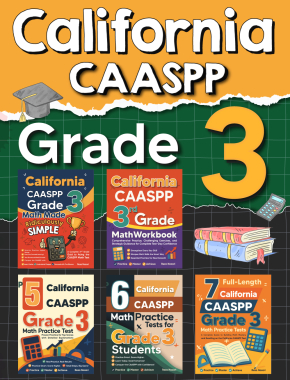
Start with the study guide
 Original price was: $27.99.$17.99Current price is: $17.99.
Learn a topic with a worked example, then ask your child to explain the steps.
Pair it with the workbook
Original price was: $24.99.$17.99Current price is: $17.99.Give your child focused practice on the skill you just reviewed before moving to a full test.
Optional five-test set
Use one printable practice test, then set aside a separate session to review it. This book is included in the five-book Effortless Math bundle and is also available on its own through Teachers Pay Teachers.
Optional six-test book
Original price was: $29.99.$18.99Current price is: $18.99.Add more practice if your child would benefit from it. Review missed questions before starting another test.
Optional seven-test book
Original price was: $29.99.$19.99Current price is: $19.99.Use it only if your child wants more practice. Space the tests apart and review each one.
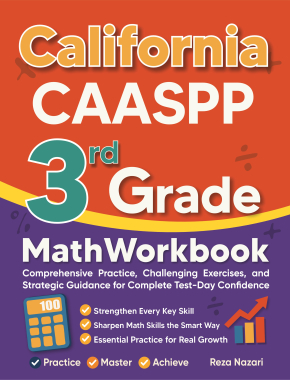

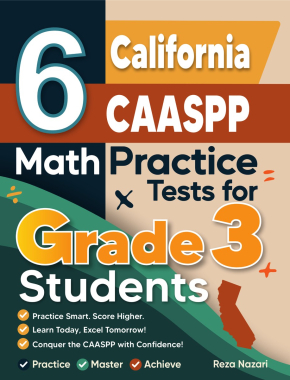
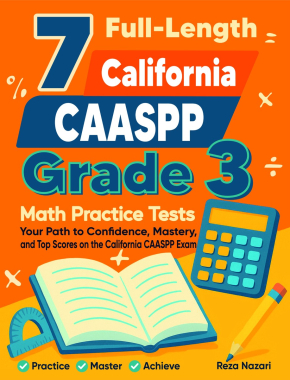
Choose the practice books that fit your child’s timeline. The bundle includes the study guide, workbook, and the five-, six-, and seven-test books.
This guide and the publisher’s books and activities are independently published resources, not official CAASPP materials. Find the free online practice test, short lessons, topic quizzes, printable worksheets, and links to Grade 3 flashcards in the California Grade 3 Math online center.
Official California sources and free practice
- California Department of Education: Smarter Balanced Assessment System — assessment overview and links to test information.
- California Department of Education mathematics standards and resources — California’s standards, framework, and assessment resources.
- California Assessment Accessibility Resources Matrix — current universal tools, designated supports, and accommodations.
- Free California Grade 3 Math center — lessons, quizzes, worksheets, and practice.
California standards and CAASPP guidance were checked against California Department of Education and Smarter Balanced sources on November 26, 2026. School testing windows and student supports can vary; confirm local details with your child’s school.
California Grade 3 CAASPP Math FAQs
Does a high score on this quiz predict my child’s CAASPP result?
This ten-question check is not a validated predictor of your child’s CAASPP result. A score of 90 or 100 is encouraging evidence for the selected skills in this check. Continue reviewing the full grade-level standards, try fresh examples, and ask the teacher about concerns.
Is the Grade 3 CAASPP math test timed?
The Smarter Balanced assessment is untimed. Schools may schedule it in sessions and set local routines, so confirm your child’s schedule with the school.
Can my child use a calculator?
The standard Grade 3 Smarter Balanced math test provides no on-screen calculator. If a calculator is required by your child’s IEP or Section 504 plan, ask the school’s testing coordinator about a non-embedded calculator request. Use for Grade 3 non-calculator items requires CDE approval as an unlisted resource and may affect score reporting; see the CDE accessibility FAQ.
How much should my child study each day?
Start with 15–20 minutes on three or four days each week, adjusting to the plan above. Include an example, a few problems, and time to discuss an answer. Shorten sessions when your child is tired and adapt the routine with the teacher’s advice.
What if my child feels anxious about the test?
Listen without dismissing the feeling. Keep practice predictable and low-pressure, rehearse a calming routine such as a slow exhale, and talk with the teacher about available supports or breaks.
What should we do after the test?
Talk about how it felt, recognize effort, and wait for the score report. Review results with the teacher alongside classwork, then choose one or two next learning goals. A score is information, not a judgment of your child.

Related to This Article
More math articles
- Your Math Buddy: How to Unravel the Mystery of Mutually Exclusive and Overlapping Probabilities
- 5th Grade Ohio’s State Tests Math Worksheets: FREE & Printable
- Grade 3 Math: Place Value (Ones, Tens, Hundreds, Thousands)
- 10 Most Common CBEST Math Questions
- Digital SAT Math Practice Test PDF with Answers (2027)
- The Ultimate 7th Grade TCAP Math Course (+FREE Worksheets)
- Navy Body Fat Calculator
- Liberty
- Division
- The Best Grade 3 ELA Practice Tests for Kansas Students







Leave a comment
Which part of this guide helped your child prepare? Tell us what worked, what was challenging, or what you would like us to cover next.