The Spanish-American and Philippine-American Wars
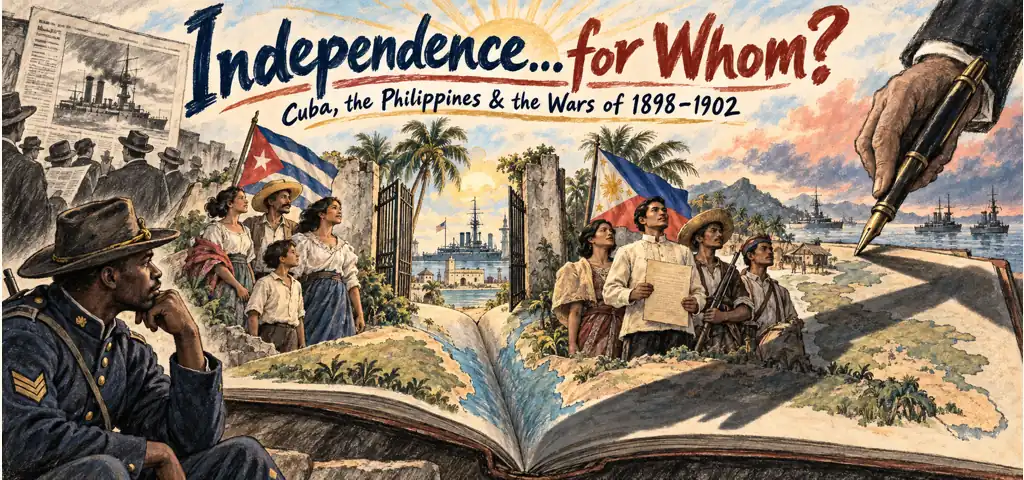
Chapter 6 of the CLEP History of the United States II study guide on Effortless Math covers The Spanish-American and Philippine-American Wars: the key terms, the core ideas, and worked examples showing how this topic is tested on the exam.
CLEP History of the United States II, Chapter 6
Cuban revolt created a humanitarian and strategic crisis
Cuban insurgents renewed their struggle against Spanish rule in 1895. Spain sent General Valeriano Weyler, who forced rural civilians into fortified towns to separate them from rebels. Hunger and disease killed many reconcentrados. Americans followed the conflict through newspapers, Cuban exile organizations, trade losses, and concern for nearby instability. Some demanded intervention on humanitarian grounds; others valued Cuban markets or feared disorder close to the Gulf. President McKinley initially sought a negotiated end to fighting. Spanish reconcentration, rather than a plan to invade the United States, drove much public outrage in 1896-1897.
Press events accelerated distrust
William Randolph Hearst's and Joseph Pulitzer's papers used sensational headlines, illustrations, and atrocity stories, although newspapers did not create the Cuban rebellion. In February 1898, Hearst's Journal published a private letter in which Spanish minister Enrique Dupuy de Lome mocked McKinley as weak and eager for popular approval. Days later the battleship Maine exploded in Havana harbor. A contemporary naval inquiry blamed an external mine; later investigations disputed the cause. "Remember the Maine" intensified pressure, but no conclusive evidence showed that Spain deliberately destroyed the ship.
Congress promised Cuba independence
After diplomacy failed, McKinley asked Congress for authority to intervene. Congress recognized Cuban independence and authorized force in April 1898. The Teller Amendment declared that the United States did not intend to annex Cuba and would leave control to its people after pacification. This pledge distinguished Cuba from later American acquisition of Puerto Rico, Guam, and the Philippines. It did not bar temporary military occupation or prevent later restrictions on Cuban sovereignty. The declaration helped frame the war as liberation rather than conquest.
A short war had two theaters
Commodore George Dewey destroyed the Spanish fleet in Manila Bay on May 1, before major fighting in Cuba. Filipino nationalists under Emilio Aguinaldo returned and fought Spanish forces, expecting independence. In Cuba, American troops including Black regular regiments and Roosevelt's volunteer Rough Riders fought near Santiago. Disease, poor supply, and administrative confusion caused more American deaths than Spanish fire. Spain's Atlantic fleet was destroyed as it left Santiago, and an armistice followed in August. The war lasted months, but victory produced decisions about peoples who had fought for their own independence.
The Treaty of Paris created an imperial decision
The December 1898 Treaty of Paris ended Spanish rule in Cuba, ceded Puerto Rico and Guam to the United States, and transferred the Philippines for $20 million. The Senate approved the treaty in February 1899 by one vote above the necessary two-thirds. William Jennings Bryan opposed empire but urged Democratic senators to ratify so the nation could decide Philippine policy in the 1900 election. Ratification did not itself settle whether Filipinos would receive independence. It supplied the legal transfer from Spain while armed conflict over sovereignty was already beginning.
Anti-imperialists attacked annexation from several directions
The American Anti-Imperialist League included figures as different as Mark Twain, Jane Addams, Andrew Carnegie, William James, and former politicians. They argued that governing without consent betrayed republican principles, colonial war would produce brutality, annexation entangled the nation in Asian rivalries, and racial hierarchy corrupted citizenship. Some opponents also expressed racist fears of incorporating nonwhite peoples or competition from their labor. Anti-imperialism was therefore not ideologically pure. Its central constitutional question remained: could a republic permanently rule subjects who had no equal voice in its government?
War with Filipino nationalists became guerrilla conflict
Fighting between American and Filipino troops began near Manila in February 1899. Aguinaldo's republic shifted from conventional operations to guerrilla war. American forces used village reconcentration, food controls, intelligence networks, and harsh interrogation; Filipino fighters also punished collaborators. Civilian suffering was extensive. Aguinaldo was captured in 1901, and President Roosevelt declared the insurrection ended in 1902, though resistance persisted in some regions. The conflict was not a continuation of combat against Spain. It pitted American colonial authority against nationalists who believed their wartime alliance entitled them to independence.
Cuban independence came with the Platt conditions
The United States occupied Cuba after Spain's defeat. Congress attached the Platt Amendment to an army appropriation in 1901 and required Cuba to incorporate its terms before occupation ended. The United States claimed a right to intervene to preserve Cuban independence and an adequate government, restricted Cuban treaty and debt choices, and obtained naval leases including Guantanamo Bay. The Teller Amendment had disclaimed annexation; the Platt Amendment created a constrained protectorate-like relationship. Formal independence in 1902 therefore coexisted with a continuing American intervention right until the amendment was abrogated in 1934.
Race shaped both war and occupation
Black regular troops played a major role in Cuba while facing segregation at home. Some Black leaders hoped military service would strengthen citizenship claims; others condemned a war that imposed racial rule abroad. White soldiers often carried domestic assumptions into the Philippines, and imperial rhetoric described Filipinos as children or savages. Filipino writers invoked the American Declaration of Independence against occupation. The wars connected the color line at home with the question of consent overseas, revealing a Progressive-era nation able to promise liberation and administer unequal rule at the same time.
test pledge against instrument
One document says the United States disclaims sovereignty over Cuba; another reserves an intervention right and naval stations.
The war transformed American reach
Victory removed Spain from most of its remaining empire and gave the United States durable positions in the Caribbean and Pacific. Yet the political outcomes varied: Cuba became formally independent under Platt restrictions; Puerto Rico and Guam became American possessions; the Philippines experienced a long colonial war; Hawaii was annexed during the conflict. The single label "Spanish-American War" can hide these distinct sovereignties. For each place, ask who claimed independence, what legal instrument followed, and whether residents became citizens, nationals, colonial subjects, or citizens of a constrained republic.
Watch the history in motion
This short lesson adds voices, images, and chronology to the ideas you just studied.
Video: The Spanish-American War, Explained [APUSH Review], Heimler's History.
Try four CLEP-style questions
- How could one war end with a promise of Cuban self-government but an American purchase of sovereignty over the Philippines?
- The peace treaty incorporated both societies but delayed statehood for the Philippines.
- Policymakers treated the Cuban disclaimer as governing all former Spanish possessions except Puerto Rico.
- The purchase placed the Philippines under the same independence timetable promised to Cuba.
- Spain retained effective sovereignty in both places while the United States collected customs temporarily.
- The United States applied different commitments in different theaters.
- A 1901 dispatch describes American troops pursuing supporters of an independence republic after Spain's defeat. For which historical question is the source most probative?
- Whether Spanish reconcentration helped justify intervention before the war
- Whether transferred sovereignty rested on postwar Filipino consent
- Whether press publication of a diplomat's letter inflamed American opinion
- Whether a prewar disclaimer defined Cuba's postwar naval relationship
- Whether Caribbean territorial administration followed the peace settlement
- An anti-imperialist invokes the Declaration of Independence while another warns against admitting nonwhite laborers. What does the pairing show?
- Opposition consistently rested on equal rights for colonized peoples.
- Racial restriction appeared among annexation supporters but not its critics.
- Republican consent arguments could coexist with racial exclusion among annexation's opponents.
- Constitutional objections displaced racial and economic arguments after ratification.
- Critics accepted colonial rule whenever it avoided immigration to the mainland.
- Black regular soldiers fight Spain in Cuba while a Black newspaper condemns American rule over Filipinos. Which interpretation best connects the two responses?
- Military service strengthened citizenship claims at home, while anticolonial criticism challenged racial hierarchy abroad.
- Criticism of Philippine rule prevented Black soldiers from using wartime service to support citizenship claims.
- Participation and criticism accepted racial hierarchy abroad while rejecting it inside the United States.
- Black regular regiments served in the Philippines but took no part in the Cuban campaign.
- Military service required Black Americans to endorse colonial government throughout the former Spanish empire.
Check your answers and reasoning
Independent preparation. CLEP is a registered trademark of the College Board, which does not endorse this lesson.

Related to This Article
More math articles
- Free Grade 3 English Worksheets for South Dakota Students
- Short-Run and Long-Run Aggregate Supply
- The Best Grade 5 Math Book for Utah Students
- SHSAT Math Practice Test Questions
- The budget line shows purchasing possibilities
- How to Solve Conditional and Binomial Probabilities?
- 5th Grade WVGSA Math Worksheets: FREE & Printable
- The Best Grade 5 Math Book for Kansas Students
- Slope from Two Points Practice — Free Drills
- ASVAB Math Course: Free Lessons, Worksheets and Practice













What people say about "The Spanish-American and Philippine Wars"?
No one replied yet.