South Carolina EOC Algebra 1 Free Worksheets: 60 Free Printable EOC-Ready Algebra 1 Worksheets with Keys
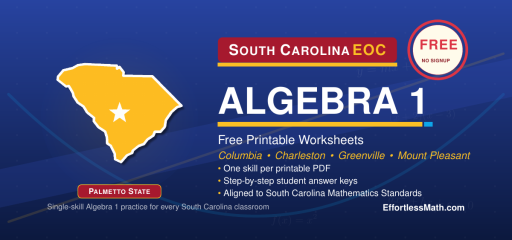
Algebra 1 has a reputation that scares more families than it should. The word algebra arrives on a ninth grader’s schedule like a small thunderclap, and parents who haven’t touched a linear equation in decades brace themselves to relearn factoring on a Tuesday night. The truth is gentler. Algebra 1 is not a single tall wall a student climbs in one go; it is a low staircase made of about sixty small steps, and almost every step is reachable on its own once you can see where the next foot goes. The course is hard to take in by chapter. It is surprisingly easy to take in by single skill.
That distinction matters in South Carolina, where Algebra 1 closes with the End-of-Course Examination Program, the EOCEP, weighted into a student’s final course grade, and where the difference between a confident May and a stressful one is usually the difference between studying broadly and studying narrowly. A Columbia ninth grader balancing marching band and homework, a Charleston student who took Algebra 1 a semester early, a Greenville teen retaking the course for a stronger transcript, a Mount Pleasant family running practice nights between sports and a job, every one of those situations is helped by the same thing. Smaller pages. Cleaner endings. One specific thing learned per sitting.
These 60 free PDFs are designed to be exactly that, one specific thing per sitting, finished in twenty minutes, checked honestly.
What’s on this page
Sixty single-skill worksheets aligned to the South Carolina College- and Career-Ready Standards for Algebra 1. The set covers the full sweep of the EOCEP course: expressions and properties of operations, every variety of linear equation, inequalities and absolute value, functions with their domains and ranges, sequences, slope and the various forms of a line, systems of equations and inequalities, exponent rules, polynomial operations, factoring, three methods for solving quadratics, and a closing run through statistics, probability, and exponential models. Each topic gets its own PDF.
Every worksheet opens with a one-page Quick Review, the skill stated in plain English, one fully worked example with reasoning visible at each step, and a short note flagging the mistake students most often make. After that come twelve practice problems that climb from a friendly warm-up to the level of difficulty South Carolina EOCEP items actually reach. The final page is a student-facing answer key written like a patient tutor, short enough to read in a minute, complete enough to teach.
Foundations of Algebra
The first unit swaps pure arithmetic for variables, building expressions, evaluating them carefully, and applying the basic properties of operations. In Columbia classrooms it tends to separate confident students from hesitant ones.
- Variables, Expressions, and Properties
- Order of Operations and Evaluating Expressions
- Simplifying Algebraic Expressions
- Introduction to Equations and Solutions
- Personal Financial Literacy
Solving Linear Equations
Students learn to undo operations in the right order, building from simple equations up to literal equations solved for any letter. Steady practice now makes the EOC feel far more manageable later.
- Solving One-Step Equations
- Solving Two-Step Equations
- Solving Multi-Step Equations
- Equations with Variables on Both Sides
Inequalities and Absolute Value
The chapter covers one- and multi-step inequalities, compound statements, and absolute-value equations and inequalities. Master it early and the rest of the South Carolina course leans on it with ease.
- Solving One-Step Inequalities
- Solving Multi-Step Inequalities
- Compound Inequalities
- Absolute Value Equations
Relations, Functions, and Sequences
Relations give way to functions here, and sequences show how a single rule can generate a whole list of values. It’s a frequent early hurdle for learners in Columbia and across the state.
- Relations and Functions
- Function Notation and Evaluating Functions
- Domain and Range
- Graphing Functions and Transformations
- Arithmetic Sequences as Linear Functions
- Geometric Sequences
- Piecewise Functions
- Combining Functions
- Inverse Functions
Linear Functions and Their Graphs
Straight lines in full: slope and rate of change, the major equation forms, parallel and perpendicular lines, and variation. These worksheets give South Carolina students focused, low-pressure practice.
- Slope and Rate of Change
- Slope-Intercept Form
- Point-Slope Form
- Standard Form of a Linear Equation
- Writing Linear Equations from Graphs and Tables
- Parallel and Perpendicular Lines
- Inverse Variation
- Understanding Graphs as Solution Sets
Systems of Equations and Inequalities
Students juggle multiple equations, choosing among graphing, substitution, and elimination, and apply systems to real situations. For South Carolina students, fluency here shows up directly on the EOC.
- Solving Systems by Graphing
- Solving Systems by Substitution
- Solving Systems by Elimination
- Applications of Systems of Equations
- Systems of Linear Inequalities
- Solving Linear-Quadratic Systems
Exponents, Polynomials, and Real Numbers
This chapter handles exponents, polynomial arithmetic, special products, and the structure of the real numbers. Getting comfortable here pays off all the way through the EOC.
- Properties of Exponents
- Adding and Subtracting Polynomials
- Multiplying Polynomials
- Special Products of Polynomials
Factoring
Factoring techniques take center stage, from greatest common factor to trinomials and difference-of-squares patterns. Time spent here is time saved when the EOC rolls around.
- Greatest Common Factor and GCF Factoring
- Factoring Trinomials: \(x^2 + bx + c\)
- Factoring Trinomials: \(ax^2 + bx + c\)
- Factoring Special Products
Quadratic Functions and Equations
From parabola shapes to the quadratic formula, students learn to handle second-degree equations end to end. Across South Carolina, this is one of the skills that rewards regular reps.
- Graphing Quadratic Functions
- Characteristics of Quadratic Functions
- Solving Quadratics by Factoring
- Solving Quadratics by Completing the Square
Statistics and Probability
Making sense of data: center and spread, histograms and box plots, two-way tables, scatter plots, and basic probability. It is worth the extra reps for South Carolina learners aiming for a strong score on the EOC.
- Scatter Plots and Correlation
- Lines of Best Fit and Predictions
- Counting Principles
- Probability
- Two-Way Frequency Tables
Exponential Functions and Modeling
Students model exponential change, graph it, and weigh it against linear and quadratic behavior. Columbia families can use these pages to lock the skill in before it’s tested.
More Topics
- Absolute Value Inequalities
- Direct Variation
- Exponential Decay
- Graphing Cube Root Functions
- Graphing Square Root Functions
How to use these worksheets at home
Use the order of the course to your advantage. Algebra 1 is full of natural pairings, and the trick to making the year feel easier is to use those pairings deliberately. Work “Solving Two-Step Equations” early in a week and “Solving Multi-Step Equations” a day or two later, the second is the first with one additional move. Schedule “Slope and Rate of Change” right before “Slope-Intercept Form,” so the slope number a student just computed walks directly into the m of y = mx + b. Sit “Factoring Trinomials” the night before “Solving Quadratics by Factoring,” and the second worksheet feels like the next sentence of the first instead of a separate skill.
Treat each PDF as one finished thing. A common trap is to print four worksheets at once and end the night with two and a half half-done pages. A single completed worksheet teaches the brain something stable; three abandoned ones teach it that math is overwhelming. Pick the one skill that matters most this week, print just that PDF, and consider the night a success the moment the page is done and graded. A South Carolina teenager will come back to a sheet they finished cleanly far more readily than to a stack of partial pages.
The answer key is the quietest part of the worksheet and the most important. Hand it over after the work is done, not before, and let your student grade themselves. Circle any miss, read the short explanation, and rewrite the corrected version on the back. That small loop is the engine of progress, and over the months leading to the EOCEP window, it adds up to far more than any cram weekend can.
A note about the EOCEP at Algebra 1
The South Carolina End-of-Course Examination Program, EOCEP, is administered at the end of an Algebra 1 course, with the spring window being the one most students sit. Under state policy, the EOCEP score counts as 20 percent of the student’s final grade in the course, which makes it one of the more consequential single tests a ninth or tenth grader will take. The exam is built on the South Carolina College- and Career-Ready Standards for Algebra 1, the same framework these worksheets are aligned to, so the items on the test and the items on these PDFs are drawn from the same source.
The EOCEP asks for working fluency, not memorization. A student needs to solve linear equations and inequalities efficiently, move between functions presented as tables, graphs, and equations, solve systems by graphing, substitution, and elimination, work with exponents and radicals, factor and solve quadratic equations by more than one method, and read a real-world situation algebraically. Because each PDF here isolates a single standard, the set lets you use the spring as a checklist. Print a sheet, see how it goes, and let one piece of evidence, a clean page or a stumbling one, decide what to print next. That kind of evidence-led study is much faster than re-reading a chapter, and over a couple of months it adds up to genuine readiness.
A short closing
The EOCEP looks heavier from a distance than it does up close. Bookmark this page, print the one PDF whose title names a skill that feels almost-but-not-quite solid, and let your South Carolina student start there tonight. By the time the spring window opens, the staircase will have built itself behind you a step at a time, and the test on the screen will look very much like the work that has been on your kitchen table all year.
New to Algebra? Start with the basics


Related to This Article
More math articles
- Free Grade 4 English Worksheets for ACT Aspire Students
- Free Grade 6 English Worksheets for Massachusetts Students
- Free Grade 6 English Worksheets for Oklahoma Students
- The Best Grade 4 ELA Practice Tests for South Dakota Students
- The Best Grade 4 ELA Practice Tests for Massachusetts Students
- Reversing Derivatives Made Easy: Power Rule of Integration
- Inspectors general
- Tracking polls
- 4th Grade OST Math Practice Test Questions
- Types of Evidence











What people say about "South Carolina EOC Algebra 1: Free Worksheets"?
No one replied yet.