Free Grade 6 English Worksheets for Alabama Students
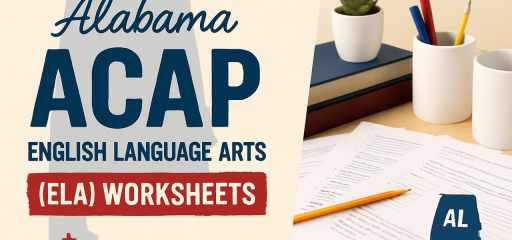
Anyone who has lived through an Alabama summer knows the way humidity changes how an afternoon feels, the same hour at the kitchen table in July is a different animal than the same hour in October. Sixth-grade reading does something similar. The texts your child read in fifth grade and the texts they bring home in November look almost the same on the surface, but they ask for something denser underneath. Inference moves from a polite question at the end of a passage to the engine that runs the whole quiz.
For Alabama families, this is the year the gear shifts. Teachers from Mobile to Huntsville will tell you the same thing in different words: a kid who could “get the gist” in fifth grade now has to point at a sentence and explain why it proves their answer. That is a real skill, and it does not appear automatically. It comes from practice on small, repeatable things.
This page collects those small things in one place. Forty-six free worksheets, every one of them lined up with the Alabama Course of Study for English Language Arts. They are not a curriculum. They are the kind of one-skill page you hand a sixth grader before homework starts so the rest of the night goes smoother.
What’s on this page
Each PDF here targets one Grade 6 skill. The first page is a short Quick Review your child can actually read on their own. The practice items follow, and the last page is the answer key with explanations written so a sixth grader can understand what went wrong without a parent having to translate.
No login. No email. Click, print, work.
Reading: Literature
- Citing Textual Evidence and Drawing Inferences, [RL.6.1] name the inference, then point at the exact line that earns it
- Theme and Objective Summary, [RL.6.2] say what the whole story is teaching in one careful sentence
- Plot, Episodes, and Character Change, [RL.6.3] track the small moments that make a character different by the end
- Figurative Language, Connotation, and Tone, [RL.6.4] the feeling words carry, not just their dictionary meaning
- Structure: How a Scene or Stanza Builds the Whole, [RL.6.5] every chunk has a job in the bigger story
- Developing the Narrator’s Point of View, [RL.6.6] how the writer makes you see the world through one character
- Reading vs. Watching: Comparing Versions, [RL.6.7] what the book does that the movie cannot, and the other way around
- Comparing Stories Across Forms and Genres, [RL.6.9] same idea, different shape, what does each version do best
Reading: Informational Text
- Citing Evidence and Drawing Inferences in Nonfiction, [RI.6.1] quote the article line that nails the conclusion
- Central Idea and Objective Summary in Nonfiction, [RI.6.2] the article’s main point in a clean sentence
- How Ideas and Events Are Developed, [RI.6.3] how a writer introduces and then elaborates on a point
- Word Meaning in Nonfiction: Figurative, Connotative, Technical, [RI.6.4] three different ways a single word can be doing work
- Text Structure: How Sections Fit Together, [RI.6.5] cause, effect, problem, solution, comparison
- Author’s Point of View and Purpose, [RI.6.6] the angle the writer is taking and why
- Integrating Information from Text, Visuals, and Data, [RI.6.7] combine the words, the chart, and the photo
- Evaluating Arguments and Claims, [RI.6.8] separate the claim from the support and judge how strong the support really is
- Comparing Two Authors on the Same Topic, [RI.6.9] different facts, different angles, same subject
Writing
- Argument Writing: Claim, Reasons, Evidence, [W.6.1] defend a position with reasons and quotes
- Informative and Explanatory Writing, [W.6.2] teach a reader something clearly and in order
- Narrative Writing, [W.6.3] hook, pacing, dialogue, sensory description, real ending
- Clear Writing for Task, Purpose, and Audience, [W.6.4] match the writing to who is reading it
- Planning, Revising, and Editing, [W.6.5] drafts get better in passes, not one shot
- Short Research Projects, [W.6.7] a focused question, multiple sources, a tidy write-up
- Gathering, Evaluating, and Citing Sources, [W.6.8] which sources to trust and how to credit them
Speaking & Listening
- Collaborative Discussions, [SL.6.1] show up prepared, listen, build on what someone said
- Interpreting Diverse Media, [SL.6.2] what each format does well and what it leaves out
- Analyzing a Speaker’s Argument, [SL.6.3] find the claim, the reasons, and the weak spots
- Presenting Claims and Findings, [SL.6.4] open with the point, walk through the evidence, end clean
- Adapting Speech to Context, [SL.6.6] the talk you give a friend is not the talk you give a principal
Grammar
- Pronoun Case: Subjective, Objective, and Possessive, [L.6.1a] when to use I vs. Me vs. My, and why
- Intensive Pronouns, [L.6.1b] myself, themselves, and how they add emphasis
- Avoiding Shifts in Pronoun Number and Person, [L.6.1c] pick one person and one number, then stay there
- Vague Pronouns and Unclear Antecedents, [L.6.1d] every he, she, and they needs a noun a reader can point at
- Recognizing and Improving Non-Standard English, [L.6.1e] when to keep your voice and when to switch into school English
Conventions: Punctuation, Spelling
- Punctuation: Commas, Parentheses, and Dashes, [L.6.2a] three ways to drop in extra information
- Spelling Grade-Appropriate Words, [L.6.2b] homophones and the words sixth graders miss most
Knowledge of Language and Style
- Varying Sentence Patterns for Style, [L.6.3a] combine, expand, and rearrange to keep writing from sounding flat
- Consistency in Style and Tone, [L.6.3b] pick a register, hold it from first sentence to last
Vocabulary and Word Study
- Using Context Clues, [L.6.4a] slow down at the strange word and look at the words around it
- Greek and Latin Roots and Affixes, [L.6.4b] port, dict, tele, photo, and the doors they open
- Using Dictionaries and Thesauruses Effectively, [L.6.4c] match the tool to the question you actually have
- Verifying Word Meaning, [L.6.4d] check your guess instead of trusting it
- Figurative Language: Personification and More, [L.6.5a] the language moves that bring writing alive
- Word Relationships: Cause-Effect, Part-Whole, Category, [L.6.5b] patterns that connect words to each other
- Connotation: Shades of Meaning, [L.6.5c] thin, slender, skinny, same idea, different feeling
- Academic and Domain-Specific Vocabulary, [L.6.6] the words that travel across subjects and the words tied to one field
How to use these worksheets at home
Sixth graders in Alabama come home tired. Between block-scheduling, athletics, marching band practice that runs into the parking lot lights, and the eternal weeknight question of supper, the homework window is small. Treat that as a feature, not a problem.
Pick one worksheet at a time. Ten or twelve focused minutes on a Wednesday will do more than a sprawling weekend cram. When your child gets something wrong, hand them the answer key and ask them to read the explanation out loud. The reading-aloud is what cements it; the silent staring at red marks teaches almost nothing.
If a worksheet does not click on a Tuesday, set it aside. Try a different one in the same group later in the week. The skill itself does not vanish, your sixth grader just needs another approach to it. Spacing the attempts is what makes the practice stick, especially with reading skills like inference and central idea that build slowly over months.
A note about ACAP Summative ELA
The ACAP Summative ELA, the Grade 6 English portion of Alabama’s spring assessment, is built on the Alabama Course of Study for English Language Arts. That means the standards your child has been learning since August are exactly what the test asks about. The reading sections lean heavily on textual evidence (point at the line that proves your answer), central idea and theme, and word meaning in context. The writing sections expect organized responses with a real claim and real support.
Nothing on this page is ACAP prep in the cram sense. These worksheets work because they keep the everyday Course of Study skills warm. By the time the spring window arrives, your child has already practiced the moves the test is asking for. They just have not seen this particular passage yet.
Want everything in one bundle?
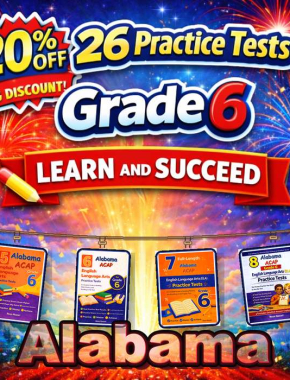
Some Alabama families want one consolidated resource for the whole year rather than a long page of single-skill PDFs. The state’s Grade 6 ELA Preparation Bundle is built for that. It pulls full-length practice tests together with thorough answer explanations so your sixth grader can rehearse the whole shape of the assessment, not just the parts.
Alabama Grade 6 ELA Preparation Bundle, four practice-test books, 26 unique full-length tests, complete answer keys with explanations.
A short closing
Sixth grade is a long year, and reading practice should feel like a steady drip, not a flood. Bookmark this page, pull a worksheet when you have fifteen quiet minutes, and come back the next time your child says “I have nothing to read.” There is always one more skill worth one more conversation.
Best Bundle to Ace the Alabama ACAP Grade 6 ELA
Looking for the best resource to help your kid ace the Alabama ACAP? Try this bundle, four full practice-test books (5 + 6 + 7 + 8 tests) covering the same Grade 6 reading, writing, and language skills your child is already learning. Instant PDF download, answer keys included.

Related to This Article
More math articles
- Head of state
- Overview of the SHSAT Mathematics Test
- FREE 6th Grade MCAS Math Practice Test
- Open-Economy Macroeconomics and Exchange Rates
- 5th Grade STAAR Math Practice Test Questions
- Math Mastery: Effortless Math Learning
- What Are Functions in Math? A Plain-English Guide
- How to Inscribe a Regular Polygon within a Circle
- Intelligent Math Puzzle – Challenge 84
- Perimeters and Areas of Rectangles





What people say about "Free Grade 6 English Worksheets for Alabama"?
No one replied yet.