CLEP U.S. History I 011: Puritans, Covenant Communities, and Massachusetts
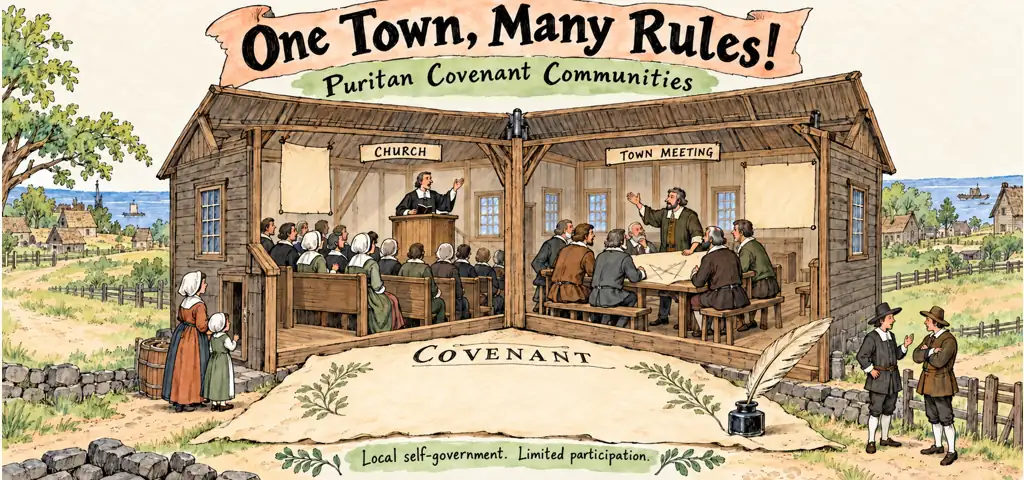
Lesson 3.1 of Chapter 3 of the U.S. History to 1877 study guide on Effortless Math covers CLEP U.S. History I 011: Puritans, Covenant Communities, and Massachusetts: the key terms, the core ideas, and worked examples showing how this topic is tested on the exam.
U.S. History to 1877 | Chapter 3 | Lesson 3.1
Puritans wanted to complete the English Reformation by removing practices they associated with Catholicism. Some Separatists founded Plymouth in 1620, but the larger Puritan migration built Massachusetts Bay after 1630. John Winthrop and other leaders imagined a covenanted community whose disciplined example would demonstrate reformed Christianity. The colony was not founded for modern religious freedom. Its leaders wanted enough autonomy to construct a particular religious society.
Puritan theology stressed human sinfulness, God’s sovereignty, and the hope of saving grace. A “visible saint” could describe a person whose conversion account persuaded church members, although no human could know salvation with certainty. Full church membership carried social importance. Massachusetts linked civil participation to male church membership for much of the seventeenth century, and magistrates enforced moral regulations. Congregations selected ministers and managed many church affairs rather than submitting to bishops.
The Great Migration brought families, not chiefly solitary young laborers. Towns commonly clustered houses near a meetinghouse and allocated fields around them. Church covenants, town agreements, and the colony’s charter created overlapping layers of authority. Town meetings permitted eligible men to decide local taxes, roads, and land use. This was meaningful self-government within a narrow electorate, not political equality.
Puritan order faced strain from the beginning. Economic differences grew, younger generations sometimes could not describe the conversion experience required for full membership, and territorial expansion brought war with Native peoples. The Half-Way Covenant of 1662 allowed the baptized children of members a partial relationship to the church, helping congregations retain families without abandoning the conversion ideal entirely. Adaptation preserved the community precisely because the original design could not remain unchanged.
Watch, then test the claim
Use this lesson from Study Hall to review the period and its central historical problem. Pause when the video reaches the turning point named above.
Video: Puritans & Pilgrims in New England | US History to 1865 | Study Hall, Study Hall.
Check your understanding
- Which aim best distinguishes Massachusetts Bay’s Puritan founders from colonies organized mainly around a staple export?
- protecting private worship while excluding church influence from civil life
- restoring episcopal supervision through Crown-appointed bishops
- building a reformed commonwealth through covenanted churches and civic discipline
- recruiting temporary field labor for a single Atlantic commodity
- replacing congregational membership with unrestricted adult suffrage
- What institutional problem did the Half-Way Covenant address?
- Quaker meetings were drawing most members away from Congregational churches.
- Ministers sought to restrict baptism to members of clerical households.
- Civil voters demanded that churches abandon conversion narratives for membership.
- Many baptized descendants lacked full membership, complicating their children’s baptism.
- Royal officials ordered Massachusetts churches to adopt Anglican sacramental rules.
- Select all that apply. Which institutions linked Puritan covenant ideas to public order?
- freeman voting based on property rather than church standing
- gathered churches admitting members after examination
- town meetings managing taxes, roads, and land
- magistrates enforcing communal moral rules
- parish vestries presenting ministers to congregations
- Explain how covenant ideas shaped both church and civic life.
Write a brief response using a named fact from the lesson.
Open the answers and reasoning
Independent preparation. CLEP is a registered trademark of the College Board, which does not endorse this lesson.

Related to This Article
More math articles
- The Ultimate TABE Math Formula Cheat Sheet
- How to Master the Pythagorean Theorem and Right Triangles
- The Best Grade 8 Math Book for Wisconsin Students
- How to Find Similar and Congruent Figures?
- 6th Grade NYSE Math Worksheets: FREE & Printable
- How to Identify Graphs of Basic Functions
- SES, Income, Wealth, Debt, and Prestige
- How to Add Polynomials to Find Perimeter
- Sentence Fragments
- Dividing with Remainders for 4th Grade







What people say about "Puritans and Covenant Communities"?
No one replied yet.