Point-Slope Form Calculator (From a Point and Slope or Two Points, with Steps)
AlgebraFreeNo sign-up
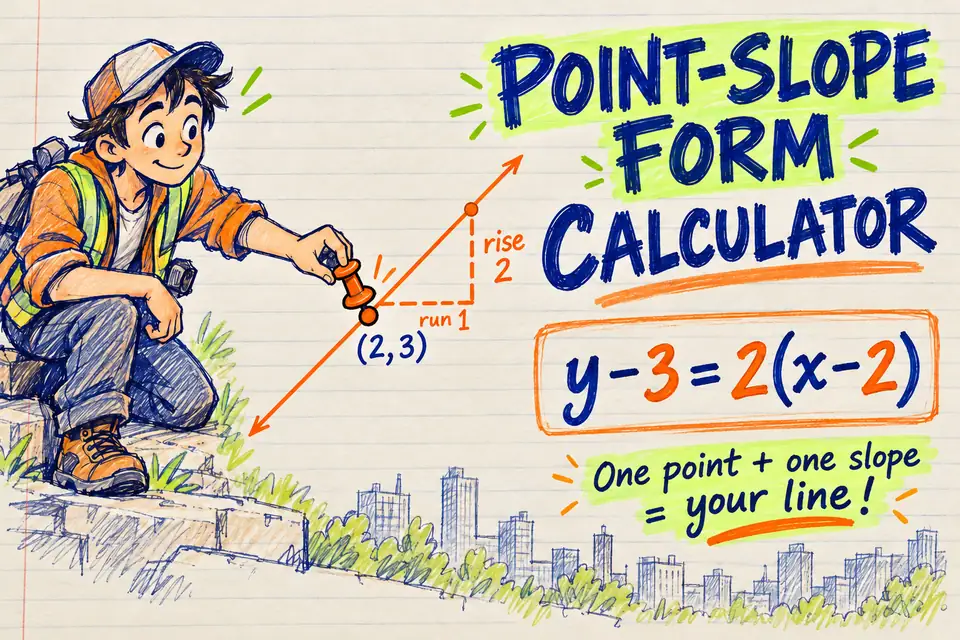
To write a line in point-slope form, put one point (x1, y1) and the slope m into y − y1 = m(x − x1), and this point-slope form calculator does that for you from a point and a slope or from two points. It also gives the slope-intercept and standard forms with exact fractions, shows every step, and graphs the line, so you can check your own work line by line.
To turn a point-slope equation into y = mx + b, use the Slope Intercept Form Calculator. It shows the slope, the y-intercept and the steps.
How to use the Point-Slope Form Calculator
- Choose A point and the slope or Two points.
- Type the coordinates and, if you have it, the slope. Integers, decimals and fractions such as -5/3 all work. For a vertical line, type undefined as the slope.
- Press Calculate or the Enter key.
- Read the point-slope, slope-intercept and standard form answers, then follow the numbered steps and the graph to see where each number came from.
- Scroll down to the practice questions to try the same skills on your own.
How to write point-slope form by hand
Point-slope form is y − y1 = m(x − x1). The letter m is the slope, and (x1, y1) is any point on the line. The form comes straight from the slope formula: if (x, y) is any other point on the line, then (y − y1) ÷ (x − x1) = m, and multiplying both sides by (x − x1) gives the equation.
Example 1: a point and a slope
Write the equation of the line through (3, −2) with slope 4.
- Substitute x1 = 3, y1 = −2 and m = 4: y − (−2) = 4(x − 3).
- Clean up the double negative: y + 2 = 4(x − 3). That is the point-slope form.
- For slope-intercept form, distribute: y + 2 = 4x − 12. Subtract 2 from both sides: y = 4x − 14.
- For standard form, move the x-term to the left: −4x + y = −14. Multiply by −1 so A is positive: 4x − y = 14.
- Check with the original point: 4(3) − (−2) = 12 + 2 = 14. It works.
Example 2: two points
Write the equation of the line through (−2, 1) and (4, 5).
- Find the slope: m = (5 − 1) ÷ (4 − (−2)) = 4 ÷ 6 = 2/3.
- Use the first point: y − 1 = 2/3(x + 2).
- Distribute: y − 1 = 2/3 x + 4/3. Add 1, which is 3/3: y = 2/3 x + 7/3.
- Standard form: −2/3 x + y = 7/3. Multiply every term by 3 to clear the fractions: −2x + 3y = 7. Make A positive: 2x − 3y = −7.
- Check with the second point: 2(4) − 3(5) = 8 − 15 = −7. It works.
If you start from the other point instead, you get y − 5 = 2/3(x − 4). It looks different, but distributing gives y = 2/3 x − 8/3 + 5 = 2/3 x + 7/3, the same line. Any point on the line is a valid choice.
If the slope step is where you get stuck, the slope calculator walks through rise over run on its own, and the simplify fractions calculator helps with reducing answers like 4/6.
Quick reference: forms of a linear equation
| Form | Equation | Best used when |
|---|---|---|
| Point-slope | y − y1 = m(x − x1) | You know a point and the slope, or two points |
| Slope-intercept | y = mx + b | You want to graph quickly or read the y-intercept |
| Standard | Ax + By = C (integers, A ≥ 0) | You want integer coefficients or the x- and y-intercepts |
| Horizontal line | y = b | The slope is 0 and every point has the same y-value |
| Vertical line | x = a | The slope is undefined and every point has the same x-value |
Common mistakes to avoid
- Sign errors with negative coordinates. The form has minus signs built in, so a point like (−5, −1) gives y + 1 = m(x + 5), not y − 1 = m(x − 5).
- Mixing up the order in the slope formula. If you subtract y2 − y1 on top, you must subtract x2 − x1 on the bottom. Reversing only one of them flips the sign of the slope.
- Putting rise and run upside down. Slope is the change in y divided by the change in x.
- Taking x1 from one point and y1 from the other. Both coordinates must come from the same point.
- Distributing to only one term. In 2/3(x + 2), the 2/3 multiplies both x and 2.
- Forcing a vertical line into point-slope form. When x1 = x2, the run is 0 and the slope is undefined, so the answer is simply x = a.
Where point-slope form fits in the curriculum
Students usually meet point-slope form in Algebra 1, right after slope-intercept form. It builds on Common Core standard 8.F.B.4, which asks students to find the rate of change and initial value of a linear function from two (x, y) values, and on 8.EE.B.6, which connects slope to the equations y = mx and y = mx + b. In high school it supports A-CED.A.2, creating equations in two variables to represent relationships.
It is the most direct form when a problem hands you a point and a rate of change. A taxi that charges $2.50 per mile and costs $13 for a 4-mile ride gives the point (4, 13) and slope 2.5, so y − 13 = 2.5(x − 4) right away. Later, in calculus, the equation of a tangent line is written in exactly this form.
Check your answer
Plug each given point into your final equation. Both sides should match. With two points, test the point you did not use to write the equation, because that is the one that catches slope mistakes. You can also compare slopes: in slope-intercept form, the number in front of x must equal the slope you found. For more practice finding slopes first, try the slope practice questions.
Worked examples: point-slope form from a point and a slope
Point-slope form is y − y₁ = m(x − x₁). Put the point’s coordinates in for x₁ and y₁ and the slope in for m. Subtracting a negative number turns into adding, so a point such as (14, −14) gives y + 14.
| Point and slope | Point-slope form | Slope-intercept form |
|---|---|---|
| (14, −14), m = 4 | y + 14 = 4(x − 14) | y = 4x − 70 |
| (13, −8), m = 2/3 | y + 8 = (2/3)(x − 13) | y = (2/3)x − 50/3 |
| (−15, −3), m = −7/3 | y + 3 = −(7/3)(x + 15) | y = −(7/3)x − 38 |
| (14, −7), m = −2 | y + 7 = −2(x − 14) | y = −2x + 21 |
| (−13, −15), m = 1 | y + 15 = x + 13 | y = x − 2 |
| (6, 7), m = −3 | y − 7 = −3(x − 6) | y = −3x + 25 |
| (−2, 4), m = 3 | y − 4 = 3(x + 2) | y = 3x + 10 |
| (−7, 6), m = 0 | y − 6 = 0 | y = 6 (a horizontal line) |
From two points. For (1, −3) and (4, −15), first find the slope: m = (−15 − (−3)) / (4 − 1) = −12/3 = −4. Then use either point: y + 3 = −4(x − 1), which simplifies to y = −4x + 1. Using the other point gives y + 15 = −4(x − 4), the same line. For (4, −6) and (6, −4), m = 2/2 = 1, so y + 6 = x − 4 and y = x − 10.
Check any answer by putting the point back in: for y = 4x − 70 and x = 14, y = 56 − 70 = −14. Enter the point and slope, or two points, in the calculator above to see these steps for your own numbers.
Point-slope form practice quiz: 10 questions
Test yourself with 10 multiple-choice questions. Choose an answer and press Submit to see if you are right and why. Your score appears at the end.
Point-slope form is y − y₁ = m(x − x₁). Substituting x₁ = 2, y₁ = 5 and m = 3 gives y − 5 = 3(x − 2).
Slope = (8 − 2) ÷ (3 − 1) = 3. Using (1, 2): y − 2 = 3(x − 1). Using (3, 8) would give y − 8 = 3(x − 3), the same line.
y − (−3) = (1/2)(x − 0), which is y + 3 = (1/2)x. In slope-intercept form that is y = (1/2)x − 3.
Substitute x = 4, y = −1: −1 + 1 = 0 and 5(4 − 4) = 0, so the equation holds. The others do not.
Parallel lines have the same slope, 4. Through (−1, 2): y − 2 = 4(x − (−1)) = 4(x + 1). Slope −1/4 would be perpendicular.
Quiz complete
Frequently asked questions
What is point-slope form?
Point-slope form is a way to write the equation of a straight line: y − y1 = m(x − x1), where m is the slope and (x1, y1) is a known point on the line. It is useful because you can write it as soon as you know one point and the slope.
How do you write point-slope form from two points?
First find the slope with m = (y2 − y1) ÷ (x2 − x1). Then substitute that slope and either one of the two points into y − y1 = m(x − x1). For (−2, 1) and (4, 5), the slope is 2/3 and one answer is y − 1 = 2/3(x + 2).
Does it matter which point I use?
No. Different points give equations that look different, but they describe the same line. If you simplify both to slope-intercept form, you get the same y = mx + b. Teachers usually accept either version unless the problem names a point.
How do you convert point-slope form to slope-intercept form?
Distribute the slope on the right side, then move the constant from the left side to the right. For y + 2 = 4(x − 3), distributing gives y + 2 = 4x − 12, and subtracting 2 gives y = 4x − 14.
Can a vertical line be written in point-slope form?
No. A vertical line has an undefined slope, so there is no number to put in place of m. Its equation is x = a, where a is the x-coordinate shared by every point on the line. A horizontal line is fine: its slope is 0, so y − y1 = 0(x − x1), which simplifies to y = y1.
What is the difference between point-slope form and slope-intercept form?
Both describe the same line. Point-slope form uses any point on the line, while slope-intercept form, y = mx + b, uses the specific point where the line crosses the y-axis. Point-slope form is faster to write; slope-intercept form is easier to graph and compare.
More algebra calculators

Related to This Article
More math articles
- Portable Power Tools: Action, Control, and Safety
- 4th Grade MCAP Math Worksheets: FREE & Printable
- Free Grade 6 English Worksheets for North Dakota Students
- Model Magic: Visualizing Division with Two-digit Divisors
- 4th Grade TNReady Math Worksheets: FREE & Printable
- How to Solve Rational Equations? (+FREE Worksheet!)
- How to Identify Statistical Questions
- Montana Algebra 1 Free Worksheets: Free Printable Algebra 1 PDF Worksheets with Full Solutions
- Epworth Sleepiness Scale Calculator
- Two-party system and electoral rules





What people say about "Point-Slope Form Calculator: Two Points or Point and Slope"?
No one replied yet.