Montana Algebra 1 Free Worksheets: Free Printable Algebra 1 PDF Worksheets with Full Solutions
If you have ever watched a beginner read music for the first time, you have already seen what learning algebra looks like. The notes on the page are not random. They sit in a grid, with a key signature and a time signature that tell you how to read every line. Before you know any of that, the page is overwhelming. After you know it, the same page becomes a sentence. Algebra 1 is the year a student learns to hear math the way a musician hears a score: as something organized, predictable, and beautiful in its structure.
That is a big idea, and Montana students get to it the same way everyone else does, one small piece at a time. A linear equation gets balanced. A point gets plotted. A function gets evaluated. Slowly, those small motions start to feel like a single skill instead of fifty disconnected ones. Whether your student is taking the course in Billings, finishing problem sets in Missoula, walking home from class in Great Falls, or studying at a kitchen table outside Bozeman, the path is the same: a worked example, a few problems, an honest answer key, repeat.
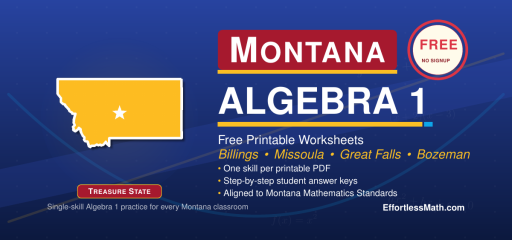
These 72 worksheets are built to make that loop short and clean. Each PDF is exactly one skill, no detours, no surprises.
What’s on this page
Seventy-two single-skill PDFs aligned to Montana’s Algebra 1 standards. The whole course is here in small, focused pieces: solving equations and inequalities, slope and lines, linear and exponential functions, systems of equations, exponents and radicals, factoring, quadratic equations and functions. One sheet covers one standard, beginning to end.
Every PDF opens with a one-page Quick Review, the skill in plain language and one example solved with the reasoning visible at every step. Then twelve practice problems climb from straightforward to thoughtfully harder. The final page is a student-facing answer key written in a warm, tutoring tone, the kind a fifteen-year-old can actually learn from on their own.
Foundations of Algebra
Algebra opens by turning words and quantities into symbols, then leaning on the order of operations and core properties to keep them honest. Across Montana, this is one of the skills that rewards regular reps.
- Variables, Expressions, and Properties
- Order of Operations and Evaluating Expressions
- Simplifying Algebraic Expressions
- Introduction to Equations and Solutions
- Personal Financial Literacy
Solving Linear Equations
Equation work begins in earnest, balancing both sides through one-, two-, and multi-step problems and variables that appear on each side. It is worth the extra reps for Montana learners aiming for a strong score on the Montana Algebra 1 course.
- Solving One-Step Equations
- Solving Two-Step Equations
- Solving Multi-Step Equations
- Equations with Variables on Both Sides
- Literal Equations and Formulas
Inequalities and Absolute Value
Students extend equation skills to inequalities, learn exactly when the inequality flips, and treat absolute value as distance. Billings families can use these pages to lock the skill in before it’s tested.
- Solving One-Step Inequalities
- Solving Multi-Step Inequalities
- Compound Inequalities
- Absolute Value Equations
Relations, Functions, and Sequences
Functions, their notation, and their domains and ranges anchor the chapter, with sequences as a first concrete example. In Billings classrooms it tends to separate confident students from hesitant ones.
- Relations and Functions
- Function Notation and Evaluating Functions
- Domain and Range
- Graphing Functions and Transformations
- Arithmetic Sequences as Linear Functions
- Geometric Sequences
- Comparing Functions
- Piecewise Functions
- Combining Functions
- Inverse Functions
Linear Functions and Their Graphs
Lines get the full treatment, from slope and its meaning to the equation forms and variation models built on them. Steady practice now makes the Montana Algebra 1 course feel far more manageable later.
- Slope and Rate of Change
- Slope-Intercept Form
- Point-Slope Form
- Standard Form of a Linear Equation
- Writing Linear Equations from Graphs and Tables
- Parallel and Perpendicular Lines
- Inverse Variation
- Understanding Graphs as Solution Sets
Systems of Equations and Inequalities
Two conditions at once: solving systems by graphing, substitution, and elimination, then extending to systems of inequalities. Master it early and the rest of the Montana course leans on it with ease.
- Solving Systems by Graphing
- Solving Systems by Substitution
- Solving Systems by Elimination
- Applications of Systems of Equations
- Systems of Linear Inequalities
- Solving Linear-Quadratic Systems
Exponents, Polynomials, and Real Numbers
Students master exponent properties, operate on polynomials, and place every value within the real-number system. It’s a frequent early hurdle for learners in Billings and across the state.
- Properties of Exponents
- Adding and Subtracting Polynomials
- Multiplying Polynomials
- Special Products of Polynomials
- Rational and Irrational Numbers
Factoring
The chapter is the key to many quadratics, teaching how to break expressions back into their factors. These worksheets give Montana students focused, low-pressure practice.
- Greatest Common Factor and GCF Factoring
- Factoring Trinomials: \(x^2 + bx + c\)
- Factoring Trinomials: \(ax^2 + bx + c\)
- Factoring Special Products
Quadratic Functions and Equations
Quadratics anchor this unit, their graphs, multiple solving methods, and the role of the discriminant. For Montana students, fluency here shows up directly on the Montana Algebra 1 course.
- Graphing Quadratic Functions
- Characteristics of Quadratic Functions
- Solving Quadratics by Factoring
- Solving Quadratics by Completing the Square
- Solving Quadratics by Square Roots
- The Discriminant
- The Quadratic Formula
- Quadratic Applications and Modeling
Statistics and Probability
Here numbers describe the world: spread and center, visual displays, correlation, and the basics of probability. Getting comfortable here pays off all the way through the Montana Algebra 1 course.
- Measures of Center and Spread
- Scatter Plots and Correlation
- Lines of Best Fit and Predictions
- Counting Principles
- Probability
- Two-Way Frequency Tables
Exponential Functions and Modeling
Growth and decay by a constant factor, graphing exponential functions, and comparing them with linear and quadratic models. Time spent here is time saved when the Montana Algebra 1 course rolls around.
- Graphing Exponential Functions
- Comparing Linear, Quadratic, and Exponential Models
- Exponential Growth
- Interpreting Functions and Parameters
More Topics
- Absolute Value Inequalities
- Direct Variation
- Displaying Data with Box Plots
- Displaying Data with Histograms
- Exponential Decay
- Graphing Cube Root Functions
- Graphing Square Root Functions
How to use these worksheets at home
Algebra 1 rewards the same study habit, almost without exception: stack related skills next to each other. Try “Solving Two-Step Equations” the night before “Solving Multi-Step Equations”, the same moves, just more of them. Run “Slope and Rate of Change” right before “Slope-Intercept Form” so the slope the student just calculated walks straight into a graph. Put “Factoring Trinomials” the day before “Solving Quadratics by Factoring,” and the second page reads as one sentence longer than the first.
For pace, think of these as drills, not marathons. Twenty minutes is about right, long enough to settle into the page, short enough that focus holds. Two of those sittings a week through the school year is more than enough to keep the skills warm; three is enough to gain ground. Montana evenings have their own rhythm, sports practices, family chores, the long quiet of winter homework, and the worksheets are made to fit inside that rhythm, not to take it over. One PDF after dinner, finished cleanly, is the whole expectation.
Lean on the answer key. A student who corrects their own work, circles the missed problem, looks at the explanation, writes one short sentence about where the reasoning bent, learns something an adult cannot teach them from across the table. Independence is part of the course content at this age, and the answer-key habit is where it gets built. Hand the page over after the work is done, and let your student be the first one to notice the missed sign or the forgotten distribution. That small private moment of catching themselves is where the skill genuinely becomes theirs.
A note about Algebra 1 in Montana
Montana students study Algebra 1 under the state’s Algebra 1 standards, which align with the Common Core framework. Many districts assess students through three through-year math windows in the fall, winter, and spring, with course expectations that look the same statewide: solve linear equations and inequalities, work with systems, interpret linear and exponential functions from tables, graphs, and equations, manipulate algebraic expressions including ones with exponents, factor and solve quadratics, and reason about univariate and bivariate data.
Because each PDF here matches a single standard, the worksheets function as a clean checklist across those windows. Print one, see how it goes, and decide based on a single page whether the skill is steady or whether the next worksheet should be its prerequisite. That kind of targeted, evidence-based study is what turns a long course into something a student can actually keep up with, and it works whether the student is preparing for a fall check-in, a winter benchmark, or the cumulative work that closes the year in spring.
A short closing
Algebra 1 is not learned in a single sitting. It is learned in many short, calm ones. Bookmark this page, print a single PDF tonight, and let your Montana student begin with whichever skill is closest to almost-easy. The rest of the course tends to follow that first finished worksheet more naturally than any of us expect.
New to Algebra? Start with the basics



Related to This Article
More math articles
- Enhanced ACT Math Four Answer Choices: Change Your Practice Habits (2027 Prep)
- Free Grade 7 English Worksheets for Indiana Students
- How to Add and Subtract Polynomials Using Algebra Tiles
- Reading and Interpreting Bar Graphs for 4th Grade
- How to Decipher the Secrets: “CLEP College Math for Beginners” Complete Solution Manual
- Louisiana LEAP Grade 3 Math: 49 Free Single-Page Printables, One Skill Each, Answer Keys Included
- Solve equilibrium equations without losing the economics
- The Baby Boom, Marriage, Family Ideals, and Women’s Paid Work
- The Best Grade 7 Math Book for Oklahoma Students
- 6th Grade CMAS Math Worksheets: FREE & Printable











What people say about "Montana Algebra 1: Free Worksheets"?
No one replied yet.