CLEP U.S. History I 010: Plantation Regions, Family, Gender, and Authority
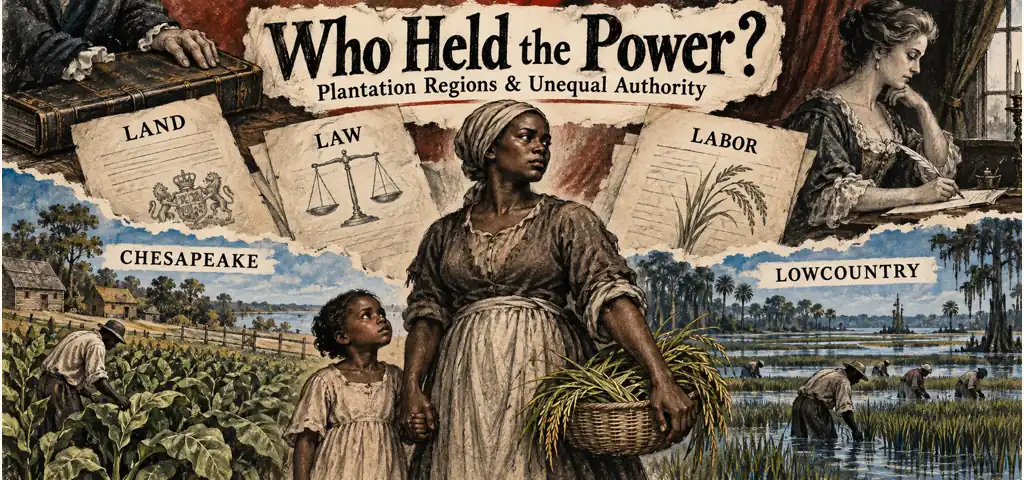
Lesson 2.5 of Chapter 2 of the U.S. History to 1877 study guide on Effortless Math covers CLEP U.S. History I 010: Plantation Regions, Family, Gender, and Authority: the key terms, the core ideas, and worked examples showing how this topic is tested on the exam.
U.S. History to 1877 | Chapter 2 | Lesson 2.5
The “South” contained several plantation regions. Chesapeake tobacco farms ranged from small holdings to large estates. In the Carolina and Georgia lowcountry, rice and indigo plantations developed through a multicultural body of knowledge: enslaved West and West-Central Africans contributed expertise in wetland cultivation and processing, Native people and Europeans contributed local and imported practices, and enslavers supplied coercive capital and claimed the profits. Rice estates often used versions of a task system, but assignments and any time remaining after them varied by plantation and period. Chesapeake gangs more often worked under continuous supervision. Such differences shaped daily life without making one system benign.
Settlement patterns affected family. Early Chesapeake mortality and a shortage of European women produced unstable households. As life expectancy improved, white planter families became more durable. Coverture placed a married woman’s legal identity and property largely under her husband’s control, although widows could manage estates and regional circumstances created practical responsibilities. Household authority and plantation authority reinforced a patriarchal ideal in which elite men claimed control over dependents.
Enslaved families faced sale, forced migration, sexual violence, and the denial of legal marriage. Yet kinship was a central source of survival. People maintained extended networks across plantations, named children, cared for unrelated community members, cultivated garden plots, worshiped, and passed on knowledge. Enslaved women’s reproductive labor was exploited because children inherited enslaved status. Gender therefore shaped the particular burdens of slavery even as all enslaved people faced coercion.
Plantation wealth produced an unequal political order. Large planters dominated assemblies, courts, churches, and credit networks, but most white southerners did not own great estates. Small farmers traded with plantations and sometimes aspired to slaveholding, while poor whites remained economically vulnerable. Native dispossession underwrote expansion. A regional hierarchy connected race, class, gender, and land. None of these categories explains authority alone.
See the history take shape
Allen Lam traces the people and chronology behind this lesson. Listen for the evidence that sharpens the written account, then try the questions below.
Video: The Colonial Family, Allen Lam.
Check your understanding
- Which interpretation best explains African influence on lowcountry rice production?
- African knowledge shaped rice cultivation within a plantation system controlled by enslavers.
- English dry-field practice supplied the region’s principal water-management methods.
- Specialized agricultural skill gave enslaved workers authority over plantation investment.
- Coastal ecology reduced the need for technical knowledge or intensive labor.
- Rice cultivation developed apart from Atlantic markets and planter investment.
- Under the common-law principle of coverture, a married woman’s independent legal identity was generally absorbed into that of
- the county court supervising her marital property
- her birth family retaining authority after marriage
- the parish vestry regulating her household contracts
- her husband, unless a settlement intervened
- the principal creditor financing her household estate
- Select all that apply. Which conditions could threaten enslaved family and kin networks?
- sale to an owner distant from relatives
- forced migration between plantations
- kin naming linking children to extended family
- separation during estate division
- denial of legally protected marriage
- Compare one aspect of labor or family life in the Chesapeake and lowcountry.
Write a brief response using a named fact from the lesson.
Open the answers and reasoning
Independent preparation. CLEP is a registered trademark of the College Board, which does not endorse this lesson.

Related to This Article
More math articles
- 8th Grade PEAKS Math Worksheets: FREE & Printable
- How to Know the Difference Between Correlation and Causation
- Compare the Temperatures Above and Below Zero
- How to Navigate Inequalities: The Impact of Addition and Subtraction on Fractional Values
- The Best Grade 5 Math Book for Maryland Students
- Fiscal Policy, Deficits, and Public Debt
- The Best Grade 6 ELA Practice Tests for Iowa Students
- Rocks and the Rock Cycle
- Free Rhode Island RICAS Grade 3 Math Worksheets: 49 Printable PDFs with Friendly Answer Keys
- Seventh Grade Writing: Argument, Informative, and Narrative Expectations Explained













What people say about "Plantation Regions, Family and Authority"?
No one replied yet.