CLEP U.S. History I 009: The Transition to Racial Slavery
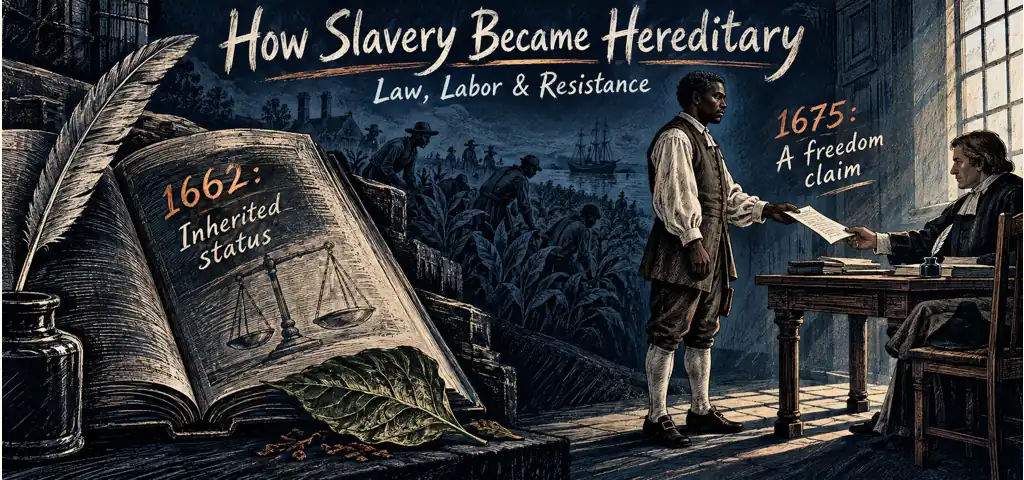
Lesson 2.4 of Chapter 2 of the U.S. History to 1877 study guide on Effortless Math covers CLEP U.S. History I 009: The Transition to Racial Slavery: the key terms, the core ideas, and worked examples showing how this topic is tested on the exam.
U.S. History to 1877 | Chapter 2 | Lesson 2.4
Africans arrived in English Virginia by 1619, but status in the early decades was not yet governed by a complete, uniform slave code. Some Africans were held for life. Some gained freedom and property. English servants also labored under coercive contracts. During the later seventeenth century, colonial lawmakers deliberately made African ancestry a marker of permanent, inheritable enslavement.
Several forces encouraged the transition. Tobacco remained labor intensive. Mortality declined, making lifelong ownership more profitable. The supply of English servants became less dependable as conditions in England and opportunities in the colonies changed. English participation in the Atlantic slave trade expanded, especially after the Royal African Company’s monopoly weakened. Planters could increasingly purchase captive Africans whom law defined as property for life.
Law did essential work. Virginia made a child’s status follow the mother, a reversal of English common-law assumptions that secured an enslaver’s claim to children born to enslaved women. Statutes distinguished conversion from freedom, restricted movement and weapons, and imposed harsher punishments on enslaved people. By granting some privileges to people classified as white, colonial governments created a racial boundary that could soften class conflict among Europeans without ending inequality among them.
Racial ideology and economic interest reinforced each other. Planters did not first discover a timeless prejudice and then apply it. Nor did profit operate without belief. Laws, sermons, pseudo-scientific claims, and daily violence made domination appear natural to beneficiaries. Enslaved Africans nevertheless formed families, preserved and remade cultural practices, negotiated work, escaped, and resisted. The emergence of a slave society describes the power of the institution, not the disappearance of enslaved people’s agency.
A focused video lesson
This Heimler's History lesson supplies a second explanation of the same period. Note where chronology, cause, and perspective connect.
Video: SLAVERY in the British Colonies [APUSH Review Unit 2 Topic 6] Period 2: 1607-1754, Heimler's History.
Check your understanding
- What was the most direct effect of Virginia’s 1662 maternal-status rule?
- A free father’s acknowledgment normally emancipated his child.
- Baptism, rather than descent, fixed a child’s civil status.
- Enslavers could claim children born to enslaved women as inheritable property.
- English paternal-status custom continued without colonial modification.
- Maternal status governed a fixed service term rather than lifetime bondage.
- Which paired change increased planters’ expected return from lifetime enslavement relative to short indentures?
- higher mortality and narrower access to captive labor
- falling tobacco demand and shorter expected working lives
- longer life expectancy and wider English participation in Atlantic slave trading
- cheaper English contracts and fewer legal claims to lifetime service
- subsistence production and reduced demand for plantation labor
- Select all that apply. Which developments helped construct hereditary racial slavery?
- expanded English participation in Atlantic slave trading
- inheritance of status through paternal descent
- inheritance of status through maternal descent
- baptism accepted as grounds for manumission
- punishment codes organized without racial status
- Explain how economic change and law worked together to create a racial slave society.
Write a brief response using a named fact from the lesson.
Open the answers and reasoning
Independent preparation. CLEP is a registered trademark of the College Board, which does not endorse this lesson.

Related to This Article
More math articles
- Full-Length 8th Grade ACT Aspire Math Practice Test
- Vermont Algebra 1 Free Worksheets: Free Printable Algebra 1 PDF Worksheets with Worked Solutions
- Maine Algebra 1 Free Worksheets: Printable Algebra 1 Practice for Every Skill
- The Ultimate 7th Grade PSSA Math Course (+FREE Worksheets)
- Manual Cleaning: Disassembly, Sinks, and Aerosol Control
- Sterilization Safety and Exposure Control
- Top 10 Tips to ACE the SSAT Math Test
- Surface Area and Volume Formulas: Complete Reference for 2026
- 8th Grade SOL Math Worksheets: FREE & Printable
- Commerce Clause
















What people say about "The Transition to Racial Slavery"?
No one replied yet.