Parallel Sides in Quadrilaterals for 4th Grade
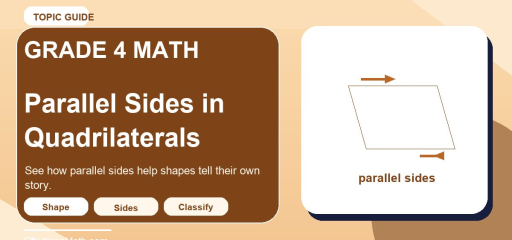
TL;DR: Any four-sided shape is a quadrilateral, but the real question is which pairs of sides run parallel. A trapezoid has at least one pair of parallel sides. A parallelogram has two pairs. Rectangles, rhombuses, and squares are all special kinds of parallelograms with extra rules about their angles or sides. Being able to spot parallel sides at a glance is a key 4th grade geometry skill, and it unlocks the whole family tree of quadrilateral shapes for you.
Key takeaways:
- A quadrilateral is any four-sided closed shape.
- Parallel lines never meet, no matter how far they extend.
- Trapezoid: at least one pair of parallel sides (some definitions say exactly one).
- Parallelogram: two pairs of parallel sides, both pairs are equal in length too.
- Squares and rectangles and rhombi are all parallelograms (two pairs of parallel sides).
Recognizing parallel sides helps students compare quadrilaterals such as rectangles, squares, trapezoids, and parallelograms.
This lesson covers classifying quadrilaterals for fourth-grade math. Use the examples and practice below to build confidence and skill.
Key Ideas to Remember
- Focus on the attribute the problem is asking about, such as side lengths, angle type, or parallel sides.
- Sketching the figure or labeling the important parts often prevents simple mistakes.
- Check the final answer against the shape's properties, not just the arithmetic.
Detailed Explanation
Quadrilaterals have four sides. Types include square, rectangle, rhombus, trapezoid, parallelogram. Squares and rectangles have right angles; parallelograms have two pairs of parallel sides.
Worked Example
Problem: Name a quadrilateral with four right angles.
- Step 1: Apply the concept from the lesson above.
- Step 2: Carry out the operation or reasoning.
Answer: A square or a rectangle (both have four right angles).
Common Mistakes
Students usually improve faster in parallel sides in quadrilaterals when they slow down and watch for a few repeated mistakes. These are the ones worth checking first:
- Looking at the wrong shape attribute when classifying or measuring.
- Confusing area with perimeter or angle type with side length.
- Forgetting that a square is also a rectangle with special properties.
Practice Strategy
A short but consistent review routine helps students build confidence with parallel sides in quadrilaterals without getting overwhelmed.
- Sketch shapes and label the attributes that matter for the problem.
- Use a ruler, grid, or protractor when the topic involves measurement.
- Sort a few examples and non-examples to strengthen the concept.
Watch Another Example
Use a second example video to hear the steps explained in a different way and reinforce the same skill from another angle.
Frequently Asked Questions
What are parallel sides of a quadrilateral?
Parallel sides are two sides that run in the same direction and stay the same distance apart, so they would never meet even if you extended them, like train tracks. In a rectangle, the top and bottom sides are parallel, and so are the left and right sides. Math drawings often mark parallel sides with matching arrow marks.
What is a quadrilateral with 4 parallel sides?
A quadrilateral cannot have all 4 sides parallel to each other, but it can have 2 pairs of parallel sides. Any shape with 2 pairs of parallel sides is a parallelogram. Rectangles, rhombuses and squares all belong to this group. A trapezoid is different because it has only one pair of parallel sides in most 4th grade books.
What is a quadrilateral with 2 pairs of parallel lines and 4 equal length sides?
That shape is a rhombus. A rhombus has 2 pairs of parallel sides and all 4 sides the same length. If it also has 4 right angles, it is a square, so every square is a special rhombus. A tilted diamond shape on a playing card is a good everyday picture of a rhombus.
How do you draw a quadrilateral with two pairs of parallel sides and no right angles?
Draw a slanted parallelogram. On grid paper, draw a bottom side 4 squares long. Start the top side 2 squares to the right and 3 squares up, and make it 4 squares long too. Connect the ends. The opposite sides are parallel, but the corners are not square, so there are no right angles.
Can parallel sides be different lengths?
Yes. Parallel only means the sides never meet; it says nothing about length. A trapezoid is the classic example: its two parallel sides, called bases, are usually different lengths, such as a top of 3 cm and a bottom of 6 cm. In a parallelogram, though, each pair of parallel sides is equal in length.
How do you teach quadrilaterals to 4th graders?
Start with shapes students can hold or draw, then sort them by one attribute at a time: number of parallel pairs, right angles and equal sides. A simple sort into no parallel pairs, one pair (trapezoid) and two pairs (parallelogram family) works well. Then ask why a square can sit in the rectangle and rhombus groups at the same time.
Related Lessons You May Like
- How to classify quadrilaterals (resource currently unavailable)
- How to find perimeter of rectangles
- How to find the area of rectangles
- How to find the area of trapezoids
- Complementary, supplementary, vertical, adjacent angles
If you want a workbook for 4th grade geometry, Mastering Grade 4 Math (resource currently unavailable) covers every 4th-grade standard. For more word-problem reps, Mastering Grade 4 Math Word Problems.

Related to This Article
More math articles
- 10 Most Common 4th Grade MAP Math Questions
- How to Solve Systems of Equations Graphically?
- NCLEX Delegation Questions: Right Person vs. Right Direction (2027 Prep)
- How to Analyze Cross Sections of 3D Solids: A Step-by-Step Guide
- Divided government
- What Kind of Math Is Taught in 8th Grade?
- The Best Grade 4 Math Book for Maine Students
- Delaware DeSSA Grade 8 Math Free Worksheets: Printable Test-Prep Worksheets with Answer Keys
- Patient-Care Equipment Basics
- GED Math – Test Day Tips




What people say about "Parallel Sides in Quadrilaterals for 4th Grade"?
No one replied yet.