CLEP U.S. History I 008: Indentured Servitude and Bacon’s Rebellion
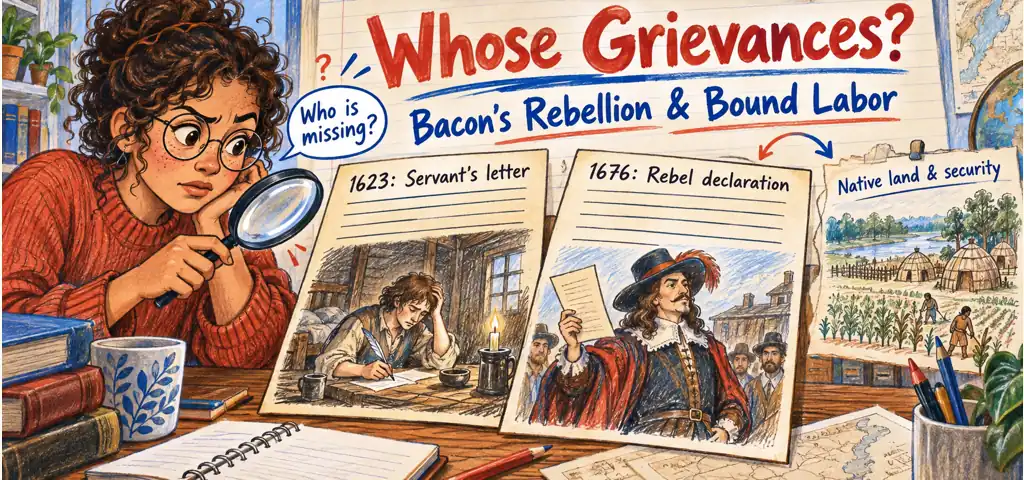
Lesson 2.3 of Chapter 2 of the U.S. History to 1877 study guide on Effortless Math covers CLEP U.S. History I 008: Indentured Servitude and Bacon’s Rebellion: the key terms, the core ideas, and worked examples showing how this topic is tested on the exam.
U.S. History to 1877 | Chapter 2 | Lesson 2.3
Tobacco planters first met much of their labor demand through indentured servants. In return for Atlantic passage, a servant promised several years of work. Contracts differed, and surviving servants might receive “freedom dues” of clothing, tools, food, or land. The arrangement offered some poor English migrants a route to America, but service was harsh. Masters could buy and sell contracts, punish workers, and extend terms for running away, pregnancy, or alleged misconduct. Chesapeake disease made the bargain deadly for many.
As mortality declined, more servants survived to freedom. They often found the best land already controlled by established planters. Many moved toward the frontier, where they competed with Native communities and demanded military protection. Colonial elites worried about a growing population of armed, land-poor men. That tension erupted in Bacon’s Rebellion in 1676. Nathaniel Bacon and his followers opposed Governor William Berkeley, attacked Native communities including some allied with Virginia, and burned Jamestown. Their coalition included former servants, small farmers, and some enslaved people, though Bacon himself was a wealthy newcomer seeking power.
The rebellion combined several grievances: frontier security, resentment of taxes and favoritism, demands for Native land, and anger at Berkeley’s leadership. Reducing it to a democratic uprising misses the rebels’ violent campaign against Native peoples. Reducing it to frontier warfare misses its challenge to the colony’s governing elite.
After the uprising collapsed, planters did not immediately replace all servants with enslaved Africans. Over time, however, elites reduced taxes for some white colonists, expanded opportunities on Native land, and tightened racial laws. These choices helped divide people who might otherwise share labor grievances. Bacon’s Rebellion mattered less as a single switch than as a warning that influenced the construction of a more stable racial and class order.
Watch the topic in context
Watch this account from Khan Academy with one question in mind: which evidence makes the lesson's strongest claim hold up?
Video: Jamestown – Bacon's Rebellion, Khan Academy.
Check your understanding
- Which description best identifies an indenture in seventeenth-century Virginia?
- inheritable lifetime status enforced through the maternal line
- a crop-rent tenancy granting possession of a planter’s field
- a headright awarded directly to every arriving laborer
- a wage agreement freely ended at the close of any month
- a contract exchanging Atlantic passage for a fixed labor term
- Bacon’s declaration calls its grievances those of “the people.” Which question should a historian ask first before treating that phrase as evidence of an inclusive political program?
- Did the declaration use the same spelling found in every surviving seventeenth-century copy?
- Did Berkeley’s supporters accept the declaration as a neutral account of the conflict?
- Could the phrase establish that allied Native communities supported Bacon’s frontier campaign?
- Did the declaration replace court, assembly, and land records as evidence about colonial society?
- Which groups joined the coalition, and which interests actually appear in its leaders’ written demands?
- Select all that apply. Which conclusions are warranted by reading Bacon’s declaration as a partisan source?
- Its charges establish the amount of taxes each planter paid.
- Its phrase “the people” should be tested against evidence about the coalition’s membership.
- Its signature and title identify the social composition of the rebel coalition.
- Its frontier claims can be compared with evidence from allied Native communities targeted by rebels.
- Its written program may omit interests held by some people who joined the coalition.
- In three sentences, distinguish the membership of Bacon’s coalition from the interests stated in its declaration, and identify one Native interest the phrase “the people” obscures.
Write a brief response using a named fact from the lesson.
Open the answers and reasoning
Independent preparation. CLEP is a registered trademark of the College Board, which does not endorse this lesson.

Related to This Article
More math articles
- MEC Testing, Exposure, and Corrective Action
- CLEP U.S. History I 104: Freedmen’s Bureau, Labor, Land, and Family
- District of Columbia DC CAPE Grade 4 Math Free Worksheets: 72 Free Printable Math Practice PDFs
- Sandy Savings: A Guide to How to Calculate Sales Tax on Your Beach Vacation
- The Best Algebra 2 Book for Students Who Want It to Click
- Incidence, Prevalence, and the Organization of Health Care
- 8th Grade PARCC Math Worksheets: FREE & Printable
- PSAT/NMSQT Math Flashcards (Free Online: Formulas, Terms & Concepts)
- Free Colorado CMAS Grade 3 Math Practice: 49 Printable PDFs for Classrooms, Tutors, and Parents
- How to Convert Repeating Decimals to Fractions? (+FREE Worksheet!)
















What people say about "Indentured Servitude and Bacon's Rebellion"?
No one replied yet.