CLEP U.S. History I 048: Embargo, Impressment, and the Road to War
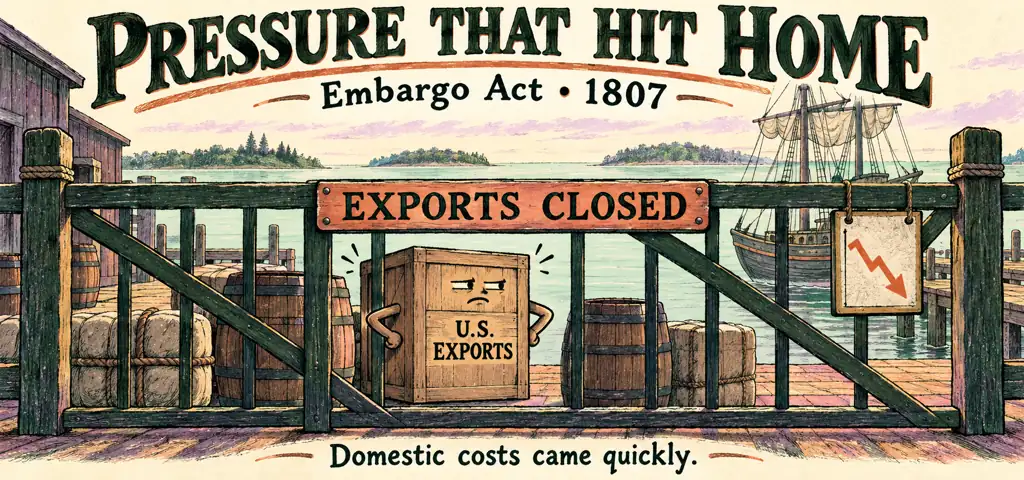
Lesson 9.4 of Chapter 9 of the U.S. History to 1877 study guide on Effortless Math covers CLEP U.S. History I 048: Embargo, Impressment, and the Road to War: the key terms, the core ideas, and worked examples showing how this topic is tested on the exam.
U.S. History to 1877 | Chapter 9 | Lesson 9.4
Napoleonic warfare placed neutral American commerce between British sea power and French continental control. Both powers restricted trade. Britain also impressed sailors from American vessels, claiming British deserters but sometimes taking U.S. citizens. The 1807 attack by HMS Leopard on the USS Chesapeake made the insult vivid. Jefferson wanted to defend neutral rights without a war the nation was unprepared to fight.
The Embargo Act of 1807 prohibited American exports to foreign ports. It was an experiment in economic coercion: because Britain and France depended on American products and markets, withdrawing trade might force respect for neutral rights. Instead, the embargo hurt American merchants, farmers, sailors, and customs revenue more quickly than it changed European policy. Smuggling increased, especially in New England, and enforcement required intrusive federal measures that sat uneasily with Jefferson’s limited-government principles. Congress replaced it with the Non-Intercourse Act, reopening most trade but excluding Britain and France. Macon’s Bill No. 2 later offered renewed nonintercourse against whichever belligerent failed to change policy after the other did.
President James Madison accepted Napoleon’s ambiguous suggestion that France would modify its restrictions and restored pressure on Britain. Britain eventually repealed its Orders in Council, but news crossed the Atlantic too slowly to prevent the U.S. declaration of war in June 1812. Causes also included British support for Native resistance, national honor, and war-hawk ambitions. Western and southern Republicans such as Henry Clay and John C. Calhoun strongly favored war. Many New England Federalists opposed it because of commercial ties and distrust of Republican policy.
The claim that Americans went to war mainly to conquer Canada is incomplete. Some war hawks expected Canada to be vulnerable and saw invasion as a way to remove British influence. Yet maritime rights, impressment, frontier security, partisan politics, and honor interacted. Historians weigh them differently because public rhetoric and strategic motives overlapped.
Watch the topic in context
Watch this account from CrashCourse with one question in mind: which evidence makes the lesson's strongest claim hold up?
Video: The War of 1812 – Crash Course US History #11, CrashCourse.
Check your understanding
- Impressment referred to Britain’s practice of
- licensing American merchants who traded in British ports
- confiscating neutral cargo under French commercial decrees
- restricting American exports to ports controlled by Britain
- removing sailors from ships and forcing them into naval service
- searching neutral vessels for contraband while leaving their crews aboard
- The Embargo Act attempted to use
- an invasion of British Canada to secure concessions
- naval escorts for merchant ships crossing the Atlantic
- economic pressure on belligerents while avoiding war
- preferential tariffs favoring French manufactured goods
- continued exports backed by diplomatic protest
- Deep Practice: select all that apply. Causes of war included
- impressment
- trade restrictions
- British-Native alliance
- national honor
- the Mexican Cession
- Deep Practice: open response. Evaluate the embargo by identifying its intended mechanism and one unintended result.
Write a brief response using a named fact from the lesson.
Open the answers and reasoning
Independent preparation. CLEP is a registered trademark of the College Board, which does not endorse this lesson.

Related to This Article
More math articles
- Low-Volatility Slots: The Math of Steady Bleed
- Latin Roots for Actions and Ideas
- Free Grade 6 English Worksheets for Minnesota Students
- Double Consciousness and Intersectionality
- Clear-and-present-danger doctrine
- New York NYSTP Grade 6 Math Free Worksheets: 72 Free Printable Practice Worksheets with Keys
- Power, Authority, Government, and the State
- 10 Most Common 6th Grade Georgia Milestones Assessment System Math Questions
- Evaluating Variables and Expressions
- Free Grade 5 English Worksheets for Virginia Students











What people say about "Embargo, Impressment and the Road to War"?
No one replied yet.