CLEP U.S. History I 049: War of 1812 Theaters and Outcomes
Lesson 9.5 of Chapter 9 of the U.S. History to 1877 study guide on Effortless Math covers CLEP U.S. History I 049: War of 1812 Theaters and Outcomes: the key terms, the core ideas, and worked examples showing how this topic is tested on the exam.
U.S. History to 1877 | Chapter 9 | Lesson 9.5
The United States entered war with a small regular army, divided public opinion, and ambitious plans to invade Canada. Early invasions failed through poor coordination, short enlistments, supply problems, and capable British and Native resistance. Naval victories on Lake Erie helped U.S. Forces regain Detroit, and the Battle of the Thames ended with Tecumseh’s death. On the Atlantic, individual U.S. Frigates won celebrated contests, but the Royal Navy imposed an increasingly effective blockade.
After Napoleon’s defeat freed British forces in 1814, Britain intensified the war. Troops entered Washington and burned public buildings, including the Capitol and President’s House. Fort McHenry resisted a British bombardment, inspiring Francis Scott Key’s poem that became the national anthem. In the North, the American defense at Plattsburgh helped discourage a British invasion from Canada. In the South, Andrew Jackson’s forces defeated Red Stick Creeks at Horseshoe Bend before defeating a British army at New Orleans in January 1815.
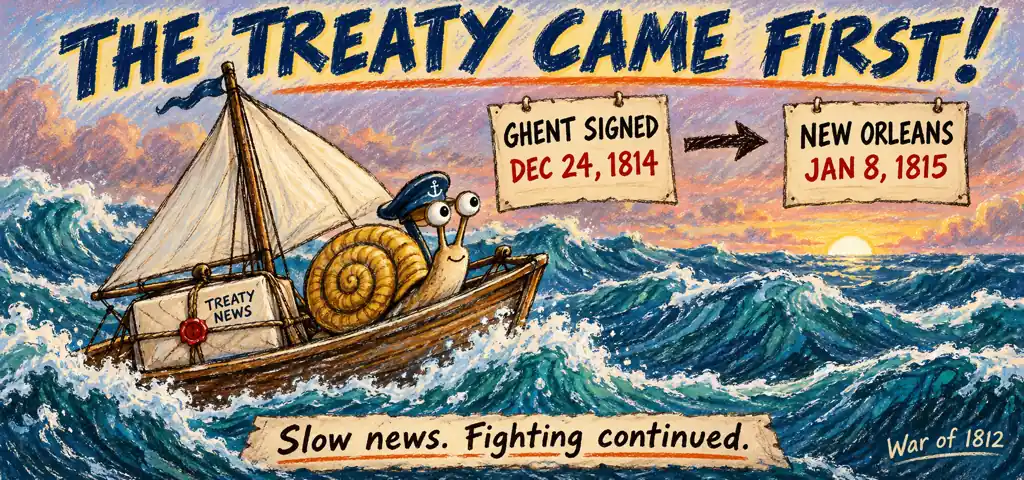
The Treaty of Ghent had been signed before the Battle of New Orleans, but slow communication meant the fighting continued. The treaty restored conquered territory and addressed neither impressment nor neutral shipping rights directly. Those issues faded because the European war had ended. Americans interpreted New Orleans and survival against Britain as a national triumph. The victory launched Jackson as a national hero and discredited Federalists whose Hartford Convention met during the war to protest Republican policies and propose constitutional changes. News of the convention arrived near news of victory, making its participants look disloyal even though they had not formally advocated secession.
Outcomes depended on perspective. Britain had defended Canada and had larger European priorities. The United States gained no Canadian territory but preserved independence and experienced a burst of nationalism. Native nations were the clearest losers: Britain abandoned the buffer-state objective, while U.S. Expansion accelerated. The conflict stimulated domestic manufacturing by disrupting imports, yet wartime finance also revealed the cost of having allowed the first national bank’s charter to expire.
9
A focused video lesson
This Buffalo Toronto Public Media lesson supplies a second explanation of the same period. Note where chronology, cause, and perspective connect.
Video: The War of 1812 | The Treaty of Ghent, Buffalo Toronto Public Media.
Check your understanding
- The Treaty of Ghent principally
- gave Canada to the United States
- settled the Oregon boundary
- created a Native buffer state
- ended slavery
- restored the prewar territorial situation
- Which statement correctly places the Battle of New Orleans in the war’s chronology?
- It was fought after the peace treaty was signed but before news reached the armies.
- It was fought after war was declared but before the invasion of Canada began.
- Its outcome persuaded British negotiators to accept the Treaty of Ghent.
- It followed Senate ratification of the treaty and formally ended hostilities.
- Its British victory forced the United States to return captured territory.
- Deep Practice: select all that apply. War outcomes included
- weakened Native resistance
- sharper Jackson reputation
- Federalist decline
- increased nationalism
- U.S. Annexation of Canada
- Deep Practice: open response. Why can a treaty restoring territory still accompany major political change?
Write a brief response using a named fact from the lesson.
Open the answers and reasoning
Independent preparation. CLEP is a registered trademark of the College Board, which does not endorse this lesson.

Related to This Article
More math articles
- FREE 7th Grade New York State Testing Program Math Practice Test
- How to Use Strip Models to Subtract Fractions with Like Denominators
- The Best Grade 8 ELA Practice Tests for New Jersey Students
- 3rd Grade OST Math Practice Test Questions
- Parallel Structure
- Free Printable Grade 2 Math Worksheets for West Virginia
- Tracking, Hidden Curriculum, Credentials, and Unequal Signals
- How to Motivate your Child to Learn Math?
- Minerals and Their Identification
- Jungle Bargains: A Guide How to Find the Original Price Using Sale Prices











What people say about "War of 1812: Theaters and Outcomes"?
No one replied yet.