CLEP U.S. History I 050: Nationalism, the American System, and the Era of Good Feelings
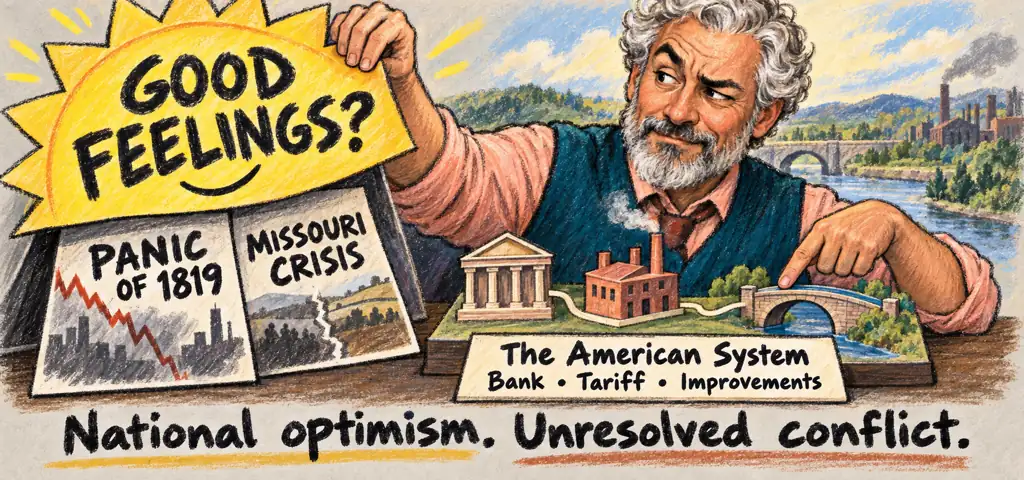
Lesson 9.6 of Chapter 9 of the U.S. History to 1877 study guide on Effortless Math covers CLEP U.S. History I 050: Nationalism, the American System, and the Era of Good Feelings: the key terms, the core ideas, and worked examples showing how this topic is tested on the exam.
U.S. History to 1877 | Chapter 9 | Lesson 9.6
The War of 1812 exposed dependence on imported manufactures, unstable currency, and weak transportation. In 1815-1816, congressional nationalists answered with a connected program. The Tariff of 1816 placed protective duties on selected imports. Congress chartered the Second Bank of the United States to hold federal deposits, restrain unreliable state-bank notes, and improve fiscal coordination. Advocates proposed roads and canals that would reduce the cost of moving western produce and eastern manufactures. Henry Clay later popularized this tariff-bank-improvements cluster as the “American System.” It was a program assembled over time, not one statute enacted under that name.
Its benefits and burdens varied. Many northeastern manufacturers wanted protection from renewed British competition, although commercial interests did not agree on every duty. Western farmers sought cheaper routes to eastern markets and supported federal land and transport spending. Southern representatives backed the 1816 tariff and bank in significant numbers, but later opposition grew as plantation exporters paid higher prices for protected goods and feared consolidated federal power. Cotton bound the South to Atlantic trade even as roads, steamboats, and canals deepened interstate exchange. National integration could therefore increase trade while also making regions more specialized and politically conscious of unequal costs.
Internal improvements revealed a constitutional fault line inside nationalism. Congress passed the Bonus Bill to pledge federal bank dividends to roads and canals. On his last day in office, Madison vetoed it because he did not find the proposed general power among Congress’s enumerated powers. He favored a constitutional amendment for a thorough system. Congress still financed particular roads, surveys, and projects under narrower theories, while states and corporations built much of the era’s infrastructure. The issue was not “roads versus no roads” but which government could fund, build, and regulate them under what authority.
The Second Bank’s early management expanded credit and then contracted it sharply as the postwar boom collapsed. The Panic of 1819 brought bank failures, falling land and commodity prices, unemployment in towns, and foreclosure pressure in western and southern communities. Debtors blamed both local banks and the national bank. This experience changed the bank from a symbol of national order into a target for many voters and helps explain later Jacksonian hostility. Economic integration did not distribute risk evenly.
James Monroe took office in 1817 as the Federalist Party collapsed nationally. The Boston Columbian Centinel’s “Era of Good Feelings” label captures presidential tours and reduced party competition, not an absence of politics. Republicans divided into personal and policy factions. The Missouri crisis of 1819-1821 exposed sectional conflict over slavery’s expansion. The Panic discredited institutions. And the four-way presidential contest of 1824 emerged from the nominally one-party system. The phrase is most useful when treated as evidence about public presentation and party structure, then tested against conflict.
Diplomacy also made national authority visible. The Rush-Bagot arrangement of 1817 limited naval armaments on the Great Lakes. The Convention of 1818 fixed much of the U.S.-British North American boundary at the forty-ninth parallel and established joint occupation, not division, of Oregon Country. The Adams-Onís Treaty was signed in 1819 but ratified and proclaimed in 1821. Spain then transferred East Florida, the United States renounced claims to Texas, and negotiators drew a transcontinental boundary to the Pacific. Jackson’s 1818 invasion of Spanish Florida pressured Spain during the First Seminole War, but it also raised questions about unauthorized war, executive control, and violence against Seminole communities and their Black allies. Diplomatic gains thus joined national confidence to imperial and constitutional conflict.
See the history take shape
Cory Kimball traces the people and chronology behind this lesson. Listen for the evidence that sharpens the written account, then try the questions below.
Video: Unit 4 Lesson 1: Nationalism During the "Era of Good Feelings" (AHI), Cory Kimball.
Check your understanding
- Which proposal most closely matches Clay’s emerging American System while preserving Madison’s constitutional objection as a real controversy?
- reduce protective duties, let state banks alone regulate currency, and leave transport entirely to foreign investors
- combine protection, a national bank, and internal improvements while debating the federal authority for roads and canals
- distribute federal land only to plantation corporations and prohibit interstate road building
- replace the national bank with state-issued legal tender and finance improvements solely through British credit
- retain the bank and tariff but prohibit Congress and the states from supporting transportation
- Which evidence most directly limits the phrase “Era of Good Feelings”?
- Monroe’s nearly unanimous reelection showed broad electoral support.
- Federalists no longer mounted an effective national presidential campaign.
- The Convention of 1818 peacefully settled several issues with Britain.
- The Panic of 1819 and Missouri crisis exposed economic and sectional conflict.
- Monroe’s national tour received praise across much of the country.
- Deep Practice: select all that apply. Evidence of postwar national coordination included
- the Tariff of 1816
- the Second Bank’s charter
- internal-improvement proposals
- boundary agreements with Britain and Spain
- a constitutional amendment granting a general improvement power
- Deep Practice: open response. Explain how one part of the American System could unite regions and also create sectional friction.
Write a brief response using a named fact from the lesson.
Open the answers and reasoning
Independent preparation. CLEP is a registered trademark of the College Board, which does not endorse this lesson.

Related to This Article
More math articles
- New Hampshire NH SAS Grade 8 Math Free Worksheets: Printable Standards-Aligned Practice with Answers
- How to Compare Fractions?
- The Best Algebra 1 Book for Hawaii Students
- Integrals: Complete Explanation of the Applications and Use
- How to Estimate Negative and Positive Square Roots
- Resource Mobilization
- The Best Grade 3 Math Book for West Virginia Students
- How to Find the Area of Composite Shapes?
- Even or Odd Numbers
- Exponents and Radicals: Rules, Examples, and Practice











What people say about "Nationalism and the American System"?
No one replied yet.