CLEP U.S. History I 051: Marshall Court and Judicial Review
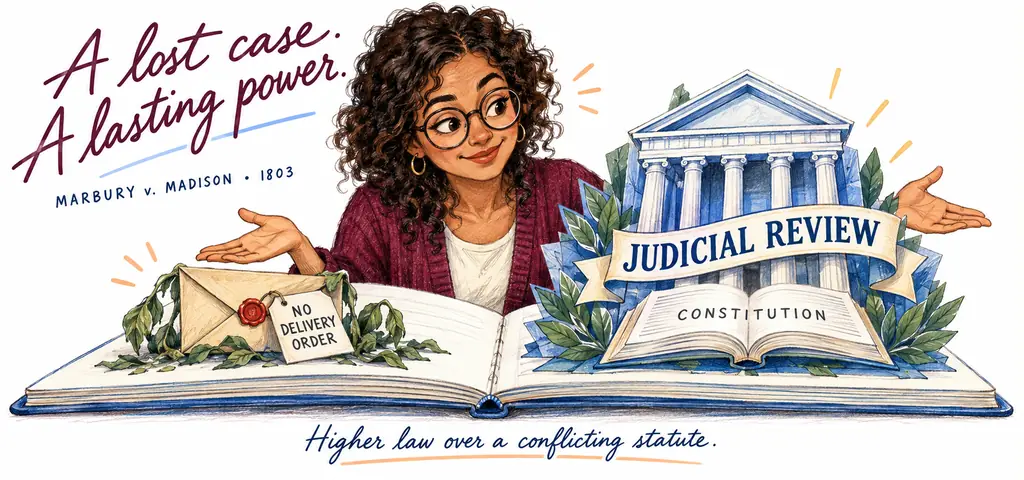
Lesson 10.1 of Chapter 10 of the U.S. History to 1877 study guide on Effortless Math covers CLEP U.S. History I 051: Marshall Court and Judicial Review: the key terms, the core ideas, and worked examples showing how this topic is tested on the exam.
U.S. History to 1877 | Chapter 10 | Lesson 10.1
Chief Justice John Marshall led the Supreme Court from 1801 to 1835. A committed Federalist, he often wrote opinions that strengthened national authority and protected contracts and property, but his influence rested on legal reasoning and institutional practice, not a constitutional power to make general policy. The foundational case was Marbury v. Madison (1803).
In the final days of the Adams administration, William Marbury had been appointed a justice of the peace. His signed commission was not delivered before Jefferson took office, and Secretary of State James Madison withheld it. Marbury asked the Supreme Court for a writ of mandamus ordering delivery, relying on a provision of the Judiciary Act of 1789. Marshall concluded that Marbury had a right to the commission and that a legal remedy was generally appropriate. Yet the Court said it lacked original jurisdiction to issue the requested writ because the statute attempted to expand the Court’s original jurisdiction beyond Article III. When a statute conflicts with the Constitution, Marshall reasoned, courts must apply the higher law. The Court declared that portion of the act unconstitutional.
The decision was institutionally shrewd. Jefferson won the immediate dispute because the Court did not order delivery. The Court asserted the longer-lasting power of judicial review. The Constitution does not use that phrase, but written constitutional supremacy, the judicial duty to decide cases, and earlier state and federal practice supported the idea. Marbury did not give courts the sole right to discuss constitutionality, nor did it make the Court superior in every political dispute. It supplied a clear judicial claim to refuse enforcement of unconstitutional federal legislation.
The Marshall Court also defended judicial review of state action. In Fletcher v. Peck, it invalidated a state law impairing a land contract despite corruption surrounding the original transaction. In Cohens v. Virginia, it affirmed Supreme Court review of state criminal judgments that raised federal questions. These decisions made federal constitutional law more uniform while provoking advocates of state authority.
Watch, then test the claim
Use this lesson from Hip Hughes (HipHughes) to review the period and its central historical problem. Pause when the video reaches the turning point named above.
Video: The Marshall Court Explained: US History Review, Hip Hughes (HipHughes).
Check your understanding
- Marbury v. Madison is chiefly associated with
- executive privilege
- judicial review
- popular election of judges
- nullification
- territorial acquisition
- Marbury failed to obtain his commission because the Court concluded that
- an appointment remained invalid until the commission was physically delivered
- the Judiciary Act had removed federal jurisdiction over appointment disputes
- a new president could revoke any signed and sealed commission
- Article III did not give the Court original jurisdiction over his request
- mandamus was unavailable whenever a federal officer was the defendant
- Deep Practice: select all that apply. Marshall Court tendencies included
- national constitutional supremacy
- protection of contracts
- federal review of state judgments raising federal questions
- stronger judicial authority
- automatic victory for every Federalist litigant
- Deep Practice: open response. Explain why Jefferson won the immediate dispute but the Court gained lasting authority.
Write a brief response using a named fact from the lesson.
Open the answers and reasoning
Independent preparation. CLEP is a registered trademark of the College Board, which does not endorse this lesson.

Related to This Article
More math articles
- CHSPE Math Flashcards (Free Online: Formulas, Terms & Concepts)
- Minnesota MCA-III Grade 7 Math Worksheets: 95 Free Printable Single-Skill PDFs
- Billionaire Basics: How to Master Addition and Subtraction of Massive Whole Numbers
- CHSPE Math Practice Test Questions
- Free CLEP College Mathematics Practice Tests and Review Guide
- Georgia Georgia Milestones Algebra 1 Free Worksheets: Free Printable Algebra 1 PDFs Covering Every Skill
- Subtraction of Amounts of Money
- Solve equilibrium equations without losing the economics
- How Do You Simplify Radicals with Fractions?
- How to Multiply and Divide Integers? (+FREE Worksheet!)
















What people say about "The Marshall Court and Judicial Review"?
No one replied yet.