CLEP U.S. History I 052: Implied Powers and Interstate Commerce
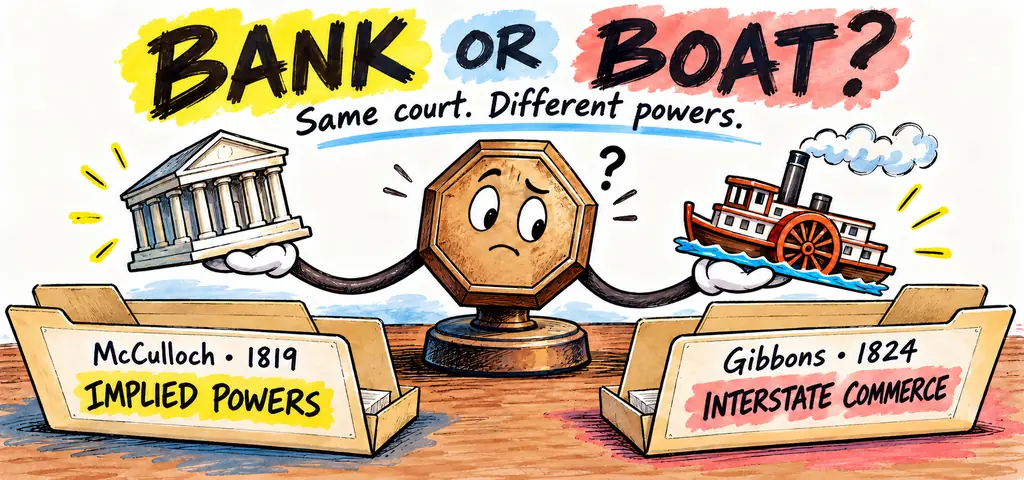
Lesson 10.2 of Chapter 10 of the U.S. History to 1877 study guide on Effortless Math covers CLEP U.S. History I 052: Implied Powers and Interstate Commerce: the key terms, the core ideas, and worked examples showing how this topic is tested on the exam.
U.S. History to 1877 | Chapter 10 | Lesson 10.2
Two Marshall Court decisions gave practical force to national economic power. McCulloch v. Maryland (1819) arose after Maryland taxed notes issued by the Baltimore branch of the Second Bank of the United States. James McCulloch refused to pay. The Court upheld Congress’s authority to charter the bank even though no enumerated power says “create corporations.” Marshall read the Necessary and Proper Clause broadly: Congress may select appropriate means plainly adapted to legitimate constitutional ends, so long as the means are not prohibited. “Necessary” did not mean absolutely indispensable.
The Court also denied Maryland’s power to tax the federal bank. Under the Supremacy Clause, a state could not use taxation to control or potentially destroy a constitutional federal instrument. The people of all states had created the national government, while Maryland represented only its own residents. The holding therefore joined implied congressional power to a limit on state interference.
Gibbons v. Ogden (1824) concerned competing steamboat rights. New York had granted a monopoly affecting navigation in its waters. Thomas Gibbons operated under a federal coastal license. The Court treated navigation as commerce and defined commerce among the states broadly enough to cover interstate activity. When valid federal and conflicting state rules met, federal law prevailed. The decision did not give Congress control over commerce wholly internal to a single state, but it restricted state-created barriers to interstate exchange.
Together the decisions supported a national market. A federal bank could operate without hostile state taxation. Federally regulated interstate navigation could proceed despite a state monopoly. They also clarified different clauses. McCulloch concerns Necessary and Proper, federal supremacy, and taxation of a federal instrument. Gibbons concerns the Commerce Clause and a conflict between federal licensing and state monopoly. Keeping those fact patterns distinct is a reliable exam strategy.
Critics saw consolidation: if Congress defined convenient means and federal courts invalidated state policies, what remained of reserved powers? Marshall’s answer was not that federal power was unlimited. The ends must come from the Constitution, and purely internal commerce remained state-regulated. But within its sphere the national government was supreme.
Watch the topic in context
Jeff Kellick offers a visual route through this topic. As you watch, compare its explanation with the source limits in the written lesson.
Video: Enumerated Powers Explained: McCulloch, Gibbons & the Early Republic, Jeff Kellick.
Check your understanding
- McCulloch v. Maryland upheld Congress’s power to charter the bank chiefly through
- the power to tax and spend for the general welfare
- federal supremacy over a conflicting state law
- the Necessary and Proper Clause’s grant of implied means
- the prohibition on state impairment of contracts
- the power to regulate commerce among the states
- Gibbons v. Ogden limited New York’s steamboat monopoly because
- a federal coastal license made each licensed vessel federal property
- a state monopoly necessarily impaired a federal commercial contract
- intrastate ferry traffic fell within federal commerce power by definition
- states could not charter companies that later operated across state lines
- navigation between states was commerce and valid federal law prevailed
- Deep Practice: select all that apply. The cases supported
- implied powers
- federal supremacy
- an integrated national market
- limits on conflicting state economic rules
- unlimited congressional police power
- Deep Practice: open response. Use the facts, the case names, to distinguish McCulloch from Gibbons.
Write a brief response using a named fact from the lesson.
Open the answers and reasoning
Independent preparation. CLEP is a registered trademark of the College Board, which does not endorse this lesson.

Related to This Article
More math articles
- Select and special committees
- Functions of political parties
- CLEP U.S. History I 099: Soldiers, Civilians, Women, and the Home Fronts
- Oklahoma OSTP Algebra 1 Free Worksheets: 64 Free PDF Worksheets Aligned to OSTP Algebra 1
- The Ultimate TASC Math Formula Cheat Sheet
- Career Development, Certification, and Continuing Education
- Budget Laptops for Online Teachers: Compare 6 Options
- The Best Grade 3 ELA Practice Tests for Idaho Students
- Chemical Reactions and Conservation of Mass
- The ratification process















What people say about "Implied Powers and Interstate Commerce"?
No one replied yet.