Grade 6 Math: Prime and Composite Numbers
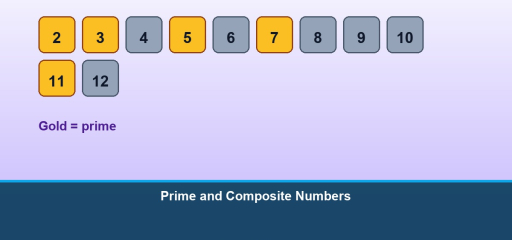
Grade 6 focus: A prime number is a whole number greater than \(1\) whose only positive factors are \(1\) and itself. A composite number is a whole number greater than \(1\) that has more than two positive factors. The number \(1\) is neither prime nor composite.
Video lesson: Watch this Math with Mr. J introduction to prime and composite numbers.
Quick examples
- Prime: \(2, 3, 5, 7, 11, 13, \ldots\)
- Composite: \(4, 6, 8, 9, 10, 12, \ldots\)
How to test “prime or composite?”
- Check divisibility by small primes (\(2, 3, 5, 7, \ldots\)) up to \(\sqrt{n}\).
- If you find a factor other than \(1\) and \(n\), then \(n\) is composite.
- If no such factor exists, \(n\) is prime.
Connection to factor trees
Prime factorization breaks a composite number into a product of primes. That skill supports GCF, LCM, and simplifying fractions.
Common mistakes
- Treating \(1\) as prime.
- Assuming all odd numbers are prime (\(9\) and \(15\) are not).
- Stopping after one failed divisibility test, always be systematic.
Fluency check
Classify \(29\) and \(39\). (\(29\) is prime; \(39 = 3 \times 13\) is composite.)
Prime and Composite Numbers Explained
Understanding prime and composite numbers is fundamental to number theory and essential for grade-6 mathematics. These concepts appear throughout algebra, factoring, and fraction simplification.
Definition of Prime Numbers
A prime number is a natural number greater than 1 that has exactly two factors: 1 and itself. In other words, prime numbers are only divisible by 1 and themselves. Examples: 2, 3, 5, 7, 11, 13, 17, 19, 23, 29.
Key Fact: 2 is the only even prime number. All other even numbers are divisible by 2, making them composite.
Definition of Composite Numbers
A composite number is a natural number greater than 1 that has more than two factors. Composite numbers can be divided by numbers other than 1 and themselves. Examples: 4, 6, 8, 9, 10, 12, 14, 15, 16, 18.
Key Fact: The number 1 is neither prime nor composite. It has exactly one factor (itself).
Divisibility Rules
Divisible by 2: Last digit is even (0, 2, 4, 6, 8)
Divisible by 3: Sum of digits is divisible by 3. Example: 147 → 1+4+7=12 → 12÷3=4 ✓
Divisible by 5: Last digit is 0 or 5
Divisible by 10: Last digit is 0
These rules speed up identifying whether a number is prime or composite.
Prime Numbers Less Than 100
2, 3, 5, 7, 11, 13, 17, 19, 23, 29, 31, 37, 41, 43, 47, 53, 59, 61, 67, 71, 73, 79, 83, 89, 97
There are 25 primes less than 100. Memorizing at least the primes less than 20 is helpful for quick factorization.
Factoring Composite Numbers
Every composite number can be expressed as a product of prime factors. This is called prime factorization.
Example 1: Factor 24
\(24 = 2 \times 12 = 2 \times 2 \times 6 = 2 \times 2 \times 2 \times 3 = 2^3 \times 3\)
Example 2: Factor 60
\(60 = 2 \times 30 = 2 \times 2 \times 15 = 2 \times 2 \times 3 \times 5 = 2^2 \times 3 \times 5\)
Fundamental Theorem of Arithmetic: Every composite number has a unique prime factorization.
The Sieve of Eratosthenes
An ancient algorithm for finding all primes up to a given number:
Step 1: List numbers 2 through n
Step 2: Circle 2 (first prime). Cross out all multiples of 2.
Step 3: Find the next uncrossed number (3), circle it, cross out its multiples.
Step 4: Repeat until all numbers up to \(\sqrt{n}\) have been processed.
Step 5: All circled and remaining uncrossed numbers are prime.
This method efficiently generates all primes up to 100 in about 5 minutes.
Worked Examples
Example 1: Is 37 prime or composite?
Check divisibility by primes up to \(\sqrt{37} \approx 6\): 2, 3, 5
37 is odd (not divisible by 2), 3+7=10 (not divisible by 3), doesn’t end in 0 or 5 (not divisible by 5).
Answer: 37 is prime.
Example 2: Find the prime factorization of 84
\(84 = 2 \times 42 = 2 \times 2 \times 21 = 2 \times 2 \times 3 \times 7 = 2^2 \times 3 \times 7\)
Frequently Asked Questions
Q: Is 1 prime or composite?
A: Neither. 1 has only one factor (itself), so it doesn’t meet the definition of prime (needs exactly 2) or composite (needs more than 2).
Q: Why is 2 the only even prime?
A: Any even number ≥ 4 is divisible by 2, giving it at least three factors (1, 2, and itself). So 2 is the only even prime.
Q: How are primes used in real life?
A: Prime numbers are essential for encryption and data security. Internet security systems rely on the difficulty of factoring large numbers into primes.
Q: What’s the largest known prime number?
A: As of 2025, the largest known prime has over 24 million digits! Discovering new primes is an active area of mathematical research.
Strengthen your foundation with Prime Factorization with Exponents and explore Mean, Median, Mode and Range of the Given Data.
Prime and Composite Numbers Explained
Understanding prime and composite numbers is fundamental to number theory and essential for grade-6 mathematics. These concepts appear throughout algebra, factoring, and fraction simplification.
Definition of Prime Numbers
A prime number is a natural number greater than 1 that has exactly two factors: 1 and itself. In other words, prime numbers are only divisible by 1 and themselves. Examples: 2, 3, 5, 7, 11, 13, 17, 19, 23, 29.
Key Fact: 2 is the only even prime number. All other even numbers are divisible by 2, making them composite.
Definition of Composite Numbers
A composite number is a natural number greater than 1 that has more than two factors. Composite numbers can be divided by numbers other than 1 and themselves. Examples: 4, 6, 8, 9, 10, 12, 14, 15, 16, 18.
Key Fact: The number 1 is neither prime nor composite. It has exactly one factor (itself).
Divisibility Rules
Divisible by 2: Last digit is even (0, 2, 4, 6, 8)
Divisible by 3: Sum of digits is divisible by 3. Example: 147 → 1+4+7=12 → 12÷3=4 ✓
Divisible by 5: Last digit is 0 or 5
Divisible by 10: Last digit is 0
These rules speed up identifying whether a number is prime or composite.
Prime Numbers Less Than 100
2, 3, 5, 7, 11, 13, 17, 19, 23, 29, 31, 37, 41, 43, 47, 53, 59, 61, 67, 71, 73, 79, 83, 89, 97
There are 25 primes less than 100. Memorizing at least the primes less than 20 is helpful for quick factorization.
Factoring Composite Numbers
Every composite number can be expressed as a product of prime factors. This is called prime factorization.
Example 1: Factor 24
\(24 = 2 \times 12 = 2 \times 2 \times 6 = 2 \times 2 \times 2 \times 3 = 2^3 \times 3\)
Example 2: Factor 60
\(60 = 2 \times 30 = 2 \times 2 \times 15 = 2 \times 2 \times 3 \times 5 = 2^2 \times 3 \times 5\)
Fundamental Theorem of Arithmetic: Every composite number has a unique prime factorization.
The Sieve of Eratosthenes
An ancient algorithm for finding all primes up to a given number:
Step 1: List numbers 2 through n
Step 2: Circle 2 (first prime). Cross out all multiples of 2.
Step 3: Find the next uncrossed number (3), circle it, cross out its multiples.
Step 4: Repeat until all numbers up to \(\sqrt{n}\) have been processed.
Step 5: All circled and remaining uncrossed numbers are prime.
This method efficiently generates all primes up to 100 in about 5 minutes.
Worked Examples
Example 1: Is 37 prime or composite?
Check divisibility by primes up to \(\sqrt{37} \approx 6\): 2, 3, 5
37 is odd (not divisible by 2), 3+7=10 (not divisible by 3), doesn’t end in 0 or 5 (not divisible by 5).
Answer: 37 is prime.
Example 2: Find the prime factorization of 84
\(84 = 2 \times 42 = 2 \times 2 \times 21 = 2 \times 2 \times 3 \times 7 = 2^2 \times 3 \times 7\)
Frequently Asked Questions
Q: Is 1 prime or composite?
A: Neither. 1 has only one factor (itself), so it doesn’t meet the definition of prime (needs exactly 2) or composite (needs more than 2).
Q: Why is 2 the only even prime?
A: Any even number ≥ 4 is divisible by 2, giving it at least three factors (1, 2, and itself). So 2 is the only even prime.
Q: How are primes used in real life?
A: Prime numbers are essential for encryption and data security. Internet security systems rely on the difficulty of factoring large numbers into primes.
Q: What’s the largest known prime number?
A: As of 2025, the largest known prime has over 24 million digits! Discovering new primes is an active area of mathematical research.
Strengthen your foundation with Prime Factorization with Exponents and explore Mean, Median, Mode and Range of the Given Data.
Understanding Prime and Composite Numbers
Understanding prime and composite numbers is fundamental to number theory and absolutely essential for grade-6 mathematics and beyond. These concepts appear throughout algebra, factoring, fraction simplification, and cryptography. Mastering these distinctions builds a foundation for advanced mathematics.
Precise Definition of Prime Numbers
A prime number is a natural number greater than 1 that has exactly two distinct factors: 1 and itself. In other words, prime numbers are only divisible evenly by 1 and by themselves, no other whole number divides them evenly. Examples: 2, 3, 5, 7, 11, 13, 17, 19, 23, 29, 31, 37, 41, 43, 47.
Key Fact about Even Primes: 2 is the only even prime number. All other even numbers are divisible by 2, making them composite with at least three factors (1, 2, and themselves), so they cannot be prime.
Precise Definition of Composite Numbers
A composite number is a natural number greater than 1 that has more than two factors. Composite numbers can be divided evenly by numbers other than just 1 and themselves. Examples: 4 (factors: 1,2,4), 6 (factors: 1,2,3,6), 8 (factors: 1,2,4,8), 9 (factors: 1,3,9), 10, 12, 14, 15, 16, 18, 20, 21.
Important Exception: The number 1 is neither prime nor composite. It has exactly one factor (itself), which doesn’t fit the definition of either category. This special status prevents certain mathematical theorems from having exceptions.
Practical Divisibility Rules for Quick Identification
Divisible by 2: The last digit is even (0, 2, 4, 6, or 8). Example: 348 is divisible by 2 because it ends in 8.
Divisible by 3: The sum of all digits is divisible by 3. Example: 147 → 1+4+7=12 → 12÷3=4, so 147 is divisible by 3.
Divisible by 5: The last digit is 0 or 5. Example: 235 is divisible by 5 because it ends in 5.
Divisible by 10: The last digit is 0. Example: 450 is divisible by 10.
These rules speed up the process of identifying whether a number is prime or composite without doing long division for every potential factor.
Complete List: Prime Numbers Less Than 100
2, 3, 5, 7, 11, 13, 17, 19, 23, 29, 31, 37, 41, 43, 47, 53, 59, 61, 67, 71, 73, 79, 83, 89, 97
There are exactly 25 primes less than 100. Memorizing at least the primes less than 20 (2, 3, 5, 7, 11, 13, 17, 19) is helpful for quick factorization work.
Prime Factorization of Composite Numbers
Every composite number can be expressed uniquely as a product of prime factors. This is called prime factorization, and it’s incredibly useful for simplifying fractions, finding greatest common factors, and understanding number structure.
Example 1: Factorize 24
24 = 2 × 12 = 2 × 2 × 6 = 2 × 2 × 2 × 3 = \(2^3 \times 3\)
24 breaks down into the prime factors 2 (appearing 3 times) and 3 (appearing once).
Example 2: Factorize 60
60 = 2 × 30 = 2 × 2 × 15 = 2 × 2 × 3 × 5 = \(2^2 \times 3 \times 5\)
60’s prime factorization shows it contains two 2’s, one 3, and one 5.
Fundamental Theorem of Arithmetic: Every composite number has a unique prime factorization. No two different composite numbers share the exact same collection of prime factors.
The Sieve of Eratosthenes Algorithm
An ancient, elegant algorithm for finding all primes up to a given number efficiently:
Step 1: Write down or list all numbers from 2 through n (your target)
Step 2: Circle 2 (the first prime number). Cross out all multiples of 2 (4, 6, 8, 10..)
Step 3: Find the next uncrossed number (3), circle it as prime, cross out all its multiples (6, 9, 12, 15..)
Step 4: Repeat until you’ve processed all numbers up to \(\sqrt{n}\) (you only need to check up to the square root)
Step 5: All circled and remaining uncrossed numbers are prime.
This method efficiently generates all primes up to 100 in about 5 minutes by hand and illustrates why certain numbers are prime versus composite.
Complete Worked Examples
Example 1: Determine if 37 is prime or composite
Check divisibility by primes up to \(\sqrt{37} \approx 6\): test 2, 3, 5
37 is odd, so not divisible by 2. 3+7=10, not divisible by 3. Doesn’t end in 0 or 5, so not divisible by 5.
Answer: 37 is prime (only factors are 1 and 37).
Example 2: Find the complete prime factorization of 84
84 = 2 × 42 = 2 × 2 × 21 = 2 × 2 × 3 × 7 = \(2^2 \times 3 \times 7\)
Prime factorization: \(2^2 \times 3 \times 7\) (two 2’s, one 3, one 7)
Example 3: Is 51 prime or composite?
Check divisibility: 51 is odd (not divisible by 2). 5+1=6, divisible by 3. So 51 = 3 × 17.
Answer: 51 is composite (factors: 1, 3, 17, 51)
Frequently Asked Questions About Primes and Composites
Q: Is 1 prime or composite? A: Neither. 1 has exactly one factor (itself), so it doesn’t meet the definition of prime (needs exactly 2 factors) or composite (needs more than 2 factors).
Q: Why is 2 the only even prime number? A: Any even number ≥ 4 is divisible by 2, giving it at least three factors (1, 2, and itself). So 2 is the only even prime because all other even numbers are composite.
Q: How are primes used in real-world applications? A: Prime numbers are essential for encryption and data security. Internet security systems, banking, and confidential communications rely on the difficulty of factoring large numbers into their prime components.
Q: What’s the largest known prime number? A: As of 2025, the largest known prime has over 24 million digits! Discovering new primes is an active area of mathematical research and computational verification.
Strengthen your foundation with Prime Factorization with Exponents and explore Mean, Median, Mode and Range of the Given Data.
Understanding Prime and Composite Numbers
Understanding prime and composite numbers is fundamental to number theory and absolutely essential for grade-6 mathematics and beyond. These concepts appear throughout algebra, factoring, fraction simplification, and cryptography. Mastering these distinctions builds a foundation for advanced mathematics.
Precise Definition of Prime Numbers
A prime number is a natural number greater than 1 that has exactly two distinct factors: 1 and itself. In other words, prime numbers are only divisible evenly by 1 and by themselves, no other whole number divides them evenly. Examples: 2, 3, 5, 7, 11, 13, 17, 19, 23, 29, 31, 37, 41, 43, 47.
Key Fact about Even Primes: 2 is the only even prime number. All other even numbers are divisible by 2, making them composite with at least three factors (1, 2, and themselves), so they cannot be prime.
Precise Definition of Composite Numbers
A composite number is a natural number greater than 1 that has more than two factors. Composite numbers can be divided evenly by numbers other than just 1 and themselves. Examples: 4 (factors: 1,2,4), 6 (factors: 1,2,3,6), 8 (factors: 1,2,4,8), 9 (factors: 1,3,9), 10, 12, 14, 15, 16, 18, 20, 21.
Important Exception: The number 1 is neither prime nor composite. It has exactly one factor (itself), which doesn’t fit the definition of either category. This special status prevents certain mathematical theorems from having exceptions.
Practical Divisibility Rules for Quick Identification
Divisible by 2: The last digit is even (0, 2, 4, 6, or 8). Example: 348 is divisible by 2 because it ends in 8.
Divisible by 3: The sum of all digits is divisible by 3. Example: 147 → 1+4+7=12 → 12÷3=4, so 147 is divisible by 3.
Divisible by 5: The last digit is 0 or 5. Example: 235 is divisible by 5 because it ends in 5.
Divisible by 10: The last digit is 0. Example: 450 is divisible by 10.
These rules speed up the process of identifying whether a number is prime or composite without doing long division for every potential factor.
Complete List: Prime Numbers Less Than 100
2, 3, 5, 7, 11, 13, 17, 19, 23, 29, 31, 37, 41, 43, 47, 53, 59, 61, 67, 71, 73, 79, 83, 89, 97
There are exactly 25 primes less than 100. Memorizing at least the primes less than 20 (2, 3, 5, 7, 11, 13, 17, 19) is helpful for quick factorization work.
Prime Factorization of Composite Numbers
Every composite number can be expressed uniquely as a product of prime factors. This is called prime factorization, and it’s incredibly useful for simplifying fractions, finding greatest common factors, and understanding number structure.
Example 1: Factorize 24
24 = 2 × 12 = 2 × 2 × 6 = 2 × 2 × 2 × 3 = \(2^3 \times 3\)
24 breaks down into the prime factors 2 (appearing 3 times) and 3 (appearing once).
Example 2: Factorize 60
60 = 2 × 30 = 2 × 2 × 15 = 2 × 2 × 3 × 5 = \(2^2 \times 3 \times 5\)
60’s prime factorization shows it contains two 2’s, one 3, and one 5.
Fundamental Theorem of Arithmetic: Every composite number has a unique prime factorization. No two different composite numbers share the exact same collection of prime factors.
The Sieve of Eratosthenes Algorithm
An ancient, elegant algorithm for finding all primes up to a given number efficiently:
Step 1: Write down or list all numbers from 2 through n (your target)
Step 2: Circle 2 (the first prime number). Cross out all multiples of 2 (4, 6, 8, 10..)
Step 3: Find the next uncrossed number (3), circle it as prime, cross out all its multiples (6, 9, 12, 15..)
Step 4: Repeat until you’ve processed all numbers up to \(\sqrt{n}\) (you only need to check up to the square root)
Step 5: All circled and remaining uncrossed numbers are prime.
This method efficiently generates all primes up to 100 in about 5 minutes by hand and illustrates why certain numbers are prime versus composite.
Complete Worked Examples
Example 1: Determine if 37 is prime or composite
Check divisibility by primes up to \(\sqrt{37} \approx 6\): test 2, 3, 5
37 is odd, so not divisible by 2. 3+7=10, not divisible by 3. Doesn’t end in 0 or 5, so not divisible by 5.
Answer: 37 is prime (only factors are 1 and 37).
Example 2: Find the complete prime factorization of 84
84 = 2 × 42 = 2 × 2 × 21 = 2 × 2 × 3 × 7 = \(2^2 \times 3 \times 7\)
Prime factorization: \(2^2 \times 3 \times 7\) (two 2’s, one 3, one 7)
Example 3: Is 51 prime or composite?
Check divisibility: 51 is odd (not divisible by 2). 5+1=6, divisible by 3. So 51 = 3 × 17.
Answer: 51 is composite (factors: 1, 3, 17, 51)
Frequently Asked Questions About Primes and Composites
Q: Is 1 prime or composite? A: Neither. 1 has exactly one factor (itself), so it doesn’t meet the definition of prime (needs exactly 2 factors) or composite (needs more than 2 factors).
Q: Why is 2 the only even prime number? A: Any even number ≥ 4 is divisible by 2, giving it at least three factors (1, 2, and itself). So 2 is the only even prime because all other even numbers are composite.
Q: How are primes used in real-world applications? A: Prime numbers are essential for encryption and data security. Internet security systems, banking, and confidential communications rely on the difficulty of factoring large numbers into their prime components.
Q: What’s the largest known prime number? A: As of 2025, the largest known prime has over 24 million digits! Discovering new primes is an active area of mathematical research and computational verification.
Strengthen your foundation with Prime Factorization with Exponents and explore Mean, Median, Mode and Range of the Given Data.

Related to This Article
More math articles
- Consultants and polling
- Modern Liberalism, Its Achievements, and Its Critics
- Place Values Relationship
- Converting Units of Capacity for 4th Grade
- House and Senate voting
- Private Maths Tutoring: A Personalized Approach to Learning
- Comparing and Ordering Fractions for 5th Grade: Unlike Denominators
- Standing committees
- 5th Grade SBAC Math Worksheets: FREE & Printable
- The Best Algebra 1 Book for Louisiana Students
What people say about "Grade 6 Math: Prime and Composite Numbers"?
No one replied yet.