The Best Grade 7 Math Book for Georgia Students
There is a moment in a lot of Georgia homes when seventh grade math stops being easy. A student who breezed through earlier grades suddenly meets ratios, negative numbers, and equations, and the homework starts taking real effort. It can look like a warning sign. Usually it is just the subject growing up.
Seventh grade is genuinely where math becomes reasoning rather than recall. That is a real shift, and almost every student needs it taught patiently. Met well, seventh grade builds the exact skills Grade 8 math and Algebra 1 depend on. A clear book is how you meet it well.
What seventh grade math covers in Georgia
Georgia teaches math through its state standards, and seventh grade math is assessed through the Georgia Milestones program. The seventh grade course covers a full year of material: ratios and proportional relationships, operations with rational numbers including negatives, writing and solving equations and inequalities, geometry topics like scale drawings, angles, area, and volume, and an introduction to probability and statistics.
A great deal of that is new thinking, and it leads straight into Grade 8. When a Georgia seventh grader struggles, the cause is rarely ability. It is usually that a new idea was explained too fast to land, and the next idea was built on the missing piece. Because these topics return in Grade 8 and high school, closing the gaps in seventh grade pays off twice.
The book we recommend for Georgia seventh graders
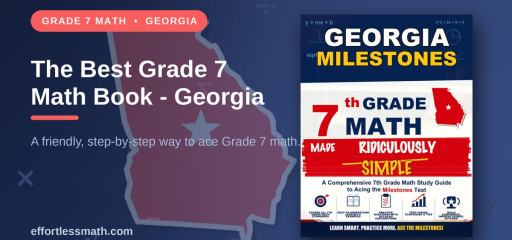
For a Georgia student working through seventh grade math, the book we recommend is Georgia Milestones Grade 7 Math Made Ridiculously Simple.
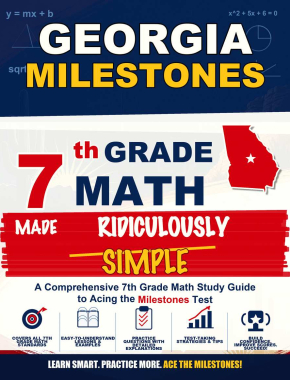
The book is exactly what its title says. Each topic begins with a clear, friendly explanation, then a worked example that shows every step, then practice with answer keys for instant feedback. It is aligned to Georgia’s standards and the Milestones assessment, and it is built to prepare a student both for the seventh grade test and for the jump to Grade 8 math.
Because the explanations are complete, the book teaches the student directly, with no tutor required. That makes it a dependable choice for homeschoolers, for summer catch-up, and for any student whose class has pulled ahead of them.
How to study with it
The routine that turns the book into real progress is simple:
- Short, regular sessions beat long, rare ones. Half an hour a few times a week is plenty.
- Use a pencil on every problem. Math is learned by doing it.
- Check answers as you go and study the misses. They show exactly what to practice next.
- Do not move on until a section feels easy. A weak spot left behind tends to resurface in Grade 8.
When seventh grade is done, Grade 8 math is next. Our guide to the best Grade 8 math book for Georgia students carries the same approach into the bridge year.
How to use this book during the school year
A strong math book works best when it becomes part of the weekly routine, not something saved only for the week before a test. For a Georgia Grade 7 student, the most useful rhythm is simple: preview the lesson, work through two or three examples, complete a short practice set, then review the missed problems while the mistake is still fresh.
Parents do not need to reteach the whole course. Their best role is to help the student slow down, show work clearly, and name the exact step that caused trouble. If the mistake is a computation error, assign a few fluency problems. If the mistake is a setup error, return to the explanation and copy one worked example before practicing again.
Skills to check before moving on
Before leaving a Grade 7 chapter, make sure the student can do more than recognize the topic. A student is ready to move forward when they can:
- solve ratio, proportion, percent, and unit-rate problems
- work accurately with integers, rational numbers, and signed operations
- write, simplify, and solve expressions and equations
- handle geometry, probability, data, and multi-step word problems with organized work
- check an answer and explain why it is reasonable
This quick check prevents the most common problem in math study: moving ahead while the student only half-understands the previous lesson. That half-understanding often looks fine during easy practice, but it breaks down on mixed review and state-style questions.
A simple weekly study plan
| Day | What to do |
|---|---|
| Day 1 | Read the lesson, copy one worked example, and talk through the steps. |
| Day 2 | Complete a short practice set without rushing. Mark every uncertain problem. |
| Day 3 | Review missed questions, correct the work, and write one sentence explaining each error. |
| Day 4 | Do mixed review so older skills stay active while new topics are added. |
| Day 5 | Try a short timed set to build focus and confidence. |
This schedule is intentionally simple. Consistency matters more than long sessions. Twenty to thirty focused minutes several times a week usually produces better results than one long study session that leaves the student tired and frustrated.
What to do if your child is already behind
If your child is missing earlier skills, do not rush through the current chapter just to stay on pace. Start with the first lesson that feels shaky, rebuild that foundation, and then return to the current assignment. In math, catching up usually means repairing one small skill at a time, not trying to relearn the whole year at once.
A good sign of progress is not simply getting more answers correct. It is seeing cleaner work, fewer skipped steps, and better explanations. When a student can show the process clearly, they are much more likely to handle Georgia's classroom work, homework, and year-end assessment questions with confidence.
Used this way, the book becomes more than a product recommendation. It becomes a practical study system: learn the lesson, practice the skill, correct mistakes, and keep old topics alive until the student is ready for the next grade level.
Questions Georgia families ask
How is seventh grade math tested in Georgia?
Seventh grade math is assessed through the Georgia Milestones program. The skills it checks lead directly into Grade 8 math and, beyond it, Algebra 1.
Why does seventh grade math suddenly feel harder?
Because it shifts from recall to reasoning, ratios, negative numbers, equations. That jump is normal, and clearer teaching is the fix.
Can my child use this book without a tutor?
Yes. It was written to teach a student directly, with self-contained explanations and answer keys for instant feedback. It also works well alongside a tutor or a helping parent.
My child understands the lessons but loses points on the test. Can this help?
Yes. That gap usually closes once a student has practiced enough Milestones-style questions that the real test feels familiar.
The bottom line
When seventh grade math suddenly feels harder, it is usually the subject growing up, not the student falling behind. Georgia Milestones Grade 7 Math Made Ridiculously Simple gives a student the clear, patient teaching that meets that shift head on, plus honest practice for the Milestones. Get this year right, and Grade 8 begins on solid ground.

Related to This Article
More math articles
- Full-Length HiSET Math Practice Test-Answers and Explanations
- The Ultimate TSI Math Formula Cheat Sheet
- The Best Grade 4 Math Book for Michigan Students
- How to Find the Polar Form of Complex Numbers?
- Congressional limits on the executive
- TSI Math Practice Test Questions
- The Ultimate CBEST Math Formula Cheat Sheet
- Using a Table to Write down a Two-Variable Equation
- The Best Grade 3 Math Book for Florida Students
- Formal presidential powers













What people say about "The Best Grade 7 Math Book for Georgia Students"?
No one replied yet.