Numerical Expressions for 5th Grade: Write and Evaluate
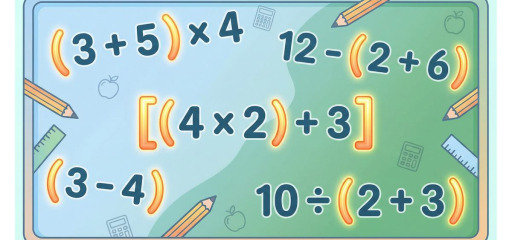
Numerical expressions are mathematical phrases that use numbers and operations (+, −, ×, ÷) to represent a quantity. Unlike equations, expressions do not have an equals sign with something on the other side. They are calculations waiting to be evaluated. In Grade 5, students write expressions from verbal descriptions, interpret expressions, and use parentheses to show which operations to do first. This skill bridges arithmetic and algebra and helps students translate real-world situations into math.
When we write “add 5 and 3, then multiply by 4,” we must use parentheses to show that the addition happens first: \((5 + 3) \times 4\). Without parentheses, \(5 + 3 \times 4\) would be evaluated as \(5 + 12 = 17\) (multiplication first), which is different from \((5 + 3) \times 4 = 32\). The words “sum of,” “difference between,” “product of,” and “quotient of” often indicate that we need parentheses around that part of the expression.
DETAILED EXPLANATION
Key phrases and how they translate:
• “Sum of A and B” → (A + B)
The Absolute Best Book to Ace Grade 5 Math
• “Difference of A and B” → (A − B), with order mattering (usually “A minus B”)
• “Product of A and B” → A × B or (A × B)
• “Quotient of A and B” → A ÷ B
• “Triple the sum of …” → 3 × (sum)
• “Add A and B, then multiply by C” → (A + B) × C
When a phrase says to do one operation first, then another, use parentheses around the first operation. Example: “Subtract 3 from 10, then divide by 7” → \((10 – 3) \div 7\).
The Ultimate Middle School Math Bundle: Grades 6 to 8
WORKED EXAMPLES WITH STEP BY STEP SOLUTIONS
Example 1
Write an expression for: “Add 5 and 3, then multiply by 4.”
Solutions:
Step 1: The phrase says to add first, then multiply. So we need the sum (5 + 3) and then multiply that by 4.
Step 2: Use parentheses so addition is done first: \((5 + 3) \times 4\).
Step 3: Without parentheses, \(5 + 3 \times 4\) would mean \(5 + 12 = 17\), which is wrong. We want \((5 + 3) \times 4 = 8 \times 4 = 32\).
Answer: \((5 + 3) \times 4 = 32\)
Example 2
Write an expression for: “Triple the sum of 6 and 4.”
Solutions:
Mastering Grade 5 Math
Step 1: “Triple” means multiply by 3. “The sum of 6 and 4” means \(6 + 4\).
Step 2: We triple that sum, so we multiply the sum by 3: \(3 \times (6 + 4)\).
Step 3: Evaluate: \(6 + 4 = 10\); \(3 \times 10 = 30\).
Answer: \(3 \times (6 + 4) = 30\)
Example 3
Write an expression for: “Subtract 8 from 20, then divide by 4.”
Solutions:
Step 1: “Subtract 8 from 20” means \(20 – 8\). We do that first.
Step 2: “Then divide by 4” means we take the result and divide by 4. Use parentheses: \((20 – 8) \div 4\).
Step 3: Evaluate: \(20 – 8 = 12\); \(12 \div 4 = 3\).
Answer: \((20 – 8) \div 4 = 3\)
Example 4
Write an expression for: “The product of 7 and the sum of 2 and 5.”
Solutions:
Step 1: “The sum of 2 and 5” is \(2 + 5\).
Step 2: “The product of 7 and [that sum]” is \(7 \times (2 + 5)\).
Step 3: Evaluate: \(2 + 5 = 7\); \(7 \times 7 = 49\).
Answer: \(7 \times (2 + 5) = 49\)

Related to This Article
More math articles
- How to Identify an Outlier
- The Best Grade 8 Math Book for South Carolina Students
- The Best Grade 5 Math Book for Alaska Students
- Multiplying Decimals Practice — Free Step-by-Step Drills
- Equipment Needed for Online Math Teaching
- Polynomial Division Calculator — Long & Synthetic (Free)
- Distributing Decimals: How to Multiply with a 1-digit Whole Number
- The Best Grade 3 Math Book for North Carolina Students
- Best equipment for online math teachers
- Religious exemptions
What people say about "Numerical Expressions for 5th Grade: Write and Evaluate"?
No one replied yet.