YOUR CLEP STUDY COMPANION
CLEP U.S. History I 101: Wartime Government, Economy, and Dissent
Lesson 18.6 of Chapter 18 of the U.S. History to 1877 study guide on Effortless Math covers CLEP U.S. History I 101: Wartime Government, Economy, and Dissent: the key terms, the core ideas, and worked examples showing how this topic is tested on the exam.
Lesson 18.6 of Chapter 18 of the U.S. History to 1877 study guide on Effortless Math covers CLEP U.S. History I 101: Wartime Government, Economy, and Dissent: the key terms, the core ideas, and worked examples showing how this topic is tested on the exam.
U.S. History to 1877 | Chapter 18 | Lesson 18.6
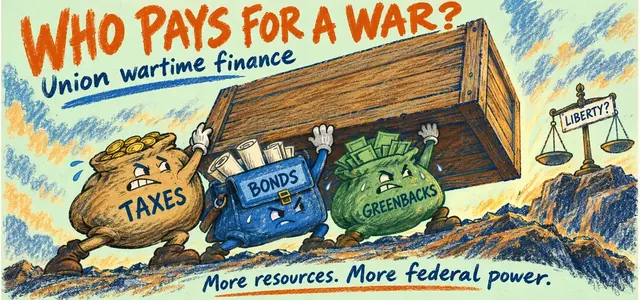
With southern representatives absent, Republicans enacted the Homestead Act, Morrill Land-Grant College Act, Pacific Railway Acts, higher tariffs, a national banking system, and federal paper money. These measures financed war and advanced a long-term free-labor development program. The Union government also expanded taxation and borrowing. Lincoln suspended habeas corpus in certain contexts, provoking constitutional controversy. Elections continued, and opposition Democrats criticized emancipation, conscription, and executive power.
These measures worked as a system. Taxes and bonds raised revenue. Greenbacks supplied currency. Nationally chartered banks purchased federal bonds and issued more uniform notes. Land and railroad legislation encouraged settlement and transport beyond the immediate battlefield. Their beneficiaries and costs were unequal, especially on Native land, but together they show that wartime state building could reshape the postwar economy rather than disappear at peace.
The Confederacy centralized more than states’-rights rhetoric suggested. It conscripted soldiers, impressed supplies, taxed in kind, and regulated economic life. Weak taxation, blockade, transportation breakdown, and excessive currency issuance contributed to severe inflation. Both governments expanded power because modern war demanded resources, revealing tension between political ideals and survival.
Modeled comparison The Union and Confederacy both centralized, but not with equal capacity. Compare revenue systems, banking, transport, legitimacy, and access to markets rather than simply counting laws.
A focused video lesson
Use this lesson from ColumbiaLearn to review the period and its central historical problem. Pause when the video reaches the turning point named above.
Video: MOOC | Financing the War | The Civil War and Reconstruction, 1861-1865 | 2.6.5, ColumbiaLearn.
Check your understanding
- The National Banking Acts helped create
- one central bank owned and directed by the Confederacy.
- free coinage of silver at a fixed legal ratio.
- nationally chartered banks issuing more uniform bank notes.
- a wartime financial system without federal borrowing.
- replacement of federal taxes with private bank subscriptions.
- Confederate conscription demonstrates
- reliance on state militias without national authority.
- the sufficiency of voluntary enlistment throughout the war.
- a permanent transfer of military control to state governors.
- decentralization as the main answer to manpower loss.
- wartime centralization despite states’-rights rhetoric.
- Select all Union wartime measures:
- Homestead Act,
- land-grant colleges,
- Pacific Railway Acts,
- greenbacks,
- national banking.
- Explain why war can expand government even when leaders praise limited power.
Write a brief response using a named fact from the lesson.
Open the answers and reasoning
Independent preparation. CLEP is a registered trademark of the College Board, which does not endorse this lesson.

Related to This Article
More math articles
- Inverse Trig Calculator — arcsin, arccos, arctan
- HiSET Testing Accommodations for Students with Disabilities
- How to Solve Finite Geometric Series? (+FREE Worksheet!)
- Mexican American and Asian American Citizenship and Resistance
- Elements, Compounds, and Mixtures
- Algebra Puzzle – Challenge 36
- How to Solve Theoretical Probability?
- Grade 3 Math: Word Problems: Addition and Subtraction
- Louisiana LEAP Algebra 1 Free Worksheets: Free Algebra 1 PDF Worksheets with Clear Answer Keys
- Florida Algebra 1 EOC Practice Test PDF with Answers for 2026












What people say about "Wartime Government, Economy and Dissent"?
No one replied yet.