Ecology and Ecosystems: A Beginner’s Guide
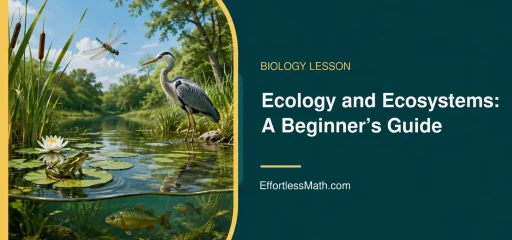
During a dry summer, soil moisture falls and grass growth slows. Herbivores have less food. A later decline in predators might follow from that shortage, although you would need observations to rule out disease or movement to another area. Ecology investigates these connections among organisms and their surroundings.
The scale of a question matters. Deer living in one area form a population. The deer, grasses, insects, fungi, and other interacting populations form a community, while a study that also considers rainfall, temperature, and soil concerns the ecosystem.
Follow a population through time
Births and immigration add individuals. Deaths and emigration remove them. To explain a changing population, identify which process changed, keeping in mind that a count made in one place cannot distinguish death from movement without further observations.
Under favorable conditions, a population can grow rapidly. Resource limits and interactions eventually matter. Carrying capacity describes an approximate population size that current conditions can support, so its value can change after a drought, disease outbreak, or habitat alteration. The value belongs to a particular setting and model, rather than being a permanent number attached to a species.
Identify what each organism gains or loses
When two organisms use the same limited resource, competition can reduce their success. A predator gains food by consuming prey. Parasites obtain resources from a host and harm it, while mutualistic partners both benefit in the interaction being measured.
These descriptions depend on evidence. A fungus that helps a plant obtain nutrients under one set of soil conditions might provide little benefit under another. Calling the relationship mutualism does not mean every possible condition produces an equal benefit for both partners.
A habitat is the place an organism lives. Its niche includes the resources it uses, the conditions it tolerates, and its interactions. Two birds may inhabit the same woodland while feeding in different parts of a tree, reducing overlap in the resources they use.
Read food-web arrows as transfers
An arrow from grass to rabbit shows matter and energy moving from the resource to its consumer. Producers build organic molecules using an energy source. Consumers obtain organic material by feeding, and decomposers process dead material and wastes from across the food web.
At each stage, metabolism disperses some energy as heat. A feeding diagram therefore needs a continuing energy input. Carbon, nitrogen, water, and other materials can move repeatedly between organisms and their environment. Decomposers contribute to that cycling, but they cannot recycle dispersed heat into the original sunlight supply.
Measure disturbance and recovery
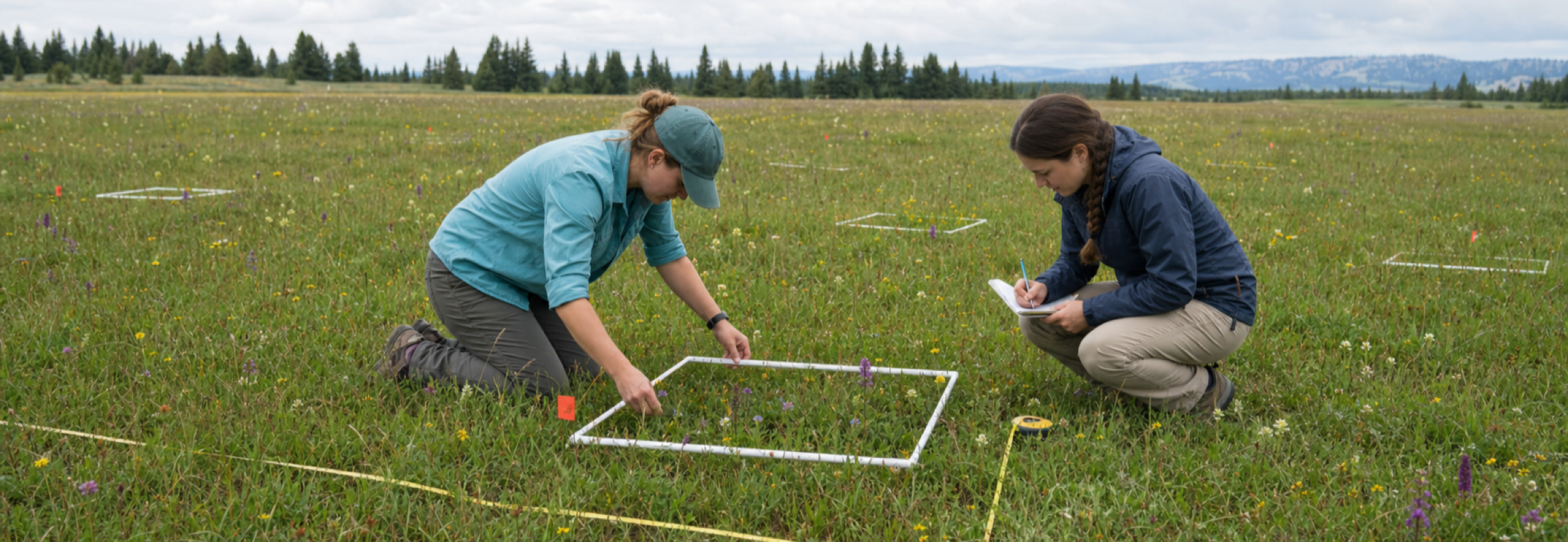
A quadrat provides a defined area for recording plants or other suitable organisms, and sampling several representative locations helps estimate abundance without relying only on the greenest patch. The method still needs a placement rule, a clear counting procedure, and enough samples to describe variation.
After a disturbance, species composition can change through succession. Primary succession begins on a surface with little or no developed soil. Secondary succession follows a disturbance where soil remains. Neither label specifies one inevitable sequence ending in a permanent community.
Suppose rabbit and hawk counts decline after the dry summer. Reduced plant production offers a plausible connection, but disease, hunting, or migration might also matter. A strong explanation needs comparisons that distinguish these alternatives, such as measurements from another grassland where rainfall stayed near its usual level while other conditions were similar.
Watch a short lesson
This video reviews the roles of producers, consumers, and decomposers. As you watch, notice that each role describes how matter and energy enter or leave an organism.
Watch communities respond to change
Start at 2:29 for succession and 7:35 for competition and niches. Connect each interaction to the resources an organism uses. A succession model describes community change; it does not require one inevitable, permanent endpoint.
Can you check your understanding?
Answer before opening each explanation.
-
Which ecological level includes soil and temperature as well as a community?
Check the answer
An ecosystem. A community refers to the interacting living populations.
-
What four processes change population size?
Check the answer
Births, deaths, immigration, and emigration.
-
Why can carrying capacity change during drought?
Check the answer
Water and food availability can change, altering the population size that the habitat supports.
-
What does a grass-to-rabbit arrow mean?
Check the answer
Matter and energy pass from grass to the rabbit when it feeds.
-
What can decomposers return to forms other organisms can use?
Check the answer
Materials such as carbon and mineral nutrients. They do not restore dispersed metabolic heat as sunlight.
-
Does a simultaneous decline in rabbits and hawks prove that one caused the other?
Check the answer
No. Their counts may respond to a shared cause or several influences. Timing, mechanisms, and comparisons help distinguish explanations.
Where does ecology connect to the rest of biology?
Ecology depends on ideas from evolution and natural selection, photosynthesis and respiration, classification and biodiversity, and experimental evidence. Return to the Biology Learning Hub for the complete chapter-by-chapter path.
For the AP course sequence and practice tests, use the AP Biology study hub.

Related to This Article
More math articles
- The Dust Bowl and the Environment of Crisis
- 6th Grade MEAP Math Practice Test Questions
- Texas STAAR Algebra 1 Free Worksheets: 59 Printable TEKS-Aligned Algebra 1 PDFs with Answer Keys
- Why Prejudice and Conflict Develop
- How to Find Probability of an Event? (+FREE Worksheet!)
- How to Understand the Concept of Scale Changes: Area and Perimeter
- Compute comparative advantage
- How to Add and Subtract Polynomials Using Algebra Tiles
- The Best Grade 8 Math Book for Iowa Students
- Texas STAAR Algebra 1 EOC Practice Test PDF with Answers











What people say about "Ecology and Ecosystems: A Beginner's Guide"?
No one replied yet.