CLEP U.S. History I 059: Wage Labor, Class, and Early Unions
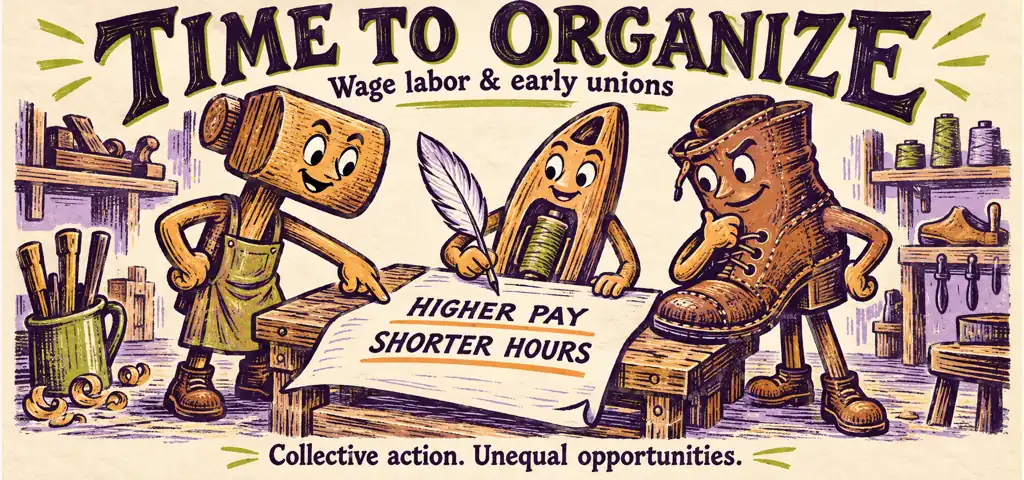
Lesson 11.4 of Chapter 11 of the U.S. History to 1877 study guide on Effortless Math covers CLEP U.S. History I 059: Wage Labor, Class, and Early Unions: the key terms, the core ideas, and worked examples showing how this topic is tested on the exam.
U.S. History to 1877 | Chapter 11 | Lesson 11.4
Before factories dominated, skilled artisans often learned through apprenticeship and hoped to become independent masters. The spread of larger shops, standardized parts, subcontracting, and mechanized production weakened that path in some trades. More people worked for wages without expecting to own a shop. Employers described labor as a freely exchanged commodity. Workers answered that political liberty required time, skill, security, and bargaining power, not merely the legal ability to accept a contract.
Cities displayed new class distinctions. Merchants and manufacturers accumulated capital. An expanding middle class of clerks, professionals, shopkeepers, and managers celebrated self-control and respectability. Wage earners faced irregular employment and crowded housing. These categories were porous. A journeyman might become a proprietor, while a failed owner might become a wage worker. Race and gender structured opportunity: women received lower wages and were concentrated in certain work. Black workers faced exclusion from many skilled trades and unions.
Workers created mutual-aid societies, trade unions, workingmen’s parties, and strikes. They demanded higher pay, a ten-hour day, public education, an end to imprisonment for debt, and reforms of lien and conspiracy law. Courts had sometimes treated worker combinations as criminal conspiracies. In Commonwealth v. Hunt (1842), Massachusetts’s highest court held that unions were not inherently illegal and that their purposes and methods mattered. The ruling did not instantly legalize every strike nationwide, but it signaled greater legal room for organization.
The ideal of “free labor” grew from these changes. It claimed that a worker could sell labor temporarily, save, acquire property, and rise. Supporters contrasted this mobility with slavery. The ideal expressed genuine opportunity for some white men, yet economic cycles, low wages, discrimination, and property concentration limited it. It could also hide women’s unpaid household labor and the dependence of northern industry on slave-grown materials.
Watch, then test the claim
This CrashCourse lesson supplies a second explanation of the same period. Note where chronology, cause, and perspective connect.
Video: The Market Revolution: Crash Course US History #12, CrashCourse.
Check your understanding
- Early trade unions most commonly tried to improve wage workers’ position through
- federal ownership of factories
- restoration of guild monopolies by Congress
- replacement of wages with land grants
- shorter hours and higher wages
- prohibition of interstate manufactured goods
- Commonwealth v. Hunt (Massachusetts, 1842) is best understood as holding that
- strikes could not be prosecuted under state conspiracy law
- Congress had established a national ten-hour workday
- worker combinations were not criminal merely because they existed
- apprentices could disregard contracts that fixed their wages
- employers lost civil remedies against organized workers
- Deep Practice: select all that apply. Limits on free-labor mobility included
- panics
- discrimination
- low wages
- unequal bargaining power
- guaranteed landownership
- Deep Practice: open response. Contrast a worker’s and an employer’s likely meaning of “freedom” in a wage dispute.
Write a brief response using a named fact from the lesson.
Open the answers and reasoning
Independent preparation. CLEP is a registered trademark of the College Board, which does not endorse this lesson.

Related to This Article
More math articles
- The Best Grade 6 ELA Practice Tests for New Hampshire Students
- How to Become a Better Math Problem Solver & Still Have Steady Nerves?
- Analyzing the Mikki Mase Gambling Strategy Using Math
- Fixing Misplaced Modifiers
- How to Multiply Binomials? (+FREE Worksheet!)
- MTEL General Curriculum Math Flashcards
- How to Use Expanded Form to Multiply One-Digit Numbers By 3-digit or 4-digit Numbers
- Rational and Irrational Numbers: Complete Guide with Video and Examples
- How to Solve the Ambiguous Case (SSA) in Trigonometry
- How to Find the Integral of Radicals















What people say about "Wage Labor, Class, and Early Unions"?
No one replied yet.