RBT Partial Interval vs Whole Interval vs Momentary Time Sampling (2027 Prep)
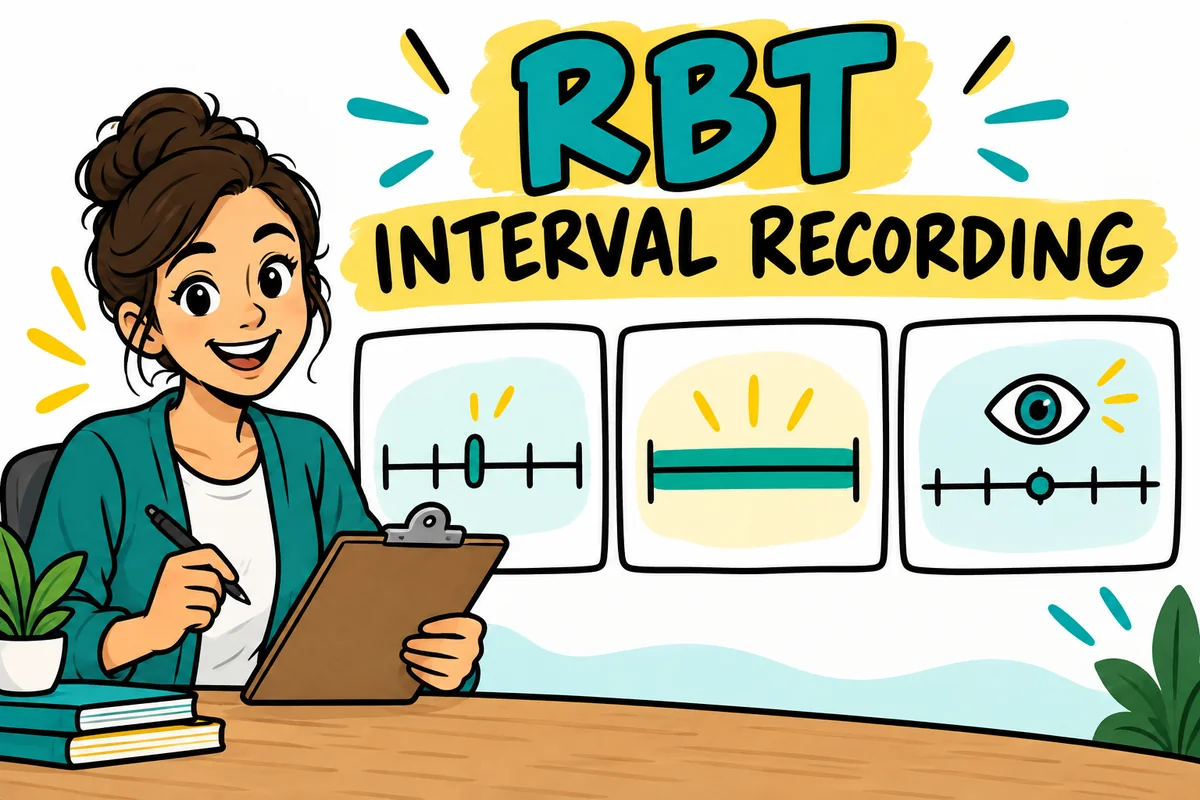
Picture a sixty-second observation with four separate hand raises. You watched the same behavior for the same amount of time, yet three recording methods will give you three different percentages. Why? Each method asks you to look for a different condition.
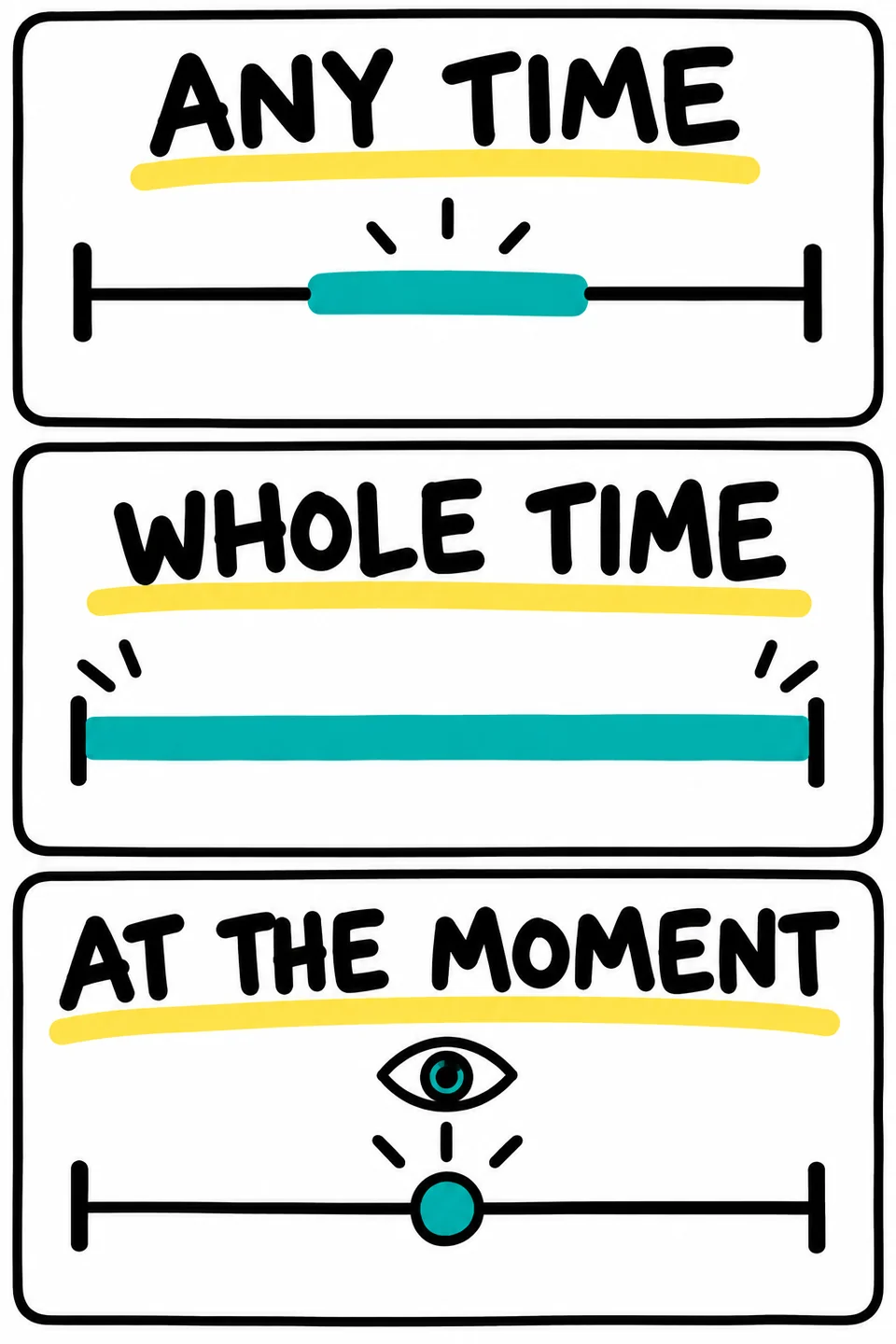
Partial interval records whether the behavior happened at any time in an interval. Whole interval requires it throughout that interval, while momentary time sampling checks whether it is happening at one scheduled instant. Keep those conditions beside the data sheet as you work. Interval Sampling Methods and Measurement Error: A Computer Simulation
Where this fits in RBT study
The BACB's third-edition RBT Test Content Outline, used for examinations beginning in 2026, lists these three discontinuous procedures under task A.2. BACB RBT Test Content Outline, third edition Our purpose here is to help you read the observation rules and understand what the resulting numbers mean.
The invented timeline below is a teaching example. In client work, use your supervisor's assigned procedure and behavior definition, including the interval length, timing signals and rules for incomplete observations.
Start with one shared timeline
For an adult learner raising a hand to request a speaking turn, define an episode as starting when the hand crosses above shoulder height and ending when it drops below shoulder height again. In this example, the observer has a clear view throughout all sixty seconds.
The hand is raised from 2 to 4 seconds, 12 to 32 seconds, 37 to 39 seconds, and 52 to 58 seconds. It is down at all other times. No episode begins or ends exactly on a ten-second boundary, which keeps the interval-end checks unambiguous.
Use six equal ten-second intervals, with momentary checks at 10, 20, 30, 40, 50 and 60 seconds. Include the final check at 60 seconds. We are scoring the three methods separately against a complete record, so you can compare them without changing the behavior.
Partial interval: any occurrence earns a yes
Look at the first interval, from 0 to 10 seconds. The hand was up from 2 to 4, so mark yes, even though it was down for the other eight seconds. You are checking whether any part of the behavior appeared in that window.
The 40-to-50-second interval is the only empty window. Each of the other five intervals contains some hand raising, so the partial-interval record has five yes marks out of six opportunities.
Partial-interval percentage = (5 / 6) x 100 = about 83.33%.
A yes mark does not count individual episodes. Three hand raises inside one interval would still produce one yes for that interval. Keep that distinction in mind if a description asks for the number of occurrences.
Whole interval: the behavior must fill the window
Return to 0 to 10 seconds. Two seconds of hand raising leaves eight seconds with the hand down, so this interval receives a no under the whole-interval rule. You need the behavior to continue throughout the observation window.
Only the interval from 20 to 30 seconds qualifies. That window falls entirely inside the long hand raise that began at 12 seconds and ended at 32, whereas every other window contains at least some time with the hand down.
Whole-interval percentage = (1 / 6) x 100 = about 16.67%.
Watch the entire window. If you look only at the final instant and mark yes because the hand is up, you still need evidence about all the preceding seconds to establish a whole-interval yes.
Momentary time sampling: inspect the scheduled instant
At 10 seconds, the hand is down. At 20 and 30 seconds, it is up during the long episode, and it is down at the remaining checks of 40, 50 and 60 seconds. Two of the six scheduled instants receive yes marks.
Momentary-sample percentage = (2 / 6) x 100 = about 33.33%.
You can see a brief hand raise at 37 to 39 seconds in the full record. The scheduled check at 40 seconds misses it. That is a consequence of sampling at particular instants, so it does not justify changing the 40-second mark to yes.
For this method, the planned instant controls the entry. If you glance over several seconds after the signal, the behavior you see then cannot establish what was happening at the scheduled instant, so document a missed check according to the assigned procedure.
Read the three records side by side
The table applies every rule to the same six intervals. Read across one row before moving down the page. A yes in one column can sit beside a no in another because the scoring condition changed.
The interval from 10 to 20 seconds makes this especially clear. Hand raising begins at 12 seconds, so partial interval receives yes, whole interval receives no, and the momentary check at 20 seconds receives yes.
| Interval (s) | Partial | Whole | Sample instant (s) | Momentary |
|---|---|---|---|---|
| 0-10 | Yes | No | 10 | No |
| 10-20 | Yes | No | 20 | Yes |
| 20-30 | Yes | Yes | 30 | Yes |
| 30-40 | Yes | No | 40 | No |
| 40-50 | No | No | 50 | No |
| 50-60 | Yes | No | 60 | No |
Why these percentages are not exact duration
The full timeline lets us calculate actual duration independently. The four episodes last 2, 20, 2 and 6 seconds, adding to 30 seconds out of the 60-second observation.
Actual percentage of time = (30 / 60) x 100 = 50%.
Compare that with 83.33% positive partial intervals, 16.67% positive whole intervals and 33.33% positive momentary samples. They describe different features of this record, and none equals its exact duration percentage. Label the numerator in your notes.
With equal contiguous intervals, complete observation and correct scoring, partial intervals include all the time windows containing any behavior, while whole intervals include only windows completely occupied by it. Relative to actual percentage of time, partial-interval scoring can overestimate and whole-interval scoring can underestimate. The records do not reveal the number of responses.
Momentary samples can miss an episode or land inside one. Their estimate can fall above or below the actual proportion of time, depending on when the behavior occurs relative to the checks. Sampling research examines these errors and their dependence on the observation arrangement. Interval Sampling Methods and Measurement Error: A Computer Simulation
In a treatment-analysis study of five data sets, researchers compared partial interval and momentary sampling with continuous records and found that agreement depended on the comparison, giving you a reason to question universal claims about the best method. Meany-Daboul and colleagues: comparison of recording methods
Choose the record your procedure asks for
Before an observation, check the operational definition and the question each mark answers, then confirm the timer settings and the procedure for a missed check. Need a blank sheet? The blank interval-record.csv includes those setup fields and separate yes/no columns for study comparison. Download the blank interval record (CSV)
A missed observation needs its own notation. Counting it as no would claim you observed the absence of behavior, and silently removing it would change the denominator. Follow the assigned handling rule and explain any gap to your supervisor. IRIS Center: Measuring Behavior
The comparison sheet keeps all three methods visible for learning. An actual recording form should match the procedure you have been assigned, so there is no need to collect every measure at once.
Keep working on the measurement skill
If you can explain why the first interval receives yes for partial interval and no for the other two methods, return to the timeline and trace the long episode across intervals 2, 3 and 4. Notice how one continuous hand raise occupies more than one interval.
Use the Effortless Math RBT study hub to continue with continuous measurement, graph interpretation or another part of the outline. Effortless Math RBT study hub
Official outline and research checked October 11, 2026. This independent study tutorial uses an original hypothetical observation. 2027 preparation edition. Official specifications were checked on October 11, 2026. Confirm current rules with the exam provider before a later appointment.

Related to This Article
More math articles
- The Ultimate 7th Grade Scantron Math Course (+FREE Worksheets)
- ALEKS Math FREE Sample Practice Questions
- How to Find Volume by Spinning: Shell Method
- Innovative Forecasts: Population Models are Predicting the Future
- Top 10 Websites to Learn About Scholarships, Federal Aid, and Student Funding
- How to Solve Theoretical Probability?
- Total revenue follows elasticity
- Free Grade 7 English Worksheets for Utah Students
- Algebra Puzzle – Challenge 38
- 5th Grade PSSA Math FREE Sample Practice Questions





















What people say about "RBT Partial Interval vs Whole Interval vs Momentary Time Sampling (2027 Prep) - Effortless Math"?
No one replied yet.