Grade 6 Math: Area of Rectangles and Squares
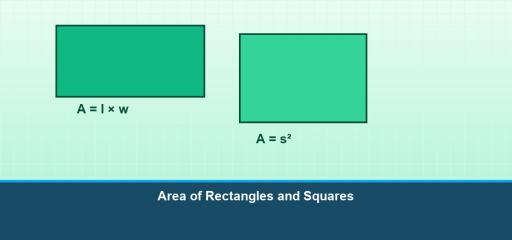
TL;DR: Picture a tiled floor, counting the tiles inside a rectangle is what area really is. Multiply length times width for a rectangle, and for a square (where all four sides are equal) it is just side times side. Both formulas come down to the same idea: how many unit squares fit inside the shape. Don’t forget to write your answer in square units like centimeters squared or feet squared, the unit tells everyone you are talking about area, not length.
Key takeaways:
- Rectangle area formula: \(A = l \times w\) (length times width).
- Square area formula: \(A = s^2\) (side length squared).
- Both sides must be in the same unit before multiplying.
- Area is measured in square units – always include them.
- A square is a special rectangle where length and width are equal.
Grade 6 focus: The area of a rectangle is the number of unit squares that cover it. The formula is \(A = \ell \times w\) (length times width). A square with side length \(s\) has area \(A = s^2\).
Video lesson: Watch this Math with Mr. J tutorial on area of rectangles and squares.
Units matter
Area is in square units (square inches, square meters, etc.). If sides are in inches, area is in square inches.
Decimals and fractions
Multiply as with whole numbers, then count decimal places, or multiply numerators and denominators for fractional side lengths.
Example: rectangle \(2.5\) m by \(4\) m: \(A = 2.5 \times 4 = 10\) square meters.
Squares
For a square with side \(3\frac{1}{2}\) ft, \(A = \left(3\frac{1}{2}\right)^2 = \left(\frac{7}{2}\right)^2 = \frac{49}{4} = 12\frac{1}{4}\) square feet.
Common mistakes
- Confusing perimeter (\(2\ell + 2w\)) with area (\(\ell \times w\)).
- Forgetting to square the side for a square’s area.
- Mixing linear units with area units.
Real-world link
Flooring, painting, and tiling problems often ask for area, estimate first, then compute.
Step-by-Step Guide to Finding Area
The area of a rectangle or square is one of the most fundamental concepts in geometry. To find the area, we multiply the length by the width. For rectangles, \(A = l \times w\), where \(l\) is the length and \(w\) is the width. For squares, since all sides are equal, \(A = s^2\), where \(s\) is the side length.
Worked Examples: Area Calculations
Example 1: A rectangle has a length of 8 cm and a width of 5 cm. The area is \(A = 8 \times 5 = 40\) square centimeters.
Example 2: A square has sides of 6 inches. The area is \(A = 6^2 = 36\) square inches.
Common Mistakes to Avoid
- Forgetting to multiply length and width
- Confusing perimeter with area
- Using the wrong units in your answer
- Not aligning units before calculating
Related Topics to Explore
Practice Problems
- Find the area of a rectangle with length 12 cm and width 9 cm.
- A square garden has sides of 15 meters. What is the total area?
- If a rectangular room has an area of 120 square feet and a length of 15 feet, what is the width?
Recommended EffortlessMath Books
For a workbook that pairs with this page, Mastering Grade 6 Math walks your sixth grader through every grade-6 topic with worked examples and plenty of practice. For more story-problem reps, Mastering Grade 6 Math Word Problems is the matching word-problem book.
Frequently Asked Questions
What’s the formula for the area of a rectangle?
\(A = l \times w\), where \(l\) is the length and \(w\) is the width. The two sides have to be in the same unit. If a rectangle is 8 cm long and 5 cm wide, the area is \(8 \times 5 = 40\) square cm. Same formula every time.
What’s the formula for the area of a square?
\(A = s^2\), where \(s\) is the length of one side. Since all four sides of a square are equal, you only need one measurement. For a square with side 9 m, \(A = 9^2 = 81\) square meters.
Why is area in square units?
Area measures how much flat space a shape covers. We measure it in unit squares (a 1-by-1 square is one square unit). A 3-by-4 rectangle can hold 12 unit squares, so its area is 12 square units. The “square” in “square units” reminds you that area is two-dimensional.
What if the sides are in different units?
Convert one before multiplying. If a rectangle is 2 feet long and 18 inches wide, convert one side: 2 feet = 24 inches. Then \(A = 24 \times 18 = 432\) square inches. Or convert 18 inches to 1.5 feet: \(A = 2 \times 1.5 = 3\) square feet. Either works.
Can a rectangle have area but no length?
No. A rectangle needs positive length AND positive width to have any area. If either side is zero, the rectangle collapses to a line segment with zero area. Tests sometimes try to trick students with “a rectangle has perimeter 20 and width 0” – that’s a degenerate case with area 0.
How do I find the area of a square if I only know the perimeter?
The perimeter of a square is \(4s\). Divide by 4 to get the side, then square it. For a square with perimeter 24: side is \(24/4 = 6\), area is \(6^2 = 36\) square units.
How do I find the side length if I know the area?
For a square, take the square root of the area: \(s = \sqrt{A}\). A square with area 49 square units has side \(\sqrt{49} = 7\) units. For a rectangle you need more info (the other side or the perimeter) since two different rectangles can have the same area.
How is area different from perimeter?
Area is the inside (the surface), measured in square units. Perimeter is the outside (the boundary), measured in regular units. A 3-by-4 rectangle has area \(3 \times 4 = 12\) square units and perimeter \(2(3) + 2(4) = 14\) units. Different numbers, different meanings.
Walk me through a word problem.
“A rectangular garden is 12 m long and 7 m wide. What’s its area?” \(A = 12 \times 7 = 84\) square meters. Now “How many bags of soil at 4 sq m each do you need?” \(84 \div 4 = 21\) bags. The area formula is just step 1; many test problems chain a second step.
Where does this skill show up later?
Everywhere in geometry. Area of complex shapes (trapezoids, triangles, parallelograms) builds on rectangle area. Surface area of 3D shapes (boxes, cubes) is just adding up rectangle areas. Volume of rectangular prisms uses the same length-times-width idea times height. Master the basics here, and the rest is easier.
Related EffortlessMath Lessons
If a topic on this page feels rusty, these short lessons go deeper:
- How to find the area of rectangles
- How to find the area of shapes (resource currently unavailable)
- How to find perimeter and area
- How to find perimeter (resource currently unavailable)
- How to graph points on the coordinate plane

Related to This Article
More math articles
- Confidence Interval Calculator for a Mean (Free)
- Indiana Algebra 1 Free Worksheets: Free Skill-Targeted Algebra 1 Worksheets with Answer Keys
- Mutations and Genetic Evidence
- Delaware DeSSA Grade 4 Math Free Worksheets: Printable Test-Prep Worksheets with Answer Keys
- Conference committees
- Embark on Your ParaPro Math Mastery: Introducing the “ParaPro Math for Beginners” Companion eBook
- GED Test: Everything You Need to Know
- How to Find Domain and Range of Trigonometric Functions?
- Grade 7 Discussion and Research Skills: Stronger Speaking, Listening, Notes, and Sources
- The Ultimate Georgia Milestones Assessment Algebra 1 Course (+FREE Worksheets)
What people say about "Grade 6 Math: Area of Rectangles and Squares"?
No one replied yet.