How to Graph the Sine Function?

A step-by-step guide to graph the sine function

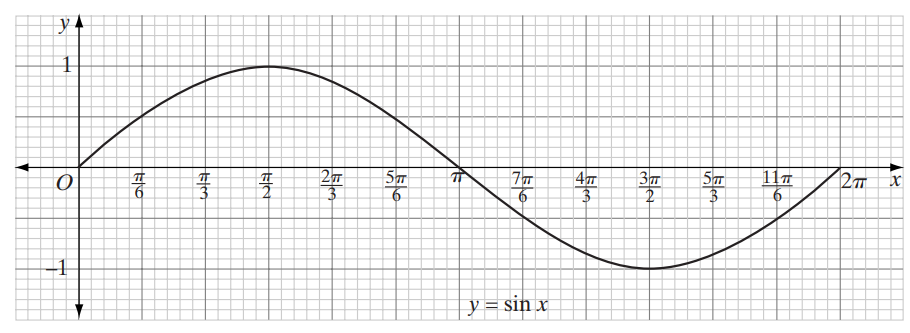
We can see how (x) and (y) change by using the graph:
Tutor-style math help
Graph the Sine Function: what to notice and how to work it
Trigonometry skill
A sine graph is a repeating wave. To sketch it well, mark the midline, amplitude, period, and five key points in one cycle.
What to notice first
For (y=Asin(Bx)+D), the amplitude is (|A|), the period is (2pi/|B|), and the midline is (y=D).
Common student mistake
Do not space the five key points randomly. Divide one period into four equal parts so the wave starts, rises, returns, falls, and returns again.
Key formulas and cues
(y=Asin(Bx)+D)
(text{amplitude}=|A|)
(text{period}=frac{2pi}{|B|})
(text{midline}=y=D)
A reliable path
- Choose the modelUse a right triangle, the unit circle, or a transformed graph.
- Track unitsConvert degrees and radians when needed.
- Use identitiesReplace complicated trig expressions with equivalent simpler ones.
Worked examples
Read a sine graph rule
Example: (y=3sin(2x)-1)
- Amplitude is |3|.
- Period is 2pi/2 = pi.
- Midline is y = -1.
Answer: Amplitude (3), period (pi), midline (y=-1).
Place five key points
Example: Graph one cycle of (y=sin x).
- Start at (0, 0).
- Use quarter-period steps: pi/2, pi, 3pi/2, 2pi.
- The y-values are 0, 1, 0, -1, 0.
Answer: ((0,0),(pi/2,1),(pi,0),(3pi/2,-1),(2pi,0)).
Try one before moving on
Try: Find the amplitude and period of (y=2sin(4x)).
Answer: Amplitude (2), period (frac{pi}{2}).
Next step: do the matching worksheet or quiz while the method is still fresh, then come back and explain the first step in your own words.
x
Graph the Sine Function: pop-up practice
Answer these quick questions, then use the feedback to decide which part of the lesson to review.
Choose an answer to begin.
1. For (y=4sin x), the amplitude is:
2. For (y=sin(3x)), the period is:
3. A sine graph's midline is:
- By increasing (x) from (0) to (frac{pi }{2}), (y) increases from (0) to (1).

- By increasing (x) from (frac{pi }{2}) to (pi), (y) decreases from (1) to (0).
- By increasing (x) from (pi) to (frac{3pi }{2}), (y) continues to decrease from (0) to (-1).
- By increasing (x) from (frac{3pi}{2}) to (2pi), (y) increases from (-1) to (0).
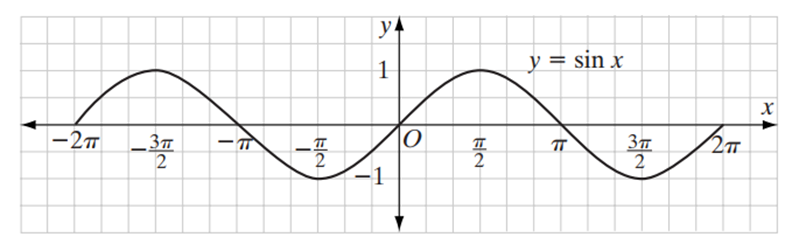
This pattern repeats itself when we plot a larger subset of the domain of the (sine) function. For example, add to the points given above the point whose (x)-coordinates are in the interval (-2pi le xle :0):


Original price was: $109.99.$54.99Current price is: $54.99.

Original price was: $109.99.$54.99Current price is: $54.99.

Related to This Article
More math articles
- Oscillations, Springs, and Pendulums
- Is your child ready for algebra 1?
- Free Grade 6 English Worksheets for Minnesota Students
- The Best Grade 6 ELA Practice Tests for North Carolina Students
- FREE SAT Math Practice Test
- Full-Length ALEKS Math Practice Test
- Maine Through Year Assessment Grade 4 Math Free Worksheets: Printable Grade 4 Math Practice for Every Skill
- TExES Core Subjects Math- Test Day Tips
- Intensity and salience
- Top 10 SSAT Middle Level Prep Books (Our 2023 Favorite Picks)
What people say about "How to Graph the Sine Function: Key Steps"?
No one replied yet.