The Mole and Molar Mass: Convert Grams to Molecules
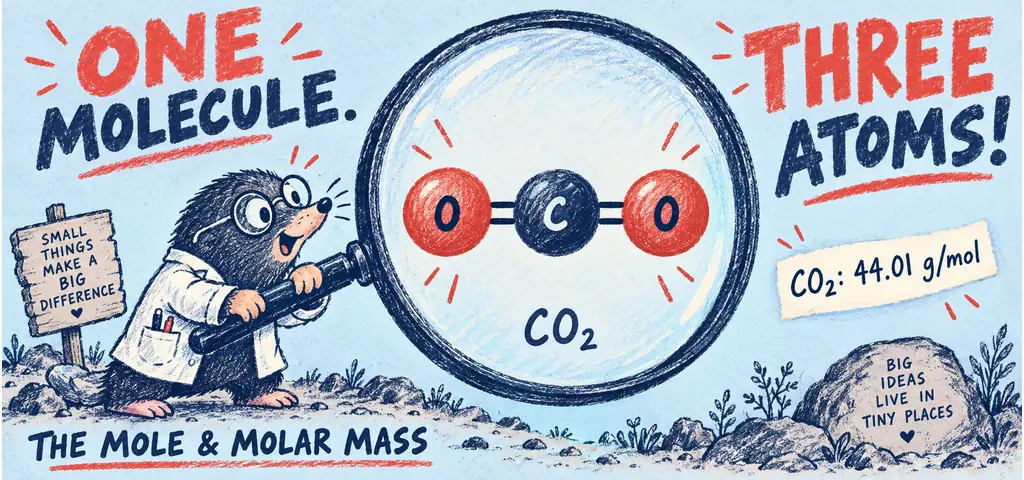
The mole is the SI unit of amount of substance. One mole contains exactly \(6.02214076\times10^{23}\) specified elementary entities. Molar mass is mass per mole of a substance. Together, molar mass and the Avogadro constant connect measured mass with numbers of atoms, molecules, ions, or formula units.
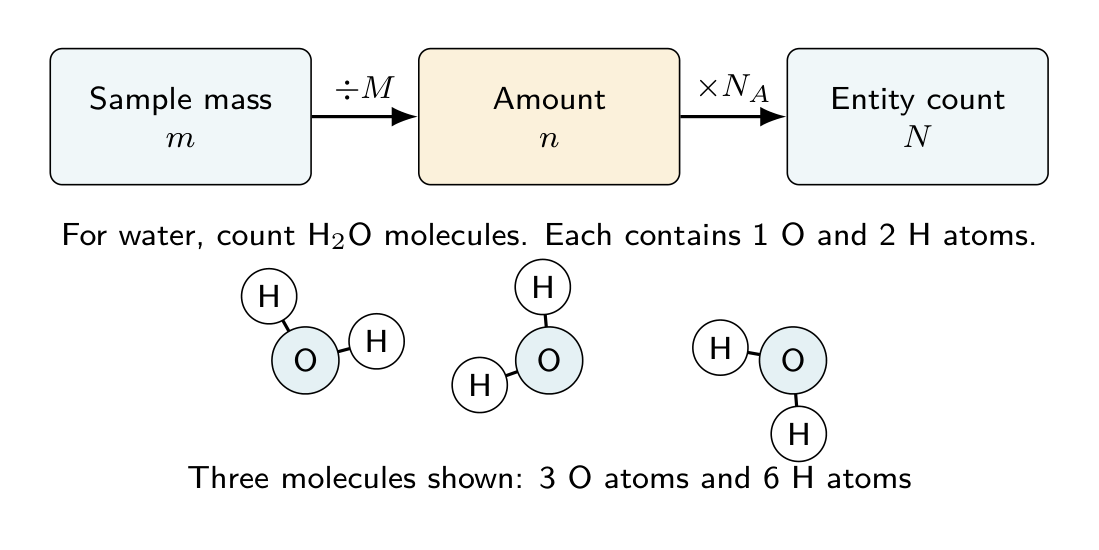
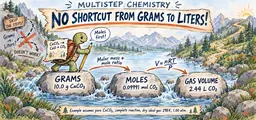
A balance measures grams, but a reaction equation compares numbers of particles. Moles connect those descriptions. To move between mass and particle count, identify the substance and the kind of particle being counted before you choose a conversion factor.
How do you find molar mass?
Add the atomic-mass contributions represented by the formula. Using 12.01 g/mol for carbon and 16.00 g/mol for oxygen, carbon dioxide has molar mass
The subscript 2 doubles oxygen’s contribution. Parentheses work the same way: an outside subscript multiplies the entire group inside.
Worked example: grams to molecules
How many carbon dioxide molecules are represented by 22.0 g of pure \(\mathrm{CO_2}\)? First convert mass to amount:
Keep the unrounded value for the next step:
The final answer has three significant figures, set by the measured mass. The Avogadro constant is exact.
What exactly are you counting?
One mole of \(\mathrm{CO_2}\) contains one mole of carbon atoms and two moles of oxygen atoms. It contains one mole of molecules in total. The number of atoms is therefore three times the number of molecules.
For an ionic compound such as sodium chloride, use formula units for the solid’s composition ratio. If discussing dissolved ions, state whether you are counting sodium ions, chloride ions, or all ions. The entity label changes the meaning of the number.
Which conversion path should you use?
- Write the chemical formula and the requested entity.
- Use molar mass to connect grams and moles.
- Use the Avogadro constant to connect moles and entities.
- Apply any formula subscripts needed for an atom or ion count.
- Check units and round at the end.
If you start with fewer grams than the numerical molar mass in grams per mole, expect less than one mole. That estimate catches a common multiply-versus-divide error.
Can you apply the idea?
-
What quantity does molar mass connect with amount in moles?
Check your answer
Mass, usually in grams.
-
Using 12.01 and 16.00 g/mol, find the molar mass of \(\mathrm{CO}\).
Check your answer
\(28.01\,\mathrm{g/mol}\).
-
How many moles are in 44.01 g of \(\mathrm{CO_2}\), using 44.01 g/mol?
Check your answer
\(1.000\,\mathrm{mol}\).
-
How many molecules are in 2.00 mol of a molecular substance?
Check your answer
\(1.20\times10^{24}\) molecules, to three significant figures.
-
How many moles of oxygen atoms are in 0.50 mol of \(\mathrm{CO_2}\)?
Check your answer
\(1.0\,\mathrm{mol}\), because each molecule contains two oxygen atoms.
-
Why is “particles” sometimes too vague in a final answer?
Check your answer
It can mean atoms, molecules, ions, or formula units. State the entity actually counted.
Watch the idea explained
Stoichiometry – Chemistry for Massive Creatures: Crash Course Chemistry #6, CrashCourse.
This selected excerpt runs from 5:59 to 8:45. Use molar mass to connect grams with moles, then convert moles to entity count. The modern Avogadro constant is exactly 6.02214076 × 10²³ per mole.
Where does this fit?
Use the chemistry learning hub to choose a lesson or practice test. Connect this topic with molecular shape and polarity, empirical and molecular formulas, chemical bonds and compound names, balancing chemical equations.
Sources for Further Study
OpenStax Chemistry 2e explains formula mass, the mole, and conversions between mass and entity count.
Continue with a chemistry study guide

Related to This Article
More math articles
- PSAT Math Worksheets: Free Topic Practice
- The Ultimate NYSTCE Grades 1-6 Math (222) Course (+FREE Worksheets & Tests)
- Algebra Puzzle – Challenge 32
- Inside the Math Gap Between Online Baccarat and the Pit-Boss Version
- The Ultimate ISEE Lower-Level Math Course (+FREE Worksheets & Tests)
- How to Prepare for the Praxis Core Math Test?
- Social Interaction, Groups, and Organizations
- Presidential veto
- Atmosphere, Oceans, and Earth Systems
- Full-Length 6th Grade PARCC Math Practice Test-Answers and Explanations




What people say about "The Mole and Molar Mass: Convert Grams to Molecules"?
No one replied yet.