Chemistry of Life: Biomolecules and Enzymes
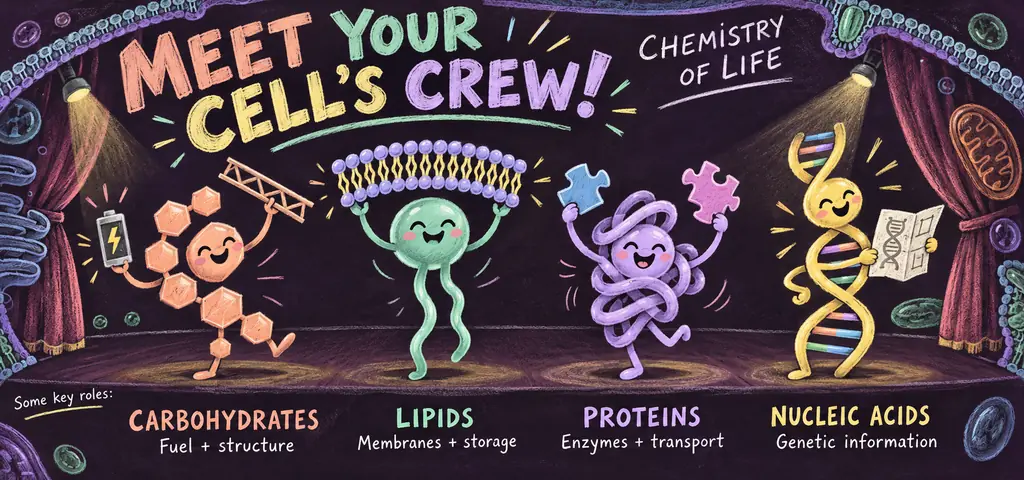
Chemistry of life, or biochemistry, examines the molecules and reactions of living systems. Carbohydrates, lipids, proteins, and nucleic acids have characteristic structural features and varied functions. Water and molecular interactions influence their behavior. Enzymes are biological catalysts that increase reaction rates through specific chemical interactions and are regenerated during the catalytic process.
Put phospholipids in water and they can arrange into a bilayer. Why that arrangement? Their head regions interact with water while their hydrophobic tails cluster inside, giving you a direct connection between molecular structure and the membrane boundary it helps form.
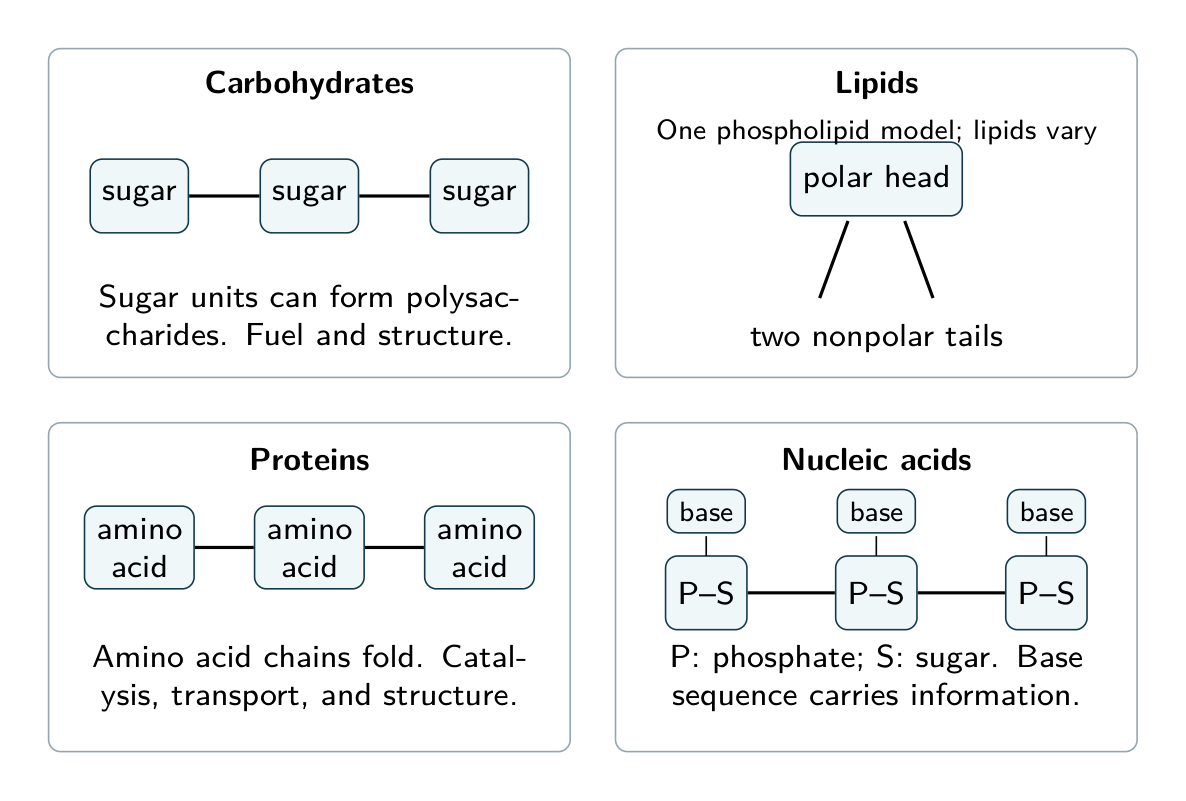
How do the main biomolecule groups compare?
| Group | Examples of roles |
|---|---|
| Carbohydrates | Fuel, energy storage, and structural materials |
| Lipids | Membranes, energy storage, and signaling |
| Proteins | Catalysis, transport, support, and signaling |
| Nucleic acids | Storage, transmission, and use of genetic information |
These categories contain diverse molecules. Lipids are grouped partly by their properties and are not all polymers built from one repeating monomer in the same way as proteins or nucleic acids.
Worked example: explain a membrane arrangement
A phospholipid has a water-interacting head region and hydrophobic tails. In water, many phospholipids arrange into a bilayer with the head regions facing the surrounding water and the tails largely sheltered inside.
The arrangement follows from interactions among water and the different molecular regions. A useful drawing shows the orientation of both parts. Draw a flexible bilayer whose components can move. Include proteins when explaining selective transport or signaling.
How does an enzyme help a reaction?
An enzyme binds substrates and provides a reaction pathway with lower activation energy. The active site provides a particular chemical environment, and its shape can change during binding and catalysis. Specificity depends on interactions as well as shape.
Changing temperature or pH can alter enzyme activity. Large changes can disrupt the interactions that support a functional structure. Moderate warming can increase reaction rate before loss of structure becomes important, but the useful range depends on the enzyme and conditions.
Enzymes do not change the equilibrium constant of the reaction at fixed conditions. They affect how quickly the system approaches equilibrium.
How should you connect structure with function?
- Identify a structural feature, such as a charged group or hydrophobic region.
- Describe its interaction with nearby molecules.
- Connect that interaction to a specific function.
- State conditions that could change the behavior.
For example, saying that a protein’s shape matters is a start. Explaining how an active-site charge helps bind a substrate gives the claim a chemical basis.
Can you apply the idea?
-
Which units are linked to build proteins?
Check your answer
Amino acids.
-
Which units build nucleic acids?
Check your answer
Nucleotides.
-
In a phospholipid bilayer, where do the hydrophobic tails mainly point?
Check your answer
Toward the bilayer interior, away from the surrounding water.
-
Does an enzyme change a reaction’s equilibrium constant at fixed conditions?
Check your answer
No. It changes the rate through a catalytic pathway.
-
Are all lipids repeating-monomer polymers?
Check your answer
No. The lipid category includes structures that do not fit that pattern.
-
Why can a large pH change reduce an enzyme’s activity?
Check your answer
It can change group charges and interactions needed for binding, catalysis, or the enzyme’s functional structure.
Watch the idea explained
Biomolecules (Updated 2023). Amoeba Sisters.
Watch temperature and pH affect enzymes
At 4:02, connect denaturation to the interactions that maintain enzyme structure. Then use the explanation above to distinguish slower catalysis from loss of a functional shape. The useful temperature and pH ranges depend on the enzyme.
Where does this fit?
Use the chemistry learning hub to choose a lesson or practice test. Connect this topic with organic chemistry basics, household chemistry, electrochemical cells, environmental chemistry.
Sources for Further Study
OpenStax Biology 2e provides further reading on biological macromolecules, membrane components and structure, and enzymes and their chemical environment.
Continue with a chemistry study guide

For the AP course sequence and practice tests, use the AP Biology study hub.

Related to This Article
More math articles
- Sunk costs belong to the past
- Decimals in Action: Completing Addition and Subtraction Sentences
- How the Federal Court System Works
- Grade 2 English Practice for West Virginia Second Graders
- Digital Tools for Teaching Math at a Distance
- How to Solve Rational Inequalities?
- 8th Grade MCAS Math Worksheets: FREE & Printable
- How to Modeling Real-World Situations Using Functions
- Enzyme Kinetics: Km, Vmax and Inhibition
- Full-Length SSAT Lower Level Math Practice Test






What people say about "Chemistry of Life: Biomolecules and Enzymes"?
No one replied yet.