Free Grade 6 English Worksheets for South Dakota Students
Two sixth graders stand at a bus stop on a county road outside Mitchell on a March morning, hands deep in jacket pockets, the wind doing what March wind on the prairie does. They are talking, in the practical, half-shouted way kids talk when wind takes half their voice away. One of them is explaining the book she is reading. The other is half listening and half watching the road for the bus. The conversation is about whether the main character should have lied to her brother. It is fragmented. It is a little impatient. It is also exactly the kind of literary thinking the South Dakota Content Standards for ELA call out at Grade 6, analyzing character motivation, inferring from text evidence, and being able to defend an opinion about both.
Nothing about that bus-stop conversation looks like test prep. There is no worksheet. There is no rubric. There is just one kid talking through a book with another kid. But the cognitive work involved, naming what a character did, inferring why, holding an opinion, and being ready to defend it with details from the page, is the cognitive work the spring Smarter Balanced assessment will sample. The worksheets below are not a replacement for the bus-stop conversation. They are the practice that makes that conversation richer.
The forty-six PDFs that follow each target one Grade 6 ELA standard from the South Dakota Content Standards for ELA. Each one prints clean on a home printer, opens with a Quick Review, and ends with a plain-language answer key. No login. No fee.
What’s on this page
The worksheets are grouped by strand, the way South Dakota’s framework organizes Grade 6 ELA expectations. Print one a night, or pull a strand on Sunday for the week.
Reading: Literature
- Citing Textual Evidence and Drawing Inferences, [RL.6.1] name the conclusion, then quote the line that proves it
- Theme and Objective Summary, [RL.6.2] the lesson the whole story teaches, in a single sentence
- Plot, Episodes, and Character Change, [RL.6.3] short scenes that quietly turn a character
- Figurative Language, Connotation, and Tone, [RL.6.4] the feeling a word carries past its definition
- Structure: How a Scene or Stanza Builds the Whole, [RL.6.5] every piece earns a job in the larger work
- Developing the Narrator’s Point of View, [RL.6.6] how a writer makes a reader see through one set of eyes
- Reading vs. Watching: Comparing Versions, [RL.6.7] what the page does that the screen cannot
- Comparing Stories Across Forms and Genres, [RL.6.9] same theme, different vessel
Reading: Informational Text
- Citing Evidence and Drawing Inferences in Nonfiction, [RI.6.1] pull the sentence that clinches the inference
- Central Idea and Objective Summary in Nonfiction, [RI.6.2] the article’s main point with the filler stripped
- How Ideas and Events Are Developed, [RI.6.3] introduce, elaborate, extend, connect
- Word Meaning in Nonfiction: Figurative, Connotative, Technical, [RI.6.4] three jobs one word can do at once
- Text Structure: How Sections Fit Together, [RI.6.5] cause, effect, problem, solution, sequence
- Author’s Point of View and Purpose, [RI.6.6] the writer’s angle and the writer’s reason
- Integrating Information from Text, Visuals, and Data, [RI.6.7] prose, chart, and image read as one source
- Evaluating Arguments and Claims, [RI.6.8] split claim from support, then weigh the support
- Comparing Two Authors on the Same Topic, [RI.6.9] different facts, different angles, same subject
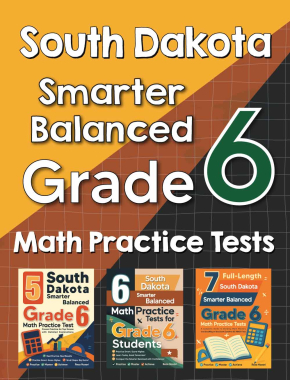
Working on Math Too? Try the South Dakota Smarter Balanced Grade 6 Math Bundle
Many third graders are getting ready for the Smarter Balanced in both subjects. If your child also needs math practice that matches the same standards, this companion bundle is the shortest path, workbook, study guide, and full practice tests in one download.
Writing
- Argument Writing: Claim, Reasons, Evidence, [W.6.1] defend a position with reasons and quoted proof
- Informative and Explanatory Writing, [W.6.2] teach a reader cleanly, in order
- Narrative Writing, [W.6.3] hook, pacing, dialogue, sensory detail, real ending
- Clear Writing for Task, Purpose, and Audience, [W.6.4] match writing to its actual reader
- Planning, Revising, and Editing, [W.6.5] drafts in passes, not single shots
- Short Research Projects, [W.6.7] focused question, several sources, tidy write-up
- Gathering, Evaluating, and Citing Sources, [W.6.8] which sources to trust and how to credit them
Speaking & Listening
- Collaborative Discussions, [SL.6.1] come prepared, listen, build on what was said
- Interpreting Diverse Media, [SL.6.2] what each format shows well and what it hides
- Analyzing a Speaker’s Argument, [SL.6.3] claim, reasons, weak spots
- Presenting Claims and Findings, [SL.6.4] open with the point, walk the evidence, end clean
- Adapting Speech to Context, [SL.6.6] different talk for friend, teacher, and principal
Grammar
- Pronoun Case: Subjective, Objective, and Possessive, [L.6.1a] which pronoun fits where in the sentence
- Intensive Pronouns, [L.6.1b] myself, themselves, and the emphasis they add
- Avoiding Shifts in Pronoun Number and Person, [L.6.1c] one person, one number, hold it
- Vague Pronouns and Unclear Antecedents, [L.6.1d] every pronoun needs a noun the reader can point to
- Recognizing and Improving Non-Standard English, [L.6.1e] voice for home, school English for the essay
Conventions: Punctuation, Spelling
- Punctuation: Commas, Parentheses, and Dashes, [L.6.2a] three ways to fold extra information into a sentence
- Spelling Grade-Appropriate Words, [L.6.2b] the homophones and trouble words sixth graders miss most
Knowledge of Language and Style
- Varying Sentence Patterns for Style, [L.6.3a] combine, expand, rearrange, anything but flat
- Consistency in Style and Tone, [L.6.3b] pick a register and stay there
Vocabulary and Word Study
- Using Context Clues, [L.6.4a] slow down at the strange word and read what surrounds it
- Greek and Latin Roots and Affixes, [L.6.4b] port, dict, tele, photo, and the doors they open
- Using Dictionaries and Thesauruses Effectively, [L.6.4c] match the tool to the question
- Verifying Word Meaning, [L.6.4d] check the guess instead of trusting it
- Figurative Language: Personification and More, [L.6.5a] the moves that make writing breathe
- Word Relationships: Cause-Effect, Part-Whole, Category, [L.6.5b] patterns that link words together
- Connotation: Shades of Meaning, [L.6.5c] slim, slender, scrawny, same idea, different feel
- Academic and Domain-Specific Vocabulary, [L.6.6] cross-subject words and field-specific words
How to use these worksheets at home
Talk about the worksheet after the kid finishes it. The PDF gives a sixth grader twenty minutes of careful, private thinking. The conversation afterward is what turns that private thinking into something the kid can repeat on a test, on an essay, or in a discussion. Ask one open question: *which one slowed you down?* The kid’s answer tells you which standard to print next.
Plan a multi-night performance task once a month. The Smarter Balanced performance task does not reward speed; it rewards stamina. Mimic the structure at home, Monday: read the source materials and outline a claim using the Argument Writing or Informative Writing PDF. Wednesday: draft. Thursday: revise with the Planning, Revising, and Editing PDF. Friday: read the draft aloud, listen for what is missing, and clean the conventions with the Grammar and Punctuation PDFs. By the spring, a sixth grader who has run that loop four or five times walks into the on-screen task with the rhythm already built.
Read the answer key alongside your kid. The key explains the right answer in plain language. Reading it out loud, slowly, with both of you looking at the same sheet, is what closes the loop on a missed item. A score is not a teaching tool. A read-aloud key is.
A note about South Dakota’s Smarter Balanced ELA
The South Dakota Statewide Assessment in English Language Arts uses the Smarter Balanced framework and is administered each spring at Grade 6, aligned to the South Dakota Content Standards for ELA. The Grade 6 assessment is structured around two distinct components, and both are worth rehearsing separately.
The first is the computer-adaptive section, which adjusts question difficulty based on student responses. It samples broadly across the reading, language, and vocabulary standards, no two adaptive sittings are identical, which is why the only durable preparation is depth in each underlying standard. The second is the multi-part performance task: a short set of related source materials followed by research-style items and a culminating piece of extended writing. The performance task rewards a planning habit and stamina more than any single piece of content knowledge. Students who walk in with a four-step routine, read prompt, outline claim and evidence, draft, revise, finish stronger than equally strong writers who try to compose live. Every Grade 6 ELA standard in the South Dakota Content Standards has at least one worksheet on this page.
Want everything in one bundle?
For families who prefer one consolidated resource over forty-six separate PDFs, the Grade 6 ELA Preparation Bundle gathers full-length practice tests and complete answer keys into a single package. It is most useful in the four to six weeks before the spring administration, when a sixth grader benefits from rehearsing the full shape of a Smarter Balanced sitting, adaptive items and a multi-part performance task, across one block of time.
South Dakota Grade 6 ELA Preparation Bundle, four practice-test books, 26 unique full-length tests, complete answer keys with explanations.
A short closing
The two kids at the bus stop outside Mitchell are doing real Grade 6 ELA work, even if they do not know it yet. Print one of these PDFs tonight. Hand it to your sixth grader before dinner. Ask one question about it afterward. That is how a wind-blown bus-stop conversation becomes the kind of literary instinct the spring assessment is built to recognize.
Best Bundle to Ace the South Dakota Smarter Balanced Grade 6 ELA
Looking for the best resource to help your kid ace the South Dakota Smarter Balanced? Try this bundle, four full practice-test books (5 + 6 + 7 + 8 tests) covering the same Grade 6 reading, writing, and language skills your child is already learning. Instant PDF download, answer keys included.


Related to This Article
More math articles
- Layout Tools: Square, Level, Plumb, and Straight
- Intelligent Math Puzzle – Challenge 81
- Hypotheses and Judging a Good Experiment
- The Best Grade 3 Math Book for Rhode Island Students
- Domestic policy
- Complete Guide to Inverse Trigonometric Ratios
- A Deep Dive Into The World of Vector-Valued Function
- Rates, Fertility, Mortality, and Reader-Friendly Calculations
- Free ACT Aspire Grade 5 Math Worksheets: 49 Printable PDFs with Friendly Answer Keys
- Nomination electorates and delegate allocation








What people say about "Free Grade 6 English Worksheets for South Dakota"?
No one replied yet.