Tennessee TCAP Grade 4 Math Free Worksheets: Free Printable TCAP-Ready Practice with Answers

TL;DR: Free printable TCAP-ready Grade 4 math practice for Tennessee families, with answers included. Worksheets cover multi-digit multiplication, long division, fractions, decimals, measurement, geometry, and the multi-step word problems TCAP focuses on.
Key takeaways:
- TCAP Grade 4 math (TNReady) covers every grade-4 math strand.
- Worksheets are free PDFs with full answer keys.
- Aligned with the Tennessee Academic Standards for Mathematics (grade 4).
- No signup or email – print at home or for a whole classroom.
- Short, daily practice (15-20 minutes) usually beats long weekend sessions.
Fourth grade is where math gets ambitious. The numbers get bigger, students read, write, and compare whole numbers well past a thousand, all the way into the hundred-thousands, and they learn that the 8 in 80,000 is worth ten times the 8 in 8,000. The operations get heavier, multiplying multi-digit numbers, dividing with remainders that have to mean something rather than just sit there. And fractions arrive as full citizens: not just pictures, but quantities a student can compare, build equal versions of, and add together. They learn that 3/4 and 6/8 are the same number, that a mixed number like 2 1/3 has a whole part and a fraction part, that decimals to the hundredths are simply another way to write those fractions. It is a lot, and it all lands in one year.
What makes the year demanding is rarely a single topic. It is the pace at which the topics stack. A child can understand multi-digit multiplication on Monday and still feel shaky when division with remainders shows up on Thursday, not because either is too hard, but because the first one had not fully set yet. Careful practice is the answer.
It is also a year that pays forward. The fourth grader who gets comfortable with multiplicative comparison, with multi-step word problems, with equivalent and comparable fractions, with decimals to the hundredths, with telling area from perimeter, and with the early geometry of angles and shapes is a fifth grader who is ready. The one who lets the shaky spots slide spends next year patching holes. So fourth grade is worth doing carefully, not fast, just carefully.
These worksheets are made for careful, unhurried practice. From Nashville to Memphis, Knoxville to Chattanooga, they hand a fourth grader one skill at a time and give it room to take hold.
What’s on this page
Here you will find 43 single-skill PDFs, each aligned to the Tennessee Mathematics Standards at Grade 4. Every file does one job. A student practicing factors and multiples is not also being asked about line plots; a student working through fraction addition is not sidetracked into measuring angles. One skill, properly practiced.
Each PDF begins with a one-page Quick Review, the skill in plain language, plus a fully worked example to anchor it. Then 20 practice problems, ordered from straightforward to challenging, and 4 word problems that set the skill into a real context. The closing page is a student-facing answer key: short, encouraging explanations a fourth grader can read alone and genuinely learn something from.
Place Value & Multi-Digit Numbers
- Understanding Place Value Relationships, [4.NBT.A.1] each place is ten times the one to its right
- Reading and Writing Multi-Digit Numbers, [4.NBT.A.2] standard form, word form, and expanded form
- Comparing and Ordering Multi-Digit Numbers, [4.NBT.A.2] use place value and the symbols >, <, and =
- Rounding Multi-Digit Numbers, [4.NBT.A.3] round to any place from tens to hundred-thousands
Multi-Digit Arithmetic
- Adding Multi-Digit Whole Numbers, [4.NBT.B.4] the standard addition algorithm, with regrouping
- Subtracting Multi-Digit Whole Numbers, [4.NBT.B.4] the standard subtraction algorithm, including across zeros
- Multiplying by a One-Digit Number, [4.NBT.B.5] multiply up to four digits by a single digit
- Multiplying Two Two-Digit Numbers, [4.NBT.B.5] the area model and the standard algorithm side by side
- Dividing with Remainders, [4.NBT.B.6] divide and name the leftover as a remainder
- Finding Factors and Multiples, [4.OA.B.4] list every factor of a number and its first multiples
- Prime and Composite Numbers, [4.OA.B.4] exactly two factors means prime; more means composite
Operations & Problem Solving
- Multiplicative Comparisons, [4.OA.A.1] read ‘4 times as many’ as a multiplication statement
- Multiplicative Comparison Word Problems, [4.OA.A.2] solve ‘times as many’ stories with multiplication or division
- Multi-Step Word Problems, [4.OA.A.3] two or more operations in one real-world problem
- Interpreting Remainders, [4.OA.A.3] decide what the leftover means, round up, drop it, or use it
- Number and Shape Patterns, [4.OA.C.5] follow a rule and find the next terms in a pattern
Fractions
- Equivalent Fractions, [4.NF.A.1] the same amount written with different numbers
- Comparing Fractions, [4.NF.A.2] compare fractions with unlike denominators using benchmarks
- Adding Fractions with Like Denominators, [4.NF.B.3a] add the numerators, keep the denominator
- Subtracting Fractions with Like Denominators, [4.NF.B.3a] subtract the numerators, keep the denominator
- Decomposing Fractions, [4.NF.B.3b] break a fraction into a sum of unit fractions
- Adding and Subtracting Mixed Numbers, [4.NF.B.3c] work with the whole and fraction parts, including regrouping
- Multiplying a Fraction by a Whole Number, [4.NF.B.4b] repeated addition of a fraction, written as multiplication
- Fraction Word Problems, [4.NF.B.3d] real-world stories that call for adding or subtracting fractions
Decimals
- Fractions with Denominators 10 and 100, [4.NF.C.5] rename tenths as hundredths and add the two
- Decimal Notation for Fractions, [4.NF.C.6] write tenths and hundredths as decimals, and back
- Comparing Decimals to Hundredths, [4.NF.C.7] line up the place values and compare with >, <, =
- Adding Decimal Fractions, [4.NF.C.5] add decimals to the hundredths place
Measurement & Data
- Converting Measurement Units, [4.MD.A.1] change from a larger unit to a smaller one
- Measurement Word Problems, [4.MD.A.2] length, weight, volume, and time in real situations
- Area of Rectangles, [4.MD.A.3] length times width, the space inside a rectangle
- Perimeter of Rectangles, [4.MD.A.3] the distance all the way around a rectangle
- Area and Perimeter Word Problems, [4.MD.A.3] decide whether a problem needs area or perimeter
- Line Plots with Fractions, [4.MD.B.4] read and use a line plot of fraction measurements
Angles
- Angles as Fractions of a Circle, [4.MD.C.5] a full turn is 360 degrees, find a fraction of it
- Measuring Angles with a Protractor, [4.MD.C.6] name angles acute, right, or obtuse by their measure
- Drawing Angles with Given Measures, [4.MD.C.6] know what a given degree measure should look like
- Adding and Subtracting Angles, [4.MD.C.7] an angle split into parts, find the missing part
Geometry
- Points, Lines, Rays, and Angles, [4.G.A.1] the building blocks of geometry and how to tell them apart
- Parallel and Perpendicular Lines, [4.G.A.1] lines that never meet, and lines that cross at a square corner
- Classifying Triangles, [4.G.A.2] sort triangles by their angles and their sides
- Classifying Quadrilaterals, [4.G.A.2] name four-sided shapes by their sides and angles
- Lines of Symmetry, [4.G.A.3] find the lines that fold a shape onto itself
How to use these worksheets at home
You do not need an elaborate study schedule. What works with nine- and ten-year-olds is a small, steady habit, one PDF, fifteen minutes or so, a couple of afternoons a week. Short and finishable beats long and dreaded every single time.
A good rhythm is to teach skills in pairs that lean on each other. Run “Multiplying by One-Digit Numbers” and then “Multiplying by Two-Digit Numbers,” with a place value page first if the lining-up of digits is what trips your child. Do “Equivalent Fractions,” then “Comparing Fractions,” so the comparing rests on ground the child already walked, once 2/3 can be rewritten as 8/12, deciding whether it beats 7/12 stops being a guess. Follow that with adding fractions that share a denominator, then mixed numbers, since a mixed number is just a whole number traveling with a fraction. Pair multi-digit division with a page on what a remainder means, because the leftover is part of the answer and a child has to decide what it tells them. Try “Area of Rectangles” alongside “Perimeter of Rectangles”, same shapes, two questions, one about covering and one about bordering, and the contrast makes both clearer. When the second worksheet builds on the first, the learning compounds.
Once several arithmetic skills feel solid, work in the geometry and measurement pages, measuring angles, classifying triangles and quadrilaterals, reading decimals to the hundredths. They draw on a different kind of thinking, and the change of pace often makes a child more willing to sit down. It is also worth looping back: every couple of weeks, pull a finished worksheet and have your child redo three or four problems cold, so a skill that has slipped gets caught early.
And treat the answer key as an after-the-work tool. Let your child complete the page, then check their own answers and read the explanations for any they missed. Tennessee parents know the difference between handing a kid an answer and helping them find it themselves, the answer key is built for the second kind.
A note about TCAP at Grade 4
Tennessee fourth graders take the TCAP Mathematics assessment, part of the Tennessee Comprehensive Assessment Program, in the spring. It is built on the Tennessee Mathematics Standards, the same standards these worksheets are aligned to, so practice here points straight at what the test asks.
The Grade 4 TCAP expects more than quick recall. It asks students to work through multi-step problems, to reason about fractions and place value, to interpret a remainder, to compare decimals to the hundredths, and to pick an approach that genuinely fits the question rather than guessing at a procedure. Because every PDF on this page targets a single standard, you can use the spring window as a checklist, find the skills your child has down, find the ones that still need work, and aim your practice there instead of reviewing everything evenly. A child who is confident with multiplication but unsure about classifying shapes gets far more from two focused weeks on shapes than from a scattered review of all of it.
A short closing
Fourth-grade math asks a lot, but it gives it back, one skill, one short sitting at a time, a child arrives ready for what comes next. The long list is not a single mountain; it is a set of small steps. Bookmark this page, print one PDF tonight, and let your fourth grader start small. Tennessee kids meet real work head-on when the next step is clear, and a worksheet on the table makes it clear.
Best Bundle to Ace the Tennessee TCAP Grade 4 Math Test
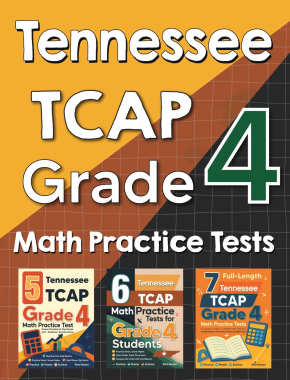
Want the fastest path through Tennessee TCAP Grade 4 math? This bundle pulls it together, four full practice-test books with complete, step-by-step answer keys, instant PDF download.
Recommended EffortlessMath Books
For a workbook that pairs neatly with these printable practice pages, Mastering Grade 4 Math walks your child through every fourth-grade topic with clear examples and lots of try-it-yourself problems. For extra word-problem practice (the part many fourth graders find hardest), see Mastering Grade 4 Math Word Problems.
Frequently Asked Questions
What topics are covered in these Tennessee Grade 4 worksheets?
Multi-digit multiplication, long division with one-digit divisors, place value to \(1{,}000{,}000\), equivalent and comparing fractions, adding and subtracting fractions with like denominators, multiplying fractions by whole numbers, decimals to hundredths, area and perimeter, measurement conversions, angle measurement, and multi-step word problems.
How do I print these worksheets?
Click any worksheet to open the PDF, then print from your browser (Ctrl/Cmd + P). Use 100% scale on letter paper so the boxes and number lines stay aligned. Most pages are one or two sheets – easy to staple into a weekly practice packet.
Are these worksheets really free?
Yes – every worksheet is a free PDF. No login, no email, no paywall. Print as many copies as you need for home use or your classroom. Please don’t repost the PDF files on other websites.
Are these aligned with the Tennessee Academic Standards?
Yes. The pages follow the Tennessee Academic Standards for Mathematics at grade 4, the same standards TCAP/TNReady uses as its blueprint. That covers Operations and Algebraic Thinking, Number and Operations in Base Ten, Number and Operations – Fractions, Measurement and Data, and Geometry.
How often should my fourth grader practice?
For most kids, 15-20 minutes a day, four or five days a week, is the sweet spot. As TCAP gets close (typically late spring), add a longer Saturday session so your child can practice pacing. Short and steady almost always beats long and exhausting.
What if my child struggles with a worksheet?
Pause and walk through one problem together out loud. If a whole topic feels too hard, drop a level – review multiplication facts before long division, or equivalent fractions before adding fractions. Filling the missing prerequisite is faster than pushing through.
Is there an answer key?
Yes – every worksheet PDF includes an answer key (usually on the last page or in a matching answer file). For fourth graders, walking through the steps together teaches more than just marking right or wrong.
How should we prep for TCAP math specifically?
TCAP at grade 4 includes multiple choice, multiple select, and a smaller number of constructed-response items. Practice writing out the steps, not just circling answers. Strongest payoff at grade 4 is fluent multi-digit operations, comparing fractions, and multi-step word problems.
Any tips for Tennessee parents new to fourth-grade math?
Three habits help most: (1) quick daily multiplication-fact drills, (2) talking about fractions and decimals at home (cooking, money, time), and (3) reading every word problem aloud before your child writes anything. Hearing the story almost always helps a fourth grader figure out the math.
Where can we get more grade 4 practice?
EffortlessMath has more grade 4 worksheets organized by topic, the Mastering Grade 4 Math workbook, and a focused Grade 4 Math Word Problems book. The Related Lessons section below links to step-by-step explanations of the trickiest fourth-grade skills.
Related EffortlessMath Lessons
If a topic on this page feels rusty, these short lessons go deeper:
- How to multiply multi-digit numbers
- How to divide multi-digit numbers
- How to add and subtract fractions with like denominators
- How to find equivalent fractions
- How to solve multi-step word problems

Related to This Article
More math articles
- Alaska AK STAR Grade 3 Math Worksheets — 49 Free Printable Single-Skill PDFs
- Texas STAAR Grade 4 Math Free Worksheets: 72 Printable TEKS-Aligned PDFs with Answer Keys
- The Double V Campaign and the Second Great Migration
- Hands-On Learning: How to Represent Subtraction of Fractions with Unlike Denominators Using Everyday Objects
- States of Matter and Changes
- Alternating Series
- How to Find Arc Length and Sector Area? (+FREE Worksheet!)
- Free Grade 7 English Worksheets for Colorado Students
- The Best Grade 5 ELA Practice Tests for California Students
- Combining Like Terms Practice — Simplify Expressions (Free)









What people say about "Tennessee TCAP Grade 4 Math: Free Worksheets"?
No one replied yet.