Why a 100% Casino Bonus Is Rarely Worth What It Sounds Like
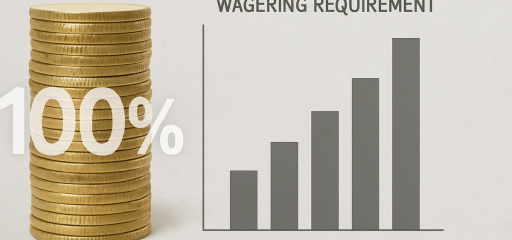
A 100% deposit match sounds like the casino is handing you a free pile of chips. Deposit $100, play with $200, what’s not to love? Well, quite a lot once you actually run the arithmetic on what it takes to convert that bonus into withdrawable cash. The marketing copy is cheerful and the fine print is where the casino quietly recovers its money, and then some.
What a 100% Match Actually Promises
The deal usually reads something like this: deposit up to $500 and we’ll match it 100%, dollar for dollar, up to a maximum bonus of $500. You drop in $100, your account shows $200, and you’re off to the slot lobby. So far, so good. But the bonus funds aren’t really yours yet. They’re locked behind a wagering requirement, which is the playthrough hurdle you have to clear before the casino lets you cash anything out.
That requirement is where the whole “100% bonus” framing breaks down. The headline number describes how much credit lands in your account. It doesn’t describe how much money you’ll have to push through the games to actually own it. And those two numbers aren’t even in the same neighborhood.
The Wagering Requirement Is the Whole Story
Most online casinos apply a 30x to 40x wagering requirement to the bonus, and many apply it to the bonus plus the deposit. Let’s say it’s 35x on deposit + bonus. You put in $100, you get a $100 match, and now you have to wager (100 + 100) × 35 = $7,000 before any of that balance turns into real money you can withdraw.
Seven thousand dollars. Off a $100 deposit. The bonus that sounded like a 100% boost is actually a contract that you’ll cycle 70x your deposit through the casino’s games. That’s the part the landing page doesn’t shout about.
Worked Example: Where the Bonus Actually Goes
Online slots run around a 96% return-to-player rate, give or take a percentage point. That means the house edge is roughly 4%, and over a large enough sample, you should expect to lose about 4 cents of every dollar wagered. Push $7,000 through a 96% RTP slot and the expected loss is 0.04 × $7,000 = $280.
Now line the numbers up. You received a $100 bonus. To unlock it, you’ll lose an expected $280 in the process. The expected value of accepting the bonus is $100 − $280 = −$180. Negative. The “free” $100 has a baked-in expected cost of $180 to the player who tries to clear it.
| Deposit | Match | Wagering Basis | Multiplier | Required Turnover | Expected Loss (4% edge) | EV of Bonus |
|---|---|---|---|---|---|---|
| $50 | $50 | Bonus only | 30x | $1,500 | $60 | −$10 |
| $100 | $100 | Bonus only | 35x | $3,500 | $140 | −$40 |
| $100 | $100 | Deposit + bonus | 35x | $7,000 | $280 | −$180 |
| $200 | $200 | Deposit + bonus | 40x | $16,000 | $640 | −$440 |
| $500 | $500 | Deposit + bonus | 30x | $30,000 | $1,200 | −$700 |
Notice what’s happening in that table. The bigger the deposit and the higher the multiplier, the deeper into negative territory you go. The 30x-on-bonus-only version with a small deposit is the closest thing to a fair offer, and even it’s slightly negative. Anything applied to deposit + bonus at 35x or higher is just a long, expensive way to lose money while feeling like you’re getting a deal.
Why Variance Saves Some People Anyway
Here’s the part that keeps the whole bonus economy running: expected value isn’t the same as your actual outcome. If you slam $7,000 through a slot in $5 spins, the variance is enormous. Some players hit a bonus round early, run the balance to four figures, finish the playthrough, and walk away with real money. Others bust before they’re halfway through.
Industry estimates put the share of bonus claimers who withdraw something at roughly 30% to 40%. That’s not nothing, but the other 60% to 70% lose everything, and the average across the whole pool is firmly in the casino’s favor. The bonus is a lottery wrapped in a marketing ribbon. You can win it. You’re just not supposed to, on average.
I’ll say what the ads won’t: the bonus exists because it’s profitable to the operator. If 100% deposit matches were a net giveaway, they wouldn’t be the most heavily advertised product in the industry. The math is doing exactly what it’s designed to do.
Game Weighting: The Quiet Restriction
You might be thinking, fine, I’ll clear the wagering on blackjack where the house edge is more like 0.5%. A 0.5% edge on $7,000 is only $35, so the bonus would have positive EV. Nice try. The casino thought of that years ago.
Almost every bonus has a game weighting table, and it looks roughly like this:
- Slots: 100% contribution to wagering, every $1 wagered counts as $1 toward playthrough.
- Video poker: often 20% or excluded entirely.
- Blackjack: 10%, sometimes 5%, sometimes excluded.
- Roulette: 10% to 20%, often only outside bets.
- Baccarat: 0% on most sites, completely excluded.
- Craps: typically 0% or 10%.
A 10% contribution means you need to wager $10 to get $1 of credit toward playthrough. So that 35x requirement on $200 becomes effectively 350x at the blackjack table, $70,000 of action, and a 0.5% edge across $70,000 is $350 in expected losses. The low-edge games look attractive until the weighting math wipes that advantage out and then some. The bonus is steering you toward slots on purpose.
Max Bet Rules and the Casino’s Hedge
Then there’s the max bet clause. While a bonus is active, your maximum allowed bet is typically capped at $5, sometimes $10, sometimes as low as $2. Place a single spin above that ceiling and the bonus is forfeit, along with any winnings derived from it. The casino doesn’t have to argue. The terms say so.
This is the operator’s hedge against variance. Big bets mean fewer spins for the same turnover, which means less time for the house edge to grind, which means the player has a better shot at finishing the wagering with a profit. The max bet rule slows you down and forces you to take a long sample of spins, which is exactly where the law of large numbers does its quiet work. By the time you’ve placed 1,400 spins at $5 each to hit $7,000 of action, the house edge has had plenty of room to operate.
I’ve watched friends violate this rule by accident, one max-bet auto-spin click and the whole balance gets confiscated. The terms are enforced strictly. The UK Gambling Commission has published guidance reminding operators that bonus terms must be clearly disclosed and fairly applied, and you can read more on bonus regulation at gamblingcommission.gov.uk. Even with regulatory pressure, the terms remain restrictive because they have to be, the bonus model depends on it.
A Note on Sticky vs. Cashable Bonuses
There’s another distinction the terms page tends to bury. A cashable bonus, once wagering is cleared, becomes real money that you can withdraw along with any winnings. A sticky bonus never converts, the bonus principal is permanently locked, and only the winnings above it can ever be cashed out. So if you deposit $100, take a $100 sticky match, grind through the wagering, and finish with a balance of $250, you can withdraw $150 (the $50 deposit-side balance plus $100 of winnings) and the $100 sticky portion gets stripped on the way out.
Sticky bonuses are sold as more generous because the wagering requirements are often lower, but the EV penalty is severe. You’re essentially renting that $100 of extra firepower for the duration of the play, paying for it with the house edge across whatever turnover you clock. Run the same 35x exercise on a sticky and you’ll see the effective return drop even further. I’ve yet to find a sticky offer that pencils out as anything other than entertainment expense, and I keep an eye on them.
When the Match Is Actually Worth Considering
Not all bonuses are equally bad. The math tells you what to look for and what to avoid:
- Wagering on bonus only, not deposit + bonus. This roughly halves the required turnover.
- Multiplier of 25x or lower. Anything 35x or above almost always lands in negative-EV territory.
- Reasonable max bet ($10 or higher) so a single mis-click doesn’t kill you.
- Long expiration window (30 days or more), not a 24-hour panic clock.
- Cashable bonus rather than sticky, sticky bonuses can’t be withdrawn even after wagering, only your winnings can.
- Transparent game weighting with at least some non-slot games at 100%.
The Wizard of Odds bonus analysis works through similar examples in more depth and is worth bookmarking before you accept any offer. Their conclusion is the same one the arithmetic above keeps pointing to: most deposit matches are negative EV, and the rare ones that aren’t are usually capped at small deposits or offered as one-time loyalty rewards to existing players.
FAQ
Is any 100% deposit match ever positive EV?
Rarely, and only at low multipliers (15x-25x) applied to the bonus alone, on high-RTP games, with no game restrictions. These offers exist but they’re usually small and aimed at retention, not acquisition.
Why do casinos advertise these bonuses so heavily if they’re bad for the player?
Because they’re profitable on average. The marketing math and the actual game math point in opposite directions, which is exactly the gap the operator monetizes.
If I get lucky early, can I just stop and withdraw?
No. Until the wagering is cleared, any “winnings” sitting in your account are still encumbered. Try to withdraw early and the casino voids the bonus plus any associated winnings.
What about no-deposit free bonuses?
Those have similar wagering structures and often even harsher max-cashout caps (sometimes $50 or $100 maximum, no matter how much you build the balance to). The EV math is comparable.
Does my game choice really matter that much?
Yes. Game weighting is the single biggest hidden lever. A bonus that looks playable on slots can be mathematically impossible to clear on the games you’d otherwise prefer.
Where can I learn the underlying probability tools to evaluate offers like this?
For the math foundations, expected value, variance, percentages, you can work through the explainers at Effortless Math, which covers the core arithmetic these promotions rely on.
The Real Takeaway
A 100% deposit bonus is a marketing label, not a financial gift. The number that controls your outcome is the wagering requirement combined with the game weighting and the house edge on whatever game actually clears the bonus. Plug those into the EV formula and most offers come out negative, sometimes painfully so. The ones that don’t are rare, small, and worth the search if you enjoy the games for their own sake and treat the bonus as a marginal edge rather than a windfall.
If you’re going to claim a bonus, do it because you were going to play anyway and the offer slightly improves an entertainment expense you’ve already budgeted. Don’t claim it because the percentage sounds generous. The percentage is doing exactly the job the casino wrote it to do, and that job, politely, profitably, and with great graphic design, isn’t to make you money.

Related to This Article
More math articles
- Revenue, Surplus and Deadweight Loss: Graph Areas
- Absolute Value Equation Solver — |ax + b| = c (Free)
- Federalists and Democratic-Republicans
- 8th Grade PEAKS Math Worksheets: FREE & Printable
- The Best Grade 3 ELA Practice Tests for South Dakota Students
- Shays’ Rebellion
- Grade 2 English Worksheets for Washington, D.C. Students
- Full-Length GED Math Practice Test-Answers and Explanations
- Full-Length 6th Grade PSSA Math Practice Test-Answers and Explanations
- Homesteads, Railroads, and the National Market





What people say about "Why a 100% Casino Bonus Is Rarely Worth What It Sounds Like - Effortless Math"?
No one replied yet.