The Best Grade 2 English Worksheets for Tennessee Students
The Best Grade 2 English Worksheets for Tennessee Students: a free, printable set you can download and use right away, with answer keys, organized by topic so students can practice one skill at a time and teachers can assign exactly what a lesson needs.
54 free, printable reading and writing PDFs, built for the year before TCAP testing.
There’s a sound that tells you a second grader has turned a corner. It’s the sound of reading that’s gone quiet. The whisper-reading of first grade fades, and one day you realize your child has been on the same couch for twenty minutes, not making a sound, just turning pages. They’ve stopped reading at a book and started reading with it.
This page is a collection of free English worksheets for Tennessee second graders, built for that steadying year. Inside you’ll find short stories and short nonfiction passages, phonics practice, grammar, punctuation, and the early writing assignments where loose sentences grow into a real paragraph.
Everything here is free. Each worksheet is a printable PDF, and each one has an answer key included. Click a title and the file opens, no login screen, no email box, no “create an account to download.” Print a single page for tonight, or copy a stack for the whole class. None of it costs a thing.
These worksheets follow the Grade 2 English Language Arts standards Tennessee has adopted. In plain words: they cover the reading, language, and writing your child’s classroom is working on right now.
How the collection is organized
The worksheets are grouped into eight strands. There’s reading literature and reading nonfiction. There’s the set of foundational decoding skills that keep reading from stalling out. Then writing, speaking and listening, grammar, the capitalization-and-punctuation group, and vocabulary.
Each worksheet sticks to one skill, and that’s the whole idea. A focused fifteen minutes on reflexive pronouns teaches more than an hour spent flipping through a thick packet. Browse the list, grab what fits your week, and leave the rest for later.
Reading: Literature
- Asking and Answering Questions About Stories, answering the who, what, and why a story raises
- Central Message, Lesson, or Moral, naming the lesson a story carries underneath
- How Characters Respond to Events, following how a character feels and acts when something happens
- Rhythm and Meaning in Stories, Poems, and Songs, catching the beat and rhyme, and what they do to meaning
- The Structure of a Story, how the beginning, middle, and end work as one
- Points of View of Characters, seeing that characters don’t all read a moment the same way
- Using Illustrations to Understand Stories, letting the pictures help carry the story
- Comparing Two Versions of the Same Story, two tellings of one tale, lined up together
Reading: Nonfiction
- Asking and Answering Questions About Nonfiction, finding real answers inside a true-information text
- Main Topic and Focus of Paragraphs, pinning down what a paragraph is mostly about
- Connections Between Events, Ideas, and Steps, seeing how one idea hands off to the next
- Nonfiction Vocabulary, the special words that pop up in science and social studies
- Text Features, using headings, bold words, and captions as guides
- The Author’s Main Purpose, working out why a writer sat down to write it
- How Images Help a Text, when a picture or diagram explains what the words skip
- How Reasons Support the Author’s Points, finding the reasons a writer puts behind an idea
- Comparing Two Texts on the Same Topic, one subject, two articles, what matches and what doesn’t
Foundational Reading Skills
- Long and Short Vowels, hearing the difference between tap and tape
- Vowel Teams, two vowels working together in words like rain and coat
- Decoding Two-Syllable Words, splitting longer words into manageable pieces
- Prefixes and Suffixes, how parts like re- and -less shift a word
- Words with Tricky Spelling Patterns, the patterns that catch kids off guard
- Irregularly Spelled Words (Sight Words), the words a reader simply learns by sight
- Reading Fluency: Accuracy, Rate, and Expression, reading accurately, at a steady pace, with feeling
- Self-Correcting While You Read, catching a mistake and fixing it on your own
Writing
- Opinion Writing, saying what you believe and propping it up with a reason
- Informative and Explanatory Writing, laying out a topic clearly on the page
- Narrative Writing, telling a story in order, with details that make it land
- Revising and Editing, improving a draft with one careful pass at a time
- Shared Research Projects, exploring a question together as a class
- Gathering Information to Answer a Question, collecting facts that truly answer the question
Speaking and Listening
- Recounting Ideas from a Read-Aloud, retelling the big ideas after a story is read aloud
- Asking and Answering Questions About a Speaker, listening closely enough to respond well
- Telling a Story or Sharing an Experience, speaking so a listener can picture what took place
Grammar
- Collective Nouns, words that name a group, like crowd or bunch
- Irregular Plural Nouns, when child turns into children and tooth into teeth
- Reflexive Pronouns, myself, himself, ourselves
- Past Tense of Irregular Verbs, verbs that don’t just add -ed, like run and ran
- Adjectives and Adverbs, words that describe nouns and words that describe verbs
- Expanding and Rearranging Sentences, growing a plain sentence into a richer one
Capitalization, Punctuation, and Spelling
- Capitalizing Holidays, Products, and Place Names, knowing which words need a capital letter
- Commas in Greetings and Closings of Letters, the commas in Dear Aunt Bea, and Your friend,
- Apostrophes: Contractions and Possessives, don’t and Noah’s backpack
- Spelling Patterns, the patterns that make spelling less of a gamble
- Using Reference Materials to Check Spelling, checking a word rather than guessing at it
Vocabulary and Word Study
- Formal and Informal English, how language shifts between recess and a written report
- Context Clues, using nearby words to unlock a new one
- Prefixes, the little beginnings that turn a word’s meaning around
- Root Words and Word Endings, finding the base word and what’s stuck onto it
- Compound Words, two words joined into one, like raincoat and playground
- Using Glossaries and Dictionaries, looking up a word and its meaning
- Real-Life Word Connections, tying fresh words to everyday experience
- Shades of Meaning, the gap between big, large, and gigantic
- Using Describing Words and New Vocabulary, folding colorful new words into speaking and writing
Making each worksheet count
A worksheet only helps as much as the way it’s used. These few habits make the difference:
One worksheet at a time. Don’t print ten just to feel ahead. A single page, done with attention and a real talk about it afterward, teaches far more than a rushed pile.
Begin with the Quick Review box. The short box at the top is the mini-lesson, not decoration. Read it together, walk through the example aloud, then hand over the pencil.
Go over the answer key together. The number right isn’t the goal. Sit with your child and study the questions they missed. Talking through why an answer is wrong is the moment that teaches.
Return to weak skills after a week. If a couple of main-topic questions tripped your child up, don’t redo that page tonight. Come back in five or six days with a different worksheet on the same skill. Spacing makes it stick.
A note on TCAP
Plenty of Tennessee families find this page because TCAP is on their radar. So here’s the straight answer. The TCAP English Language Arts assessment begins in third grade. There is no TCAP ELA test in second grade.
That makes second grade the foundation year, the year your child builds the reading and writing skills TCAP will eventually draw on. So treat these worksheets as skill-building, not cramming. A second grader who reads with real understanding and can write a clear paragraph is already on a strong path toward TCAP. The unhurried work you do now pays off quietly later on.
Common questions
Are these aligned to Tennessee’s standards? Yes. Each worksheet targets a specific skill from the Grade 2 English Language Arts standards Tennessee has adopted.
Is there a TCAP test in second grade? No. The TCAP ELA assessment starts in Grade 3. Second grade is about laying the groundwork.
My child is ahead in reading. What should we try? Reach for Comparing Two Texts on the Same Topic and Shades of Meaning. Both stretch a strong reader while staying inside second grade.
Reading is a struggle right now. Where do we begin? Start with Long and Short Vowels and Context Clues. Steady decoding and the habit of using clues lift everything else.
What if my child resists worksheets? Keep it short and sit with them. Five focused minutes side by side beats twenty minutes of pushing alone.
Can homeschoolers use these? Definitely. They fit a kitchen table as easily as a classroom, whether for daily practice or a quick check after a lesson.
Before you go
If tonight’s worksheet ends up with four answers and a sketch of a guitar on the back, that’s an ordinary second-grade night. Try a shorter page tomorrow, or revisit that skill next week. Progress in second grade is steady, not flashy. Keep the practice small and regular, and come back anytime you need a new page.
Ready for Grade 3 English? The Tennessee TCAP Grade 3 English Bundle
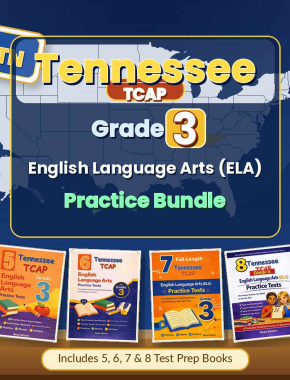
Second grade is the build-up year, and when your child is ready for what comes next, this bundle makes the jump to Grade 3 English feel easy. It includes four full practice-test books (5 + 6 + 7 + 8 tests) covering the Grade 3 reading, writing, and language skills just ahead, with explained answer keys and an instant PDF download.
Getting Ready for Grade 3 Math, Too? The Tennessee TCAP Grade 3 Math Bundle
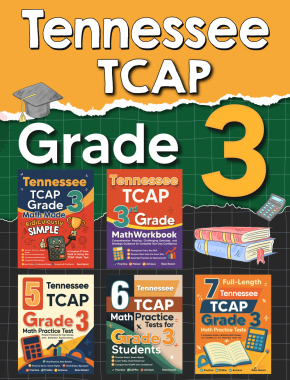
The same jump to Grade 3 happens in math. If your second grader could use a head start there as well, this Tennessee TCAP Grade 3 Math bundle is the shortest path, workbook, study guide, and full practice tests in one instant download, with answer keys throughout.

Related to This Article
More math articles
- MTEL Middle School Mathematics Flashcards
- The Best ALEKS Math Worksheets: FREE & Printable
- Ethnicity and Minority-Group Status
- Best Laptops for Middle School Students
- 10 Most Common 6th Grade SBAC Math Questions
- How Is the CLEP College Algebra Test Scored?
- How to Analyze Cross Sections of 3D Solids: A Step-by-Step Guide
- Cofunction Identities
- The Best Grade 8 Math Book for Maryland Students
- The Ultimate SBAC Algebra 1 Course (+FREE Worksheets)








What people say about "Tennessee Grade 2 English Worksheets: Free PDFs"?
No one replied yet.