Free Utah Grade 2 Math Worksheets
TL;DR: Free printable grade 2 math worksheets aligned with Utah’s Core Standards and the RISE assessment framework, place value, addition and subtraction within 1,000, money, time, measurement, and basic geometry. Answer keys included.
Key takeaways:
- Free printable PDFs aligned with Utah’s grade 2 Core Standards.
- Builds the foundation for the Utah RISE assessment (which starts at grade 3).
- Covers place value, arithmetic, time, money, shapes, and basic data.
- Each worksheet includes an answer key.
- Works for classroom, homeschool, or at-home practice.
Printable practice that meets Utah second graders right where they are, coins, clocks, base-ten blocks, and all.
The other evening a second grader in Salt Lake County dumped a jar of coins onto the kitchen table and started sorting, quarters here, nickels there, counting out loud the whole time. That messy little pile is real math. Counting mixed coins, regrouping when you run out of pennies, figuring out how much is left after a purchase: these are exactly the things Utah second graders are working on this year.
Second grade is a quietly huge math year. Kids learn to read and write numbers all the way to 1,000, add and subtract with regrouping, tell time on a real clock face, measure with a ruler, and make sense of bar graphs. None of it is small. Each piece becomes a brick in the wall that third, fourth, and fifth grade math will lean on.
We put together this free collection of Grade 2 math worksheets so Utah families have something solid to practice with at home. Every worksheet is a printable PDF, and every one comes with an answer key. There’s no signup, no email to hand over, and nothing to pay. You pick a page, you print it, you’re done.
The whole collection is built around the Grade 2 math standards Utah has adopted, so the practice your child does at the table lines up with the way their teacher is teaching it. No clashing methods, no “but that’s not how we do it at school.”
What’s Inside the Collection
There are 34 worksheets here, sorted into eight chapters that walk through a complete second grade math year. Treat it like a menu rather than a checklist. Go in order if you like the structure, or jump straight to whatever your child is wrestling with this week.
Every worksheet has the same calm, predictable shape. A short “Key Ideas” box explains the skill in plain words. A couple of worked examples show it in action. Then there’s a set of practice problems, and the answer key sits on the last page. Kids settle into that rhythm fast, which means you spend less time explaining and more time practicing.
Here’s everything, chapter by chapter.
Place Value and Number Sense
- Understanding Place Value, Seeing why the 7 in 738 means seven hundred.
- Reading and Writing Numbers to 1,000, Moving easily between number words and digits.
- Expanded Form, Pulling a number apart into hundreds, tens, and ones.
- Skip Counting, Counting by 5s, 10s, and 100s until it runs on its own.
- Comparing and Ordering 3-Digit Numbers, Deciding which number wins and lining sets up in order.
Addition and Subtraction
- Addition Facts Within 20, Working toward quick, certain recall of basic sums.
- Subtraction Facts Within 20, The same fluency, this time for take-away facts.
- Adding Within 100, Two-digit addition, regrouping into the tens included.
- Subtracting Within 100, Two-digit subtraction with borrowing taken one step at a time.
- Adding Within 1,000, Carrying the same habits into three-digit sums.
- Subtracting Within 1,000, Three-digit subtraction that rewards neat columns.
- Mentally Adding and Subtracting 10 and 100, Hopping by tens and hundreds without a pencil.
Word Problems and Equations
- One-Step Word Problems, Reading a short story and writing one math sentence for it.
- Two-Step Word Problems, Problems that take two moves to finish.
- Finding the Unknown Number, Tracking down the missing value in an equation.
Odd, Even, and Arrays
- Odd and Even Numbers, Checking whether a number splits into equal pairs.
- Even Numbers as Equal Addends, Writing an even number as two matching parts.
- Rectangular Arrays, Rows and columns that quietly hint at multiplication.
- Repeated Addition with Arrays, Adding equal rows to find the total.
Measurement and Length
- Measuring Length with Tools, Lining up a ruler or tape measure the right way.
- Estimating Lengths, Making a smart guess, then checking it.
- Comparing Lengths, Finding which object is longer and by how much.
- Adding and Subtracting Lengths, Combining measurements inside word problems.
- Length on a Number Line, Showing length and distance on a number line.
Time and Money
- Telling Time to the Nearest Five Minutes, Reading an analog clock to the five-minute mark.
- A.M. And P.M., Telling morning hours apart from evening ones.
- Counting Coins, Adding up mixed handfuls of coins.
- Money Word Problems, Buying, spending, and working out the change.
Data and Graphs
- Line Plots, Marking measurement data above a number line.
- Picture Graphs, Reading graphs that count with pictures.
- Bar Graphs, Comparing categories with bars and answering questions.
Geometry
- Recognizing and Drawing Shapes, Naming and sketching shapes by their sides and corners.
- Partitioning Rectangles into Rows and Columns, Slicing a rectangle into a tidy grid of squares.
- Equal Shares: Halves, Thirds, and Fourths, Sharing shapes fairly, the doorway into fractions.
Getting the Most From Each Page
These worksheets shine when you keep things light. A few habits make a real difference for second graders.
Stick to one page at a time. A single sheet has a finish line your child can actually see. A thick packet just feels like a chore before the pencil ever moves.
Read the Key Ideas box first, together. It’s short for a reason, the whole skill boiled down to a few sentences. Two minutes here saves ten later.
Have your child explain the worked examples back to you. When a kid puts a method into their own words, it sticks in a way that watching never quite does.
Treat the answer key as a chat, not a scoreboard. When something’s off, ask your child to walk you through their thinking. Nine times out of ten you’ll spot the one step that needs another look.
Circle back. If a skill came out wobbly, print that same page again about a week later. That second pass is usually where shaky turns steady.
A Note About the RISE Assessment
Utah families often ask about RISE, the state’s spring assessment. Here’s the reassuring truth: the RISE math test starts in third grade. Second graders don’t take a statewide math test at all.
That makes second grade the foundation year, and honestly, that’s a good thing. Your child gets a full year to build number sense, lock in addition and subtraction facts, and grow steady work habits with no test hanging over the calendar. Every skill in this collection, three-digit place value, regrouping, two-step word problems, reading a bar graph, is exactly the groundwork RISE will draw on once third grade arrives.
So in second grade the job is simple and unhurried: build a real, confident understanding of the math. A child who genuinely gets the Grade 2 content won’t be scrambling later. They’ll already be standing on solid ground.
Frequently Asked Questions
Do these worksheets match what Utah teaches? Yes. The collection follows the Grade 2 math standards Utah has adopted, so the content lines up with your child’s classroom.
Is anything hidden behind a signup? No. Every worksheet is a free printable PDF, no account, no email, no payment of any kind.
My second grader gets frustrated quickly. Any advice? Keep sessions short and end on a win. Ten focused minutes beats a tearful half hour. If a page is too hard, drop back one chapter and rebuild from there.
Should we do these in order? You can, but you don’t have to. The chapters are independent enough to pick from. Match the worksheet to whatever your child is studying right now.
Are these useful for summer practice? Very. A page or two each week over the summer keeps skills from going cold, so the next grade starts smoother.
One Last Thing
Second grade math doesn’t need to come with stress, not for your child and not for you. With steady practice and an encouraging voice nearby, three-digit numbers and clock faces slowly stop being intimidating and start feeling ordinary. Print a page, pull up a chair, and spend a few minutes together. Your Utah second grader is building something real, one worksheet at a time.
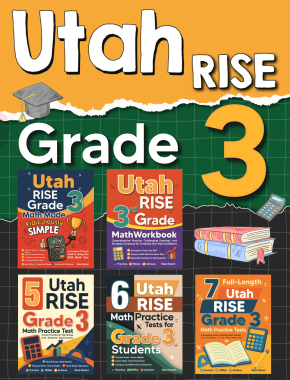
Ready for Grade 3 Math? The Utah Grade 3 Math Bundle
Second grade is the build-up year, and when your child is ready for what comes next, this bundle makes the jump to Grade 3 math feel easy. It packs full practice-test books, complete answer keys, and step-by-step explanations for the Grade 3 math skills just ahead.
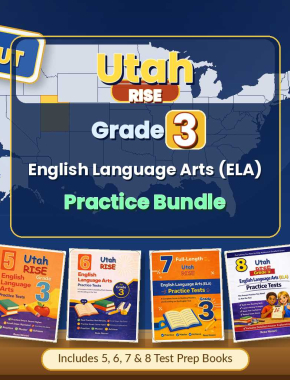
Getting Ready for Grade 3 English, Too? The Utah Grade 3 English Bundle
Reading and writing grow right alongside math. If your second grader could use a head start in English as well, this Utah Grade 3 English bundle covers it — practice tests, answer keys, and friendly explanations in one download.
Recommended EffortlessMath Books
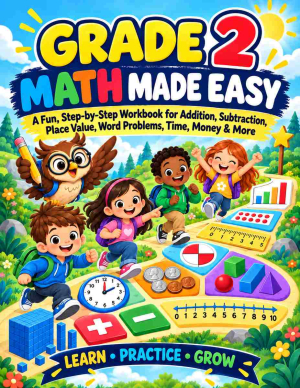
For a structured grade 2 workbook, the Grade 2 Math for Beginners covers every Utah-aligned topic with worked examples. For students ready to preview next year’s RISE content, the Grade 3 Math for Beginners covers what RISE will test.
Related EffortlessMath Lessons
If a topic on this page feels rusty, these short lessons go deeper:
- How to add large numbers
- How to subtract large numbers
- How to tell time
- How to count money
- How to identify 2D shapes

Related to This Article
More math articles
- Best PERT Math Prep Books-Which book is the best for you
- Discovering the Magic of Triangle Midsegments
- Digital SAT Math Practice Test PDF with Answers (2026)
- The Best Grade 6 ELA Practice Tests for Hawaii Students
- CLEP U.S. History I 082: Expansion, Native Dispossession, and Borderlands
- The Best Grade 3 ELA Practice Tests for Alabama Students
- Transitive Property: Definition, Geometry Examples & Practice
- Managing Math Fear as an Adult
- Natural and Artificial Selection
- The Ultimate MCA Algebra 1 Course (+FREE Worksheets)








What people say about "Free Utah Grade 2 Math Worksheets: Free and Printable"?
No one replied yet.