Grade 2 Math Practice for Washington Second Graders
TL;DR: Free printable Grade 2 math worksheets for Washington families and teachers – place value, two- and three-digit addition and subtraction, time, money, measurement, and word problems aligned with the Washington State K-12 Math Learning Standards.
Key takeaways:
- Washington’s Smarter Balanced math test starts in grade 3, so grade 2 builds the foundation for that first state test.
- Worksheets cover place value to \(1{,}000\), addition and subtraction within 1000, time, money, measurement, and word problems.
- Every page is a free PDF – no signup, no payment, print as many copies as you need.
- Aligned with the Washington State K-12 Math Learning Standards (Common Core based) at grade 2.
- Short daily practice (10-15 minutes) builds the fluency grade-3 Smarter Balanced expects.
Free printable worksheets with answer keys, the kind of practice that makes math feel doable.
A Washington second grader sits cross-legged on the living room floor, building rows of toy cars, four cars across, three rows down. “How many cars?” you ask. He counts the rows: four, eight, twelve. Without knowing it, he just did repeated addition with an array, one of the quiet stepping stones toward multiplication. Second grade math is full of these small, almost invisible breakthroughs.
It’s a year that asks a lot. Children learn to read and write numbers up to 1,000, add and subtract with regrouping, solve word problems, tell time, count money, measure length, and read graphs. Each skill seems ordinary on its own. Stacked together, they form the foundation that every later math year depends on.
This free collection of Grade 2 math worksheets is here to help Washington families practice all of it at home. Every worksheet is a printable PDF that comes with an answer key. There’s no signup, no email, and no fee. You choose a page, print it, and start.
The collection is built around the Grade 2 math standards Washington has adopted, so what your child practices at home matches what’s happening in their Washington classroom. Same methods, same vocabulary, no crossed wires.
What’s Inside
The collection holds 34 worksheets, sorted into eight chapters that cover a full second grade math year. Treat it as a menu, not a march. Work through it in order if that suits you, or skip ahead to the skill your child needs help with this week.
Every worksheet uses the same friendly structure. A short “Key Ideas” box explains the skill in plain words. Two worked examples model it. Then there’s a set of practice problems, with the answer key on the last page. Kids learn that pattern quickly, so you spend less time setting up and more time practicing.
Here’s the full lineup, chapter by chapter.
Place Value and Number Sense
- Understanding Place Value, Why the 8 in 814 means eight hundred, not eight.
- Reading and Writing Numbers to 1,000, Moving easily between number words and digits.
- Expanded Form, Spreading a number out into hundreds, tens, and ones.
- Skip Counting, Counting by 5s, 10s, and 100s until it’s automatic.
- Comparing and Ordering 3-Digit Numbers, Working out which number is bigger and ordering sets.
Addition and Subtraction
- Addition Facts Within 20, Building quick, sure recall of the basic sums.
- Subtraction Facts Within 20, The same fluency, now for take-away facts.
- Adding Within 100, Two-digit addition, regrouping into the tens included.
- Subtracting Within 100, Two-digit subtraction with borrowing handled step by step.
- Adding Within 1,000, Carrying those skills into three-digit numbers.
- Subtracting Within 1,000, Three-digit subtraction that rewards careful columns.
- Mentally Adding and Subtracting 10 and 100, Jumping by tens and hundreds in your head.
Word Problems and Equations
- One-Step Word Problems, Reading a short story and writing one math sentence.
- Two-Step Word Problems, Problems that need two moves to finish.
- Finding the Unknown Number, Tracking down the missing value in an equation.
Odd, Even, and Arrays
- Odd and Even Numbers, Deciding whether a number splits into equal pairs.
- Even Numbers as Equal Addends, Writing an even number as two equal parts.
- Rectangular Arrays, Rows and columns that quietly preview multiplication.
- Repeated Addition with Arrays, Adding equal rows to find the total.
Measurement and Length
- Measuring Length with Tools, Using a ruler or tape measure correctly.
- Estimating Lengths, Making a smart guess, then checking it.
- Comparing Lengths, Finding which is longer, and by how much.
- Adding and Subtracting Lengths, Combining measurements inside word problems.
- Length on a Number Line, Showing length and distance on a number line.
Time and Money
- Telling Time to the Nearest Five Minutes, Reading an analog clock to the five-minute mark.
- A.M. And P.M., Telling morning hours apart from evening ones.
- Counting Coins, Adding up mixed handfuls of coins.
- Money Word Problems, Buying, spending, and working out the change.
Data and Graphs
- Line Plots, Marking measurement data above a number line.
- Picture Graphs, Reading graphs that count with pictures.
- Bar Graphs, Comparing categories with bars and answering questions.
Geometry
- Recognizing and Drawing Shapes, Naming and sketching shapes by sides and corners.
- Partitioning Rectangles into Rows and Columns, Slicing a rectangle into a tidy grid of squares.
- Equal Shares: Halves, Thirds, and Fourths, Sharing shapes fairly, the start of fractions.
How to Use the Worksheets Well
These pages work best when the mood stays easy. A few habits help second graders the most.
One page at a time. A single sheet has a finish line your child can see. A thick stack just feels heavy before anyone picks up a pencil.
Start with the Key Ideas box. Read it together first. It’s short for a reason, the whole skill in a handful of sentences.
Work through the examples out loud. Ask your child to explain a worked example back to you. Saying it themselves is what makes the method stick.
Treat the answer key as a conversation. When an answer is wrong, ask your child to retrace their steps. That walk-through almost always reveals the one spot to fix.
Revisit weak skills. If something came out shaky, print that same page again a week later. The repeat is where wobbly becomes steady.
A Word About Smarter Balanced
Washington’s statewide math test is the Smarter Balanced assessment, and parents often wonder when it begins. Here’s the reassuring answer: Smarter Balanced math testing starts in third grade. Second graders don’t take a statewide math test.
That makes second grade the foundation year, and that’s a quiet gift. Your child gets a full year to build number sense, fact fluency, and steady work habits with no test pressure in sight. Every skill in this collection, three-digit place value, regrouping, two-step word problems, reading a bar graph, is exactly the groundwork the Smarter Balanced assessment will draw on once third grade arrives.
So the second grade goal is simple and unrushed: build a real, confident understanding of the math. A child who genuinely gets the Grade 2 content won’t need to cram for Smarter Balanced later. They’ll already be ready.
Frequently Asked Questions
Do these worksheets line up with what Washington teaches? Yes. The collection follows the Grade 2 math standards Washington has adopted, so the content matches your child’s classroom.
Is there any cost or registration? No. Every worksheet is a free printable PDF, no account, no email, no payment.
How often should we use these? A page or two, a few times a week, works well. Short and regular beats long and occasional.
What if my child rushes and makes careless mistakes? Slow things down. Ask them to read each problem twice and to point at what it’s asking before solving. The answer key then becomes a gentle check, not a scold.
Can older or younger siblings use parts of this? Sure. An advanced first grader might enjoy the early chapters, and a third grader can use the harder ones to refresh skills.
One Last Word
Second grade math doesn’t have to be a source of stress, for your child or for you. With steady practice and an encouraging voice close by, those three-digit numbers and clock faces slowly stop being hurdles and start being routine. Print a page, sit down together, and spend a few minutes on it. Your Washington second grader is building something solid, one worksheet at a time.
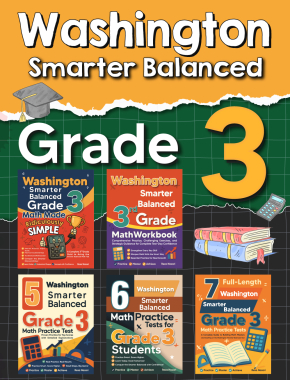
Ready for Grade 3 Math? The Washington Grade 3 Math Bundle
Second grade is the build-up year, and when your child is ready for what comes next, this bundle makes the jump to Grade 3 math feel easy. It packs full practice-test books, complete answer keys, and step-by-step explanations for the Grade 3 math skills just ahead.
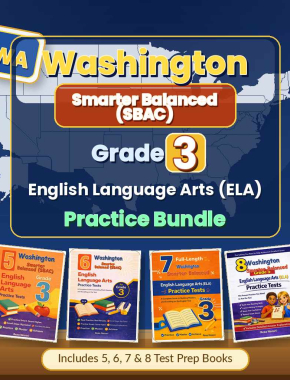
Getting Ready for Grade 3 English, Too? The Washington Grade 3 English Bundle
Reading and writing grow right alongside math. If your second grader could use a head start in English as well, this Washington Grade 3 English bundle covers it — practice tests, answer keys, and friendly explanations in one download.
Recommended EffortlessMath Books
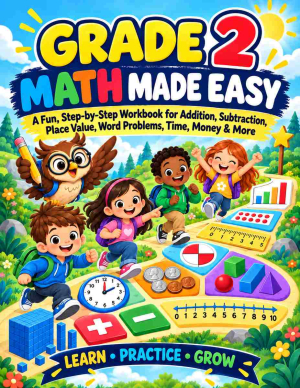
For a workbook that pairs neatly with these printable practice pages, Mastering Grade 2 Math walks your child through every second-grade topic with clear examples and lots of try-it-yourself problems. For extra word-problem practice (the part many second graders find hardest), see Mastering Grade 2 Math Word Problems.
Related EffortlessMath Lessons
If a topic on this page feels rusty, these short lessons go deeper:
- How to add and subtract two-digit numbers
- Place value to the hundreds
- How to tell time to the nearest five minutes
- How to count coins and dollar bills
- How to solve word problems

Related to This Article
More math articles
- From Collective Behavior to Social Movements
- Is Arbitrage Betting Legal in Australia?
- How to Use Models to Divide Whole Numbers by Unit Fractions?
- FREE 6th Grade ACT Aspire Math Practice Test
- Market demand adds individual quantities
- Complete Sentences and Clauses
- Descriptive Statistics Calculator — Mean, SD, Quartiles (Free)
- How long Is the CBEST Test Valid?
- GRE Math Flashcards (Free Online: Formulas, Terms & Concepts)
- 10 Most Common CBEST Math Questions







What people say about "Grade 2 Math Worksheets for Washington"?
No one replied yet.