Electrochemical Cells: Electron Flow and Cell Voltage
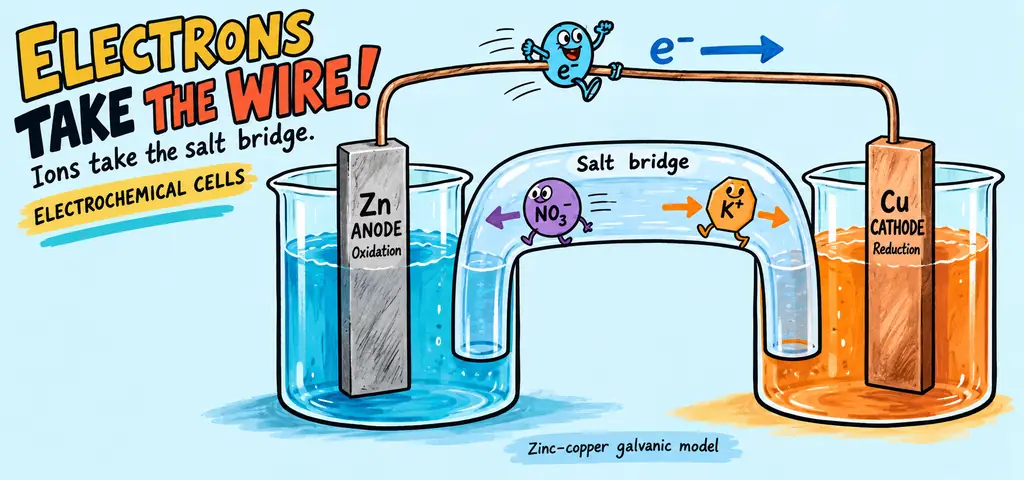
An electrochemical cell couples oxidation and reduction at electrodes. Oxidation occurs at the anode and reduction at the cathode. A galvanic cell delivers electrical energy from a spontaneous overall reaction under its operating conditions. An electrolytic cell uses supplied electrical energy to drive a reaction that would not proceed that way on its own.
A battery separates oxidation and reduction so electrons can travel through an external circuit. Ions move within the cell to maintain charge balance. Those two paths work together, and confusing them makes a cell diagram difficult to interpret.
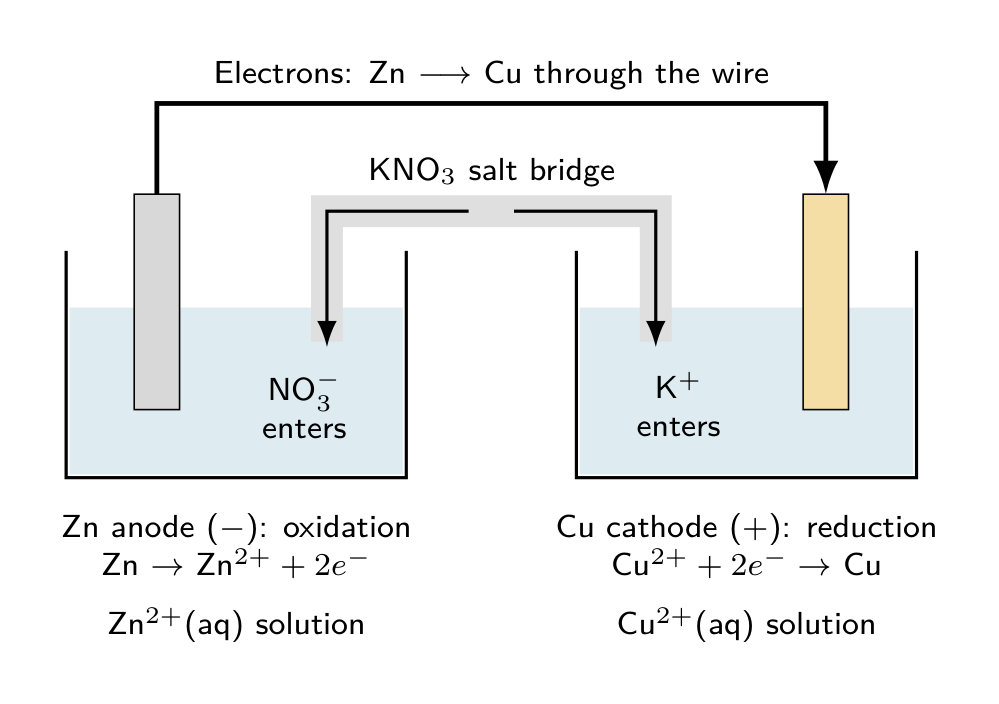
Which direction do electrons travel?
In a zinc-copper galvanic model, zinc is oxidized:
Electrons travel through the external wire to the copper cathode, where copper ions are reduced:
The anode is identified by oxidation and the cathode by reduction. Their signs differ between galvanic and electrolytic operation, so memorize the reaction definitions first.
What does the salt bridge do?
The salt bridge provides an ionic path between the half-cells. In the simple zinc-copper model, anions move toward the anode region as zinc ions accumulate, while cations move toward the cathode region as copper ions are consumed.
Electrons pass through the wire. The salt bridge carries ions. Without a suitable ionic connection, charge separation rapidly interferes with continued cell operation.
Worked example: calculate a standard cell potential
Suppose tabulated standard reduction potentials are +0.34 V for the copper-ion/copper couple and -0.76 V for the zinc-ion/zinc couple. Use both as reduction potentials:
The positive standard cell potential indicates a favorable overall reaction under the corresponding standard conditions. Actual voltage depends on conditions and load.
Do not multiply an electrode potential by a coefficient used to balance electrons. Potential is an intensive quantity.
How is corrosion connected?
Corrosion can involve coupled oxidation and reduction at different regions of a material. Protective coatings limit contact with the environment, while sacrificial protection uses a more readily oxidized material under suitable conditions.
- Identify the two half-reactions.
- Locate oxidation and reduction.
- Trace the external electron path and internal ion path separately.
- Use consistently tabulated potentials and check the operating conditions.
Can you apply the idea?
-
At which electrode does oxidation occur?
Check your answer
The anode, in both galvanic and electrolytic cells.
-
At which electrode does reduction occur?
Check your answer
The cathode.
-
Does a salt bridge carry electrons through its solution?
Check your answer
Its conducting path is ionic. Electrons travel through the external circuit.
-
Should a standard reduction potential be doubled when its half-reaction is doubled?
Check your answer
No. Electrode potential is not multiplied by stoichiometric coefficients.
-
In the zinc-copper example, which electrode loses metal as oxidation proceeds?
Check your answer
The zinc anode, as zinc atoms become dissolved zinc ions.
-
Why can a sacrificial metal protect another metal?
Check your answer
The sacrificial material preferentially undergoes oxidation in the coupled system, reducing oxidation of the protected metal.
Watch the idea explained
Electrochemistry: Crash Course Chemistry #36, CrashCourse.
This selected excerpt runs from 4:42 to 7:02. Calculate a standard cell voltage from tabulated standard reduction potentials.
Where does this fit?
Use the chemistry learning hub to choose a lesson or practice test. Connect this topic with buffers and titrations, organic chemistry basics, acids, bases, and ph, chemistry of life.
Sources for Further Study
OpenStax Chemistry 2e provides further reading on galvanic cells and charge balance, electrode and cell potentials, and corrosion and sacrificial protection.
Continue with a chemistry study guide


Related to This Article
More math articles
- Louisiana LEAP Grade 4 Math Free Worksheets: Free PDF Math Worksheets with Clear Answer Keys
- Taylor and Maclaurin Series Calculator (Free)
- Suffixes and Word Families: How Endings Change Meaning
- 6th Grade OSTP Math Worksheets: FREE & Printable
- 5 Tips for Surviving a Statistics Course
- Civil disobedience
- Setting and Context
- Michigan M-STEP Grade 7 Math Worksheets: 95 Free Printable PDFs with Answer Keys
- The Ultimate 6th Grade NJSLA Math Course (+FREE Worksheets)
- Free Grade 3 English Worksheets for Missouri Students










What people say about "Electrochemical Cells: Electron Flow and Cell Voltage"?
No one replied yet.