Chemistry Laboratory Safety: Use RAMP Before You Start
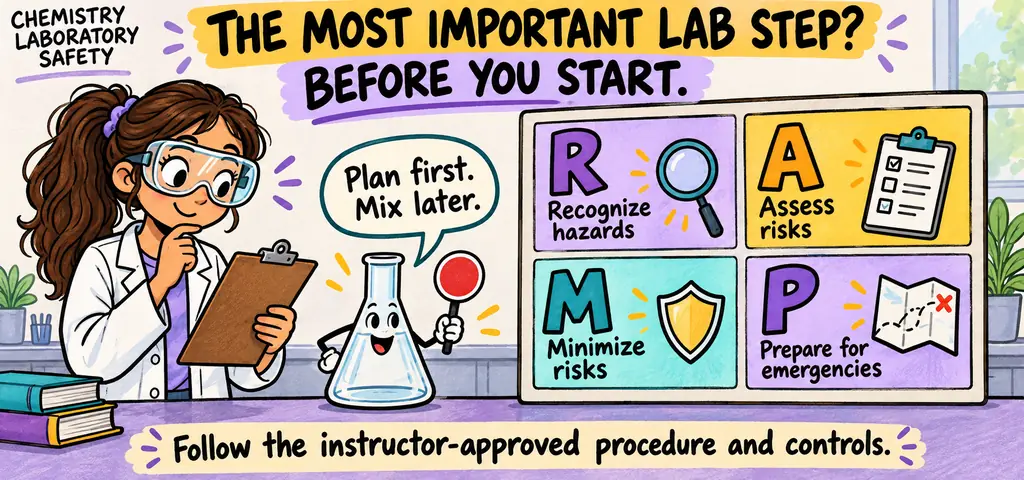
Chemistry laboratory safety starts with recognizing hazards and confirming the approved plan before work begins. You should know what can go wrong and what you will do if it does. Safety preparation belongs with the procedure itself. Read the full method and ask your instructor about any step you cannot explain.
Laboratory safety uses hazard recognition, risk assessment, controls, and emergency preparation to guide work. A hazard is a potential source of harm. Risk considers the likelihood and severity of harm under the actual conditions. Safe technique combines appropriate equipment, training, supervision, and attention to the specific chemicals and procedure.
What does RAMP ask you to do?
| Step | Before you begin |
|---|---|
| Recognize hazards | Identify chemical and physical sources of harm in the procedure. |
| Assess risks | Consider how harm could occur and how serious it could be. |
| Minimize risks | Confirm the instructor-approved controls and required protection. |
| Prepare for emergencies | Know how to alert the instructor and follow the response plan. |
The American Chemical Society organizes safety thinking around RAMP: recognize hazards, assess risks, minimize risks, and prepare for emergencies. For a school investigation, that means identifying chemical and physical hazards before work begins and following the instructor’s approved controls.
Consult the ACS guidance for middle and high school chemistry safety together with your school’s procedures. A general lesson cannot specify every control for every experiment.
Worked example: plan for heated glassware
A procedure uses a hot beaker. Glass can remain hot after a heat source is switched off, and appearance alone does not tell you its temperature. The plan should specify where the beaker rests, how hot equipment is identified, what suitable handling tool or heat protection is used, and when it can be moved safely.
Keep the work area clear and follow the supervised procedure. A folded paper towel is not a substitute for appropriate hot-glass handling equipment. Do not improvise a new carrying method when the beaker is already hot.
Which habits protect both people and results?
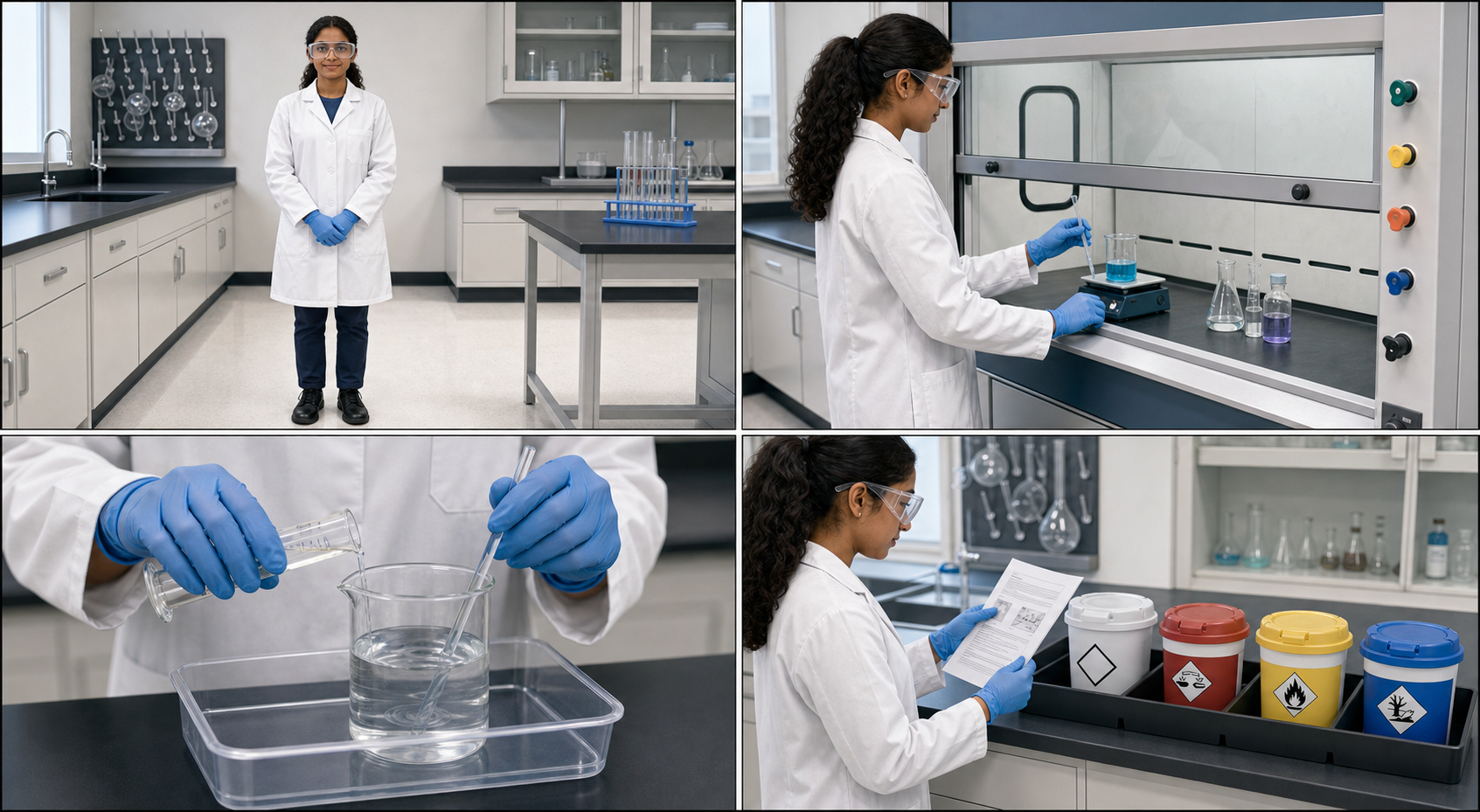
Wear the required chemical splash goggles and other procedure-specific protection. Secure long hair and loose clothing. Keep food and drink out of the laboratory. Read labels before transferring substances, and use the designated waste containers rather than assuming the drain is appropriate.
Never taste laboratory materials. Do not directly sniff a chemical. Odor observations should occur only when explicitly included in an instructor-approved procedure with suitable controls. Report spills, broken glass, injuries, and unexpected changes immediately.
What should happen when something unexpected occurs?
Stop the activity, alert the instructor, and follow the school’s response plan. Students should not decide independently to neutralize an unknown spill or fight a fire. Emergency equipment is useful only when people know its location and the appropriate response.
- Read the method and identify hazards.
- Confirm controls, equipment, and waste routes.
- Locate emergency resources and review the response plan.
- Perform only the authorized procedure under supervision.
- Report problems promptly and leave the work area as directed.
Can you apply the idea?
-
What is the difference between hazard and risk?
Check your answer
A hazard can cause harm. Risk concerns how likely and severe harm could be under the actual conditions.
-
Can you determine whether glass is safe to touch solely by looking at it?
Check your answer
No. Hot glass can look like cool glass.
-
What should a student do first after an unexpected spill?
Check your answer
Stop the activity, alert the instructor, and follow the response plan.
-
Is food-grade status enough to permit tasting a material in the laboratory?
Check your answer
No. Laboratory materials and equipment must not be treated as food.
-
Where should chemical waste go?
Check your answer
Into the waste route designated by the approved procedure and instructor.
-
Why review emergency equipment before starting?
Check your answer
An incident may require an immediate trained response, leaving little time to locate equipment or learn the procedure.
Watch the idea explained
Lab Techniques & Safety: Crash Course Chemistry #21, CrashCourse.
This selected excerpt runs from 0:52 to 1:40. Tie back hair and wear body-covering clothing, closed shoes, and proper eye protection under school protocols.
Where does this fit?
Use the chemistry learning hub to choose a lesson or practice test. Connect this topic with materials chemistry, multistep chemistry problems, environmental chemistry, chemistry final review.
Continue with a chemistry study guide

Related to This Article
More math articles
- The Best Grade 5 Math Book for Maine Students
- Chapter 38: Political Participation
- ASVAB Math Formulas
- The Ultimate ParaPro Math Course (+FREE Worksheets & Tests)
- Sum and Difference of Trigonometric Functions Formulas
- 5th Grade MCAS Math Practice Test Questions
- Top 5 Best Math YouTube Channels for High School Students
- GRE Math Flashcards (Free Online: Formulas, Terms & Concepts)
- ALEKS Math Placement Practice Test PDF with Answers
- Top 10 Free Websites for CLEP College Algebra Preparation



What people say about "Chemistry Laboratory Safety: Use RAMP Before You Start"?
No one replied yet.