Carbon, Functional Groups and pH: A Biology Guide
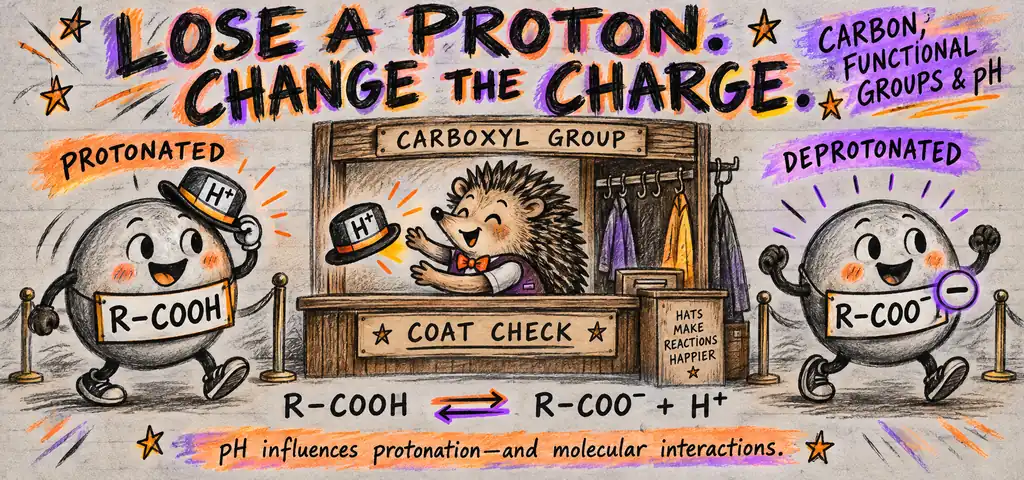
Carbon skeletons give biological molecules their framework; functional groups help determine polarity, charge and reactivity. pH affects protonation, and each one-unit decrease corresponds to roughly ten times as much hydrogen ion in dilute-solution calculations. Buffers resist changes over a limited range; they do not lock pH at one value.
Two molecules can contain exactly the same atoms in exactly the same numbers and behave nothing alike. Ethanol and dimethyl ether are both \(\text{C}_2\text{H}_6\text{O}\). One is a liquid that mixes with water in any proportion and that yeast produces by the ton; the other is a gas at ordinary room temperature and pressure. The different arrangement changes how each molecule interacts with its surroundings.
Watch the process
The Molecules of Life
Carbon Skeletons and Isomers
A carbon skeleton determines a molecule’s overall shape. Attached functional groups determine how particular regions interact with water and other molecules.
Carbon has four valence electrons and typically forms four covalent bonds in biological molecules. Four bonds allow straight chains, branched chains, rings, and double bonds, and carbon can bond to itself to form the long, stable frameworks of many biological molecules. The resulting carbon skeleton provides a scaffold. Hydrocarbon regions are nonpolar and interact poorly with water; their shape and size help determine energy storage, membrane organization, and molecular recognition.
Different bonding patterns and spatial arrangements produce isomers, molecules with the same molecular formula but different structures. Compare three kinds of isomer. Structural isomers differ in the order the atoms are connected, as ethanol and dimethyl ether do. Cis-trans isomers have the same connections but differ in the arrangement of groups around a double bond, which cannot rotate; this is the distinction that separates a kinked cis fatty acid from a straight trans one, as seen in membrane lipids. Enantiomers are mirror images that cannot be superimposed, like your two hands. Enantiomers matter because a binding site is itself asymmetric, so two mirror images can bind with different strengths or produce different effects. Proteins predominantly contain L-amino acids, and many common biological sugars have the D configuration; exceptions occur. Molecular recognition helps explain why stereochemistry matters, and drugs that come as a pair of enantiomers can have one active form and one inert or harmful one.
Seven Functional Groups
| Group | Useful clue |
|---|---|
| Hydroxyl | Polar; can hydrogen-bond with water. |
| Carbonyl | Polar; position distinguishes aldehydes and ketones. |
| Carboxyl | Can donate a proton; commonly negative near neutral pH. |
| Amino | Can accept a proton; commonly positive near neutral pH. |
| Sulfhydryl | Can form disulfide links; ionization depends on context. |
| Phosphate | Often negatively charged near neutral pH. |
| Methyl | Nonpolar; can affect molecular recognition. |
These are starting clues. Local chemistry and pH affect charge; the entire molecule determines its behavior.
Chemistry gets interesting when functional groups are attached to that skeleton. A functional group is a cluster of atoms with predictable behavior, and that behavior travels with the group from molecule to molecule. The seven groups below provide a useful starting point for biology review.
The hydroxyl group (\(-\text{OH}\)) is polar, so it can hydrogen-bond with water. Whole-molecule solubility also depends on the size and chemistry of the rest of the molecule. Sugars are studded with hydroxyls, which is why they dissolve so readily. The carbonyl group (\(\text{C}=\text{O}\)) is polar as well; its position distinguishes an aldehyde, at the end of a skeleton, from a ketone, inside one. The carboxyl group (\(-\text{COOH}\)) combines a carbonyl and a hydroxyl on the same carbon, and the combination makes the hydrogen easy to release. A carboxyl group is therefore an acid: in a cell at neutral pH it is usually ionized to \(-\text{COO}^-\) and carries negative charge.
The amino group (\(-\text{NH}_2\)) does the opposite. Its nitrogen has a lone electron pair that can accept a hydrogen ion, so an amino group is basic and usually sits as \(-\text{NH}_3^+\) in a cell. Amino acids carry both a carboxyl and an amino group, which is why they can act as either acid or base and why they buffer. The sulfhydryl group (\(-\text{SH}\)) is the one that forms covalent cross-links: two sulfhydryls can be oxidized into a disulfide bridge that locks distant parts of a folded protein together. The phosphate group can carry negative charge at cell pH (a common monoester form is \(-\text{OPO}_3^{2-}\)), which increases the water affinity of that region; interactions among phosphate groups also affect the energetics of molecules such as ATP. Finally the methyl group (\(-\text{CH}_3\)) is nonpolar and relatively unreactive in many biological settings; it can influence molecular recognition: adding a methyl group to DNA or to a histone changes what binding proteins see without changing the underlying sequence.
Memory Hook: Charge Tells You the Job
Sort the seven groups by what they do with charge. Hydroxyl and carbonyl groups are polar and can favor interactions with water, but they do not guarantee that a whole molecule dissolves. Carboxyl gives a hydrogen ion away and goes negative; amino takes one and goes positive; phosphate groups commonly carry negative charge near neutral pH. Sulfhydryl groups can form disulfide bonds and can also ionize, depending on pH and their molecular environment. Methyl groups are nonpolar. Use charge and polarity as clues, then consider the complete molecule.
Comparing pH Values
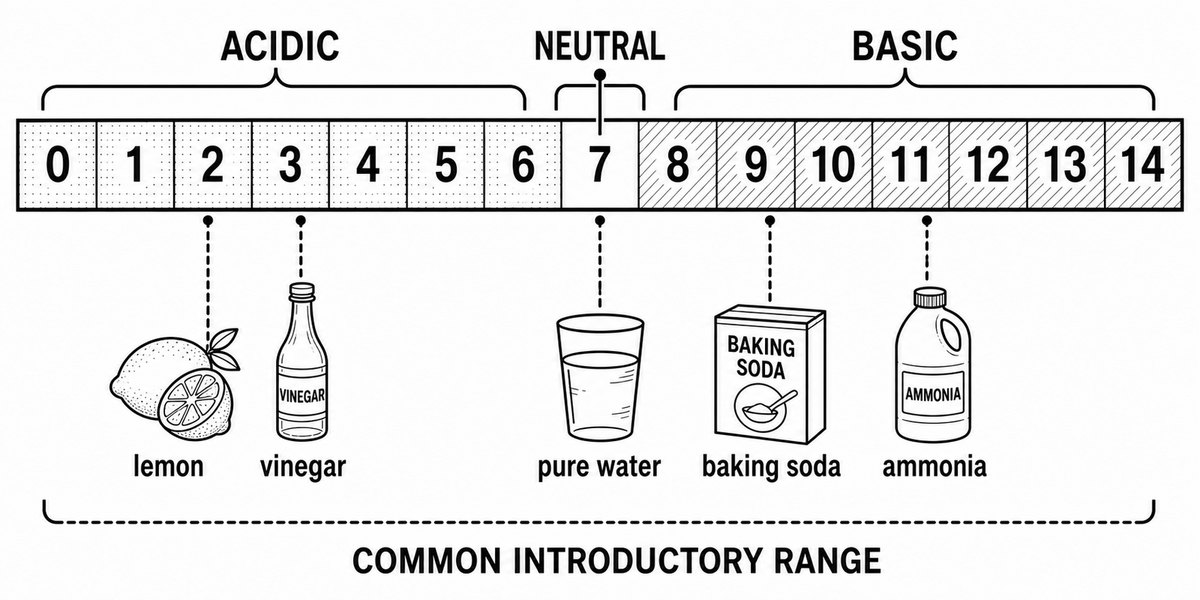
Here is the observation to start from. Stomach fluid and blood plasma are both water-based solutions in the same body, separated by a few centimeters of tissue, yet stomach fluid is strongly acidic and blood plasma is slightly basic. Their different pH values suit different biological processes; pH is one part of the explanation, alongside the enzymes and other substances present.
Pure water is not chemically inert. Every so often a proton hops from one water molecule to another, leaving a hydrogen ion, written \(\text{H}^+\), and a hydroxide ion, \(\text{OH}^-\). In pure water at \(25^\circ\text{C}\) this dissociation reaches an equilibrium at \(10^{-7}\,\text{M}\) of each, which is why neutral means pH 7 and not some rounder number. The symbol M is short for molar, meaning moles of the substance per liter of solution, and square brackets around a formula, as in \([\text{H}^+]\), mean “the concentration of.” An acid is a substance that raises the hydrogen-ion concentration of a solution, usually by donating protons. A base is a substance that lowers it, either by accepting protons directly or by releasing hydroxide ions that consume them. The two definitions are about what happens to \([\text{H}^+]\), not about taste, corrosiveness, or where the substance came from.
Water dissociates slightly into hydrogen ions and hydroxide ions. For the dilute-solution calculations here, pH is approximated by the negative base-ten logarithm of hydrogen-ion concentration, \(\text{pH} =-\log_{10}[\text{H}^+]\). Because the scale is logarithmic, equal pH intervals correspond to equal ratios, not equal differences.
Work the Tenfold Rule
Consider two illustrative solutions at pH 7.4 and pH 7.1, a difference of 0.3 pH unit. Calculate the hydrogen-ion concentrations and their ratio.
Start from the definition. At pH 7.4, \([\text{H}^+] = 10^{-7.4}\,\text{M} \approx 4.0 \times 10^{-8}\,\text{M}\). At pH 7.1, \([\text{H}^+] = 10^{-7.1}\,\text{M} \approx 7.9 \times 10^{-8}\,\text{M}\). The ratio is \[\frac{10^{-7.1}}{10^{-7.4}} = 10^{(-7.1)-(-7.4)} = 10^{0.3} \approx 2.0 .\] A drop of 0.3 pH units doubled the hydrogen-ion concentration. Extend the same arithmetic to a full unit and the point sharpens: pH 6 has \(10^{1} = 10\) times the hydrogen-ion concentration of pH 7, and pH 4 has \(10^{3} = 1000\) times the concentration of pH 7. Since protein folding depends on the charge state of carboxyl and amino side chains, a change of this size is a large change to the molecules doing the work.
Answer: A Twofold Concentration Change
One pH unit is a tenfold change in \([\text{H}^+]\); the 0.3-unit drop here roughly doubled it, so a small numerical difference can represent a substantial concentration change. The biological effect depends on the system.
How Buffers Resist pH Change
A buffer is a solution that resists pH change because it contains a weak acid and its conjugate base in equilibrium. The conjugate base is simply what is left of the weak acid after it has given up its proton, so the two are the same molecule in its protonated and deprotonated forms. Add hydrogen ions and the conjugate base absorbs them; remove hydrogen ions and the weak acid releases more. The carbonic acid and bicarbonate pair does this in blood. A buffer’s protection has limits. A buffer does not hold pH constant, it slows the change; and a buffer has a finite capacity, so near exhaustion of one member of the pair, additional acid or base produces much larger changes.
Consider the carbonic acid, bicarbonate buffer in blood. Carbon dioxide from respiring tissue combines with water to give carbonic acid, which dissociates into a hydrogen ion and bicarbonate: \[\text{CO}_2 + \text{H}_2\text{O} \rightleftharpoons \text{H}_2\text{CO}_3 \rightleftharpoons \text{H}^+ + \text{HCO}_3^-.\] Read the double arrows as a system that can slide either way. Add acid to the blood and the extra hydrogen ions push the right-hand equilibrium leftward, because bicarbonate mops them up into carbonic acid; the pH falls, but far less than it would have. Add base and hydrogen ions are removed, the equilibrium slides rightward, and carbonic acid releases replacement protons. The lungs then adjust the whole system by exhaling more or less carbon dioxide, which is why a person who hyperventilates raises blood pH. This equilibrium connects proton transfer with physiological regulation.
Optional Extension: Estimating Buffer pH
Optional enrichment: this acid-equilibrium calculation is not required memorization for AP Biology. Skip it on a first pass; return when pH and buffer action feel secure. Use it to estimate buffer pH from composition; buffer capacity also depends on the amounts of both components. The acid dissociation constant, written \(K_a\), is the equilibrium constant for a weak acid giving up its proton; a larger \(K_a\) means the acid lets go more readily. Because those constants are tiny numbers, chemists report \(\text{p}K_a =-\log_{10} K_a\), exactly the way pH compresses \([\text{H}^+]\). The useful consequence is that the pH of a dilute buffer can be estimated from the p\(K_a\) and the ratio of the two members of the pair: \[\text{pH} = \text{p}K_a + \log_{10}\frac{[\text{base}]}{[\text{acid}]} .\] Read that equation as a statement about a ratio. When the weak acid and its conjugate base are present in equal amounts the ratio is 1, the logarithm is 0, and the pH equals the p\(K_a\). Consume some of the base and the ratio falls below 1, the logarithm goes negative, and the pH drops. Use this optional relationship to connect the buffer’s composition with the shape of a titration record.
Core Review: pH Ratios
Return to pH ratios and the limits of buffer action.
Avoid Two Common pH and Buffer Mistakes
The pH scale is logarithmic, not linear. A student who reads pH 5 and pH 8 as “three apart” and answers “three times” has applied ruler logic to a logarithm. Three pH units is a factor of one thousand, and the direction is inverted: the lower pH has the higher hydrogen-ion concentration. Say the inversion out loud each time, low pH, high \([\text{H}^+]\), until it stops needing to be said.
A buffer limits pH change; it does not fix pH at one value. A buffer is not a thermostat and has no set point it returns to. It is a chemical sponge with a finite capacity. While both members of the conjugate pair are present, added acid or base is largely absorbed and the pH drifts slowly. Once one member runs out, the sponge is saturated and further acid causes a much larger pH change; its size still depends on the solution’s composition and volume. A graph of pH against added acid for a buffered solution therefore has a relatively shallow region followed by a steeper region, as the available conjugate partner becomes depleted.
Review: Carbon Skeletons, Functional Groups, and the pH Scale
A functional group’s charge and polarity help explain water interactions and pH sensitivity; pH itself is a logarithm of hydrogen-ion concentration, not a linear rating.
Change the pH and you change which groups are protonated, which changes charge, which changes what a molecule can bind or how it folds.
Do not read one pH unit as one small step. It is a factor of ten in \([\text{H}^+]\), and protein side chains respond to that factor, not to the number printed on the scale.
Optional Extension: Track Buffer Inventories
Optional worked extension: follow the buffer inventories if helpful, but the equilibrium calculations below are not required AP Biology memorization.
When a Buffer Runs Out
A beaker holds \(1.0\,\text{L}\) of a buffer containing \(0.010\,\text{mol}\) of a weak acid and \(0.010\,\text{mol}\) of its conjugate base. Assume additions change the volume negligibly. You add strong acid in \(0.002\,\text{mol}\) portions and record the pH after each addition. The first four additions move the pH from 7.00 to 6.05. The sixth addition drops it to 2.70. Explain the shape of that record and predict where the elbow falls.
Start with the constant the setup hands you for free. The two members are present in equal amounts, so the ratio in \(\text{pH} = \text{p}K_a + \log_{10}([\text{base}]/[\text{acid}])\) is 1, the logarithm is zero, and \(\text{p}K_a = 7.00\). Everything sits in the same \(1.0\,\text{L}\), so you can work in moles throughout; the volume cancels inside the ratio.
Now take the additions one at a time and track the conjugate base, because that is the member being consumed. Each \(0.002\,\text{mol}\) of strong acid converts \(0.002\,\text{mol}\) of conjugate base into the weak acid form. Start: \(0.010\,\text{mol}\) base, \(0.010\,\text{mol}\) acid. After one addition: \(0.008\) and \(0.012\). After two: \(0.006\) and \(0.014\). After three: \(0.004\) and \(0.016\). After four: \(0.002\) and \(0.018\). The fifth addition consumes the last of the base, leaving \(0.000\) and \(0.020\).
Feed each inventory back into the equation and the record writes itself. After one addition, \(7.00 + \log_{10}(0.008/0.012) = 7.00-0.18 = 6.82\). After two, \(7.00 + \log_{10}(0.006/0.014) = 7.00-0.37 = 6.63\). After three, \(7.00 + \log_{10}(0.004/0.016) = 7.00-0.60 = 6.40\). After four, \(7.00 + \log_{10}(0.002/0.018) = 7.00-0.95 = 6.05\). Four portions of strong acid, and the pH has moved 0.95 units in total. That is the flat part of the curve, and notice that it is not perfectly flat: each portion costs more than the one before, because the ratio you are taking the logarithm of is falling faster and faster as the base runs low.
The fifth addition ends the buffering. With no conjugate base left the ratio is zero and the equation no longer applies; the pH is now set by the dissociation of \(0.020\,\text{M}\) weak acid alone, with \(K_a = 10^{-7.00} = 1.0\times10^{-7}\). For a weak acid dissolved by itself, each molecule that dissociates makes one \(\text{H}^+\) and one conjugate base, so those two concentrations are equal and \(K_a \approx [\text{H}^+]^2 / C\), where \(C\) is the concentration of acid you started with. Solving that for \([\text{H}^+]\) gives the square root below: \[[\text{H}^+] = \sqrt{K_a C} = \sqrt{(1.0\times10^{-7})(0.020)} = 4.5\times10^{-5}\,\text{M}, \qquad \text{pH} = 4.35.\] After the sixth addition, the added strong acid is in excess. Its contribution dominates the hydrogen-ion concentration, approximately \(0.002\,\text{mol}\) of \(\text{H}^+\) in this idealized calculation. In one liter that is \(2.0\times10^{-3}\,\text{M}\), and \(-\log_{10}(2.0\times10^{-3}) = 2.70\). Two portions of acid have now moved the pH 3.35 units, against 0.95 units for the first four. That is the elbow.
Check the last value rather than explaining a mismatch away. At pH 2.70 the weak acid is essentially all in its protonated form: the fraction dissociated is about \(K_a/[\text{H}^+] = (1.0\times10^{-7})/(2.0\times10^{-3}) = 5\times10^{-5}\), so of the \(0.020\,\text{mol}\) present only about \(1\times10^{-6}\,\text{mol}\) has given up a proton, about one two-thousandth of the strong acid you added. It cannot touch the second decimal place. Watch the direction of that term as well: whatever the weak acid does dissociate adds hydrogen ions, so it can only push the pH below 2.70, never above it. If a meter read higher than the calculation, the weak acid would not be the explanation, look instead for dilution by the added solution or for a mis-standardized electrode.
Answer: The Sharp Region Near Addition Five
The sharp region is near the fifth addition, the stoichiometric point where the initial conjugate-base inventory is consumed. Dissociation still regenerates a small amount of conjugate base. Before it the buffer converts added acid and the pH slides from 7.00 to 6.05; after it, added acid simply accumulates and the pH falls to 4.35 and then to 2.70 in this specified solution. The residual weak acid still contributes at the fifth addition.
Core Review: Buffer Capacity
Use pH ratios and explain why buffers have a limited capacity.
Functional groups and the pH scale
Practice question 1
An unfamiliar molecule releases a hydrogen ion in aqueous solution and carries a net negative charge at pH 7. The group most likely responsible is the
-
carboxyl group
-
methyl group
-
amino group
-
sulfhydryl group
Practice question 2
A solution is adjusted from pH 7 to pH 4. The hydrogen-ion concentration has
-
decreased approximately one thousandfold
-
increased approximately threefold
-
increased approximately one thousandfold
-
increased approximately thirtyfold
Practice question 3
A buffered solution receives a steady addition of strong acid. The pH holds nearly steady for a time and then falls sharply. The best explanation is that
-
the buffer converted the added acid into a base
-
the conjugate base component was consumed, so buffering capacity was exhausted
-
the weak acid component was consumed, so no acid-absorbing partner remained
-
the buffer molecules were denatured by the added hydrogen ions
Practice answer key
1. A; 2. C; 3. B.
Practice answer explanations
-
Functional groups and the pH scale, Question 1. Choice A is correct. A carboxyl group readily donates its hydrogen ion and remains as a negatively charged carboxylate at pH 7. Choice B names the one nonpolar, unreactive group in the set, which cannot ionize. Choice C reverses the behavior, since an amino group accepts a hydrogen ion and becomes positive. Choice D is less likely for the neutral-pH example: sulfhydryls commonly remain protonated near pH 7, although their ionization depends on their environment.
-
Functional groups and the pH scale, Question 2. Choice C is correct. pH is a base-ten logarithm, so a drop of three units is a factor of \(10^3\), or one thousandfold more hydrogen ion. Choice A has the right magnitude but the wrong direction, which is the inversion to watch for: lower pH always means more hydrogen ion, not less. Choice B reads the scale as a ruler and takes three units to mean three times. Choice D applies the tenfold rule but multiplies ten by the number of units instead of raising ten to that power.
-
Functional groups and the pH scale, Question 3. Choice B is correct. A buffer works because a weak acid and its conjugate base absorb added hydrogen or hydroxide ions, and its resistance becomes much weaker as one component is depleted. Choice A describes a chemical conversion that buffering does not perform. Choice C names the wrong member of the pair: added hydrogen ions are absorbed by the conjugate base and converted into the weak acid, so the weak acid accumulates while the base runs out. Choice D applies the word denature, which describes the unfolding of a protein rather than anything a small-molecule buffer pair can undergo.
Continue your review at the AP Biology study hub.
Connect Chemistry to Biological Function
Use these charge and polarity clues when reviewing protein structure, folding and function. Then connect chemical groups to DNA strand structure and direction.
Sources for Further Study
OpenStax Biology 2e explains carbon bonding and functional groups and water, pH and buffer action. Its Chemistry 2e chapter develops buffer calculations and capacity.

Related to This Article
More math articles
- Understanding Decimals for 5th Grade: Place Value and Meaning
- New Hampshire Algebra 1 Free Worksheets: Printable Standards-Aligned Algebra 1 Practice with Answers
- ACT Math Practice Test Questions
- How to Graph Trigonometric Functions?
- Free Grade 6 English Worksheets for West Virginia Students
- SHSAT Math Practice Test Questions
- How to Calculate Unit Prices and Total Price
- Time Conversions for 5th Grade: Hours, Minutes, Seconds
- How to Use the Quadratic Formula: Every Case for 2026
- How to Solve Two-variable Linear Equations Word Problems






What people say about "Carbon, Functional Groups and pH: A Biology Guide"?
No one replied yet.